
AI & Web Development
Google just fixed the biggest problem with AI-built websites. Here's what it doesn't fix.
Google's free Modern Web Guidance keeps AI-written code on current best practice. That's great news. It still doesn't decide whether you can edit your own website.
Google Just Fixed the Biggest Problem With AI-Built Websites. Here’s What It Doesn’t Fix.
Google's free Modern Web Guidance keeps AI-built websites on current best practice. Here's what it does, what it doesn't do, and how we use it on client sites.
Created: November 17, 2026 | Reading Time: 4 mins


Websites built with AI are fast. Fast to build and fast to load. For the most part they follow good web design practice too.
But hand that code to an expert developer and ask them to read it closely, and they will find a problem. Some of those “best practices” are years out of date.
Why AI builds websites the old way
AI learned to code from decades of websites, tutorials and forum answers, and most of that material is years old.
That matters because of how these tools work. An AI model is a prediction engine. It writes whatever its training suggests is the most likely answer, and the most likely answer is the one it has seen most often, not the newest one. A technique that has been around for fifteen years shows up in far more examples than one that arrived last year.
So it reaches for the way things used to be done: heavy scripts where the browser now does the job itself, pop-ups that trap keyboard users, animations that ignore people who have asked their device for less motion.
None of it breaks the site on day one. It just means a brand new website can arrive already a little bit old.
Agencies like ours have dealt with this by writing our own rulebooks. We document current best practice, and the AI follows those rules while it builds. It works, but it takes time, and it is one more thing to keep up to date.
Modern Web Guidance: a rulebook from the people who build the browsers
On 10 November 2026, Google’s Chrome team released version 1.0 of something called Modern Web Guidance. The teams behind Firefox and Edge have joined as contributors, so it is no longer just a Google project.
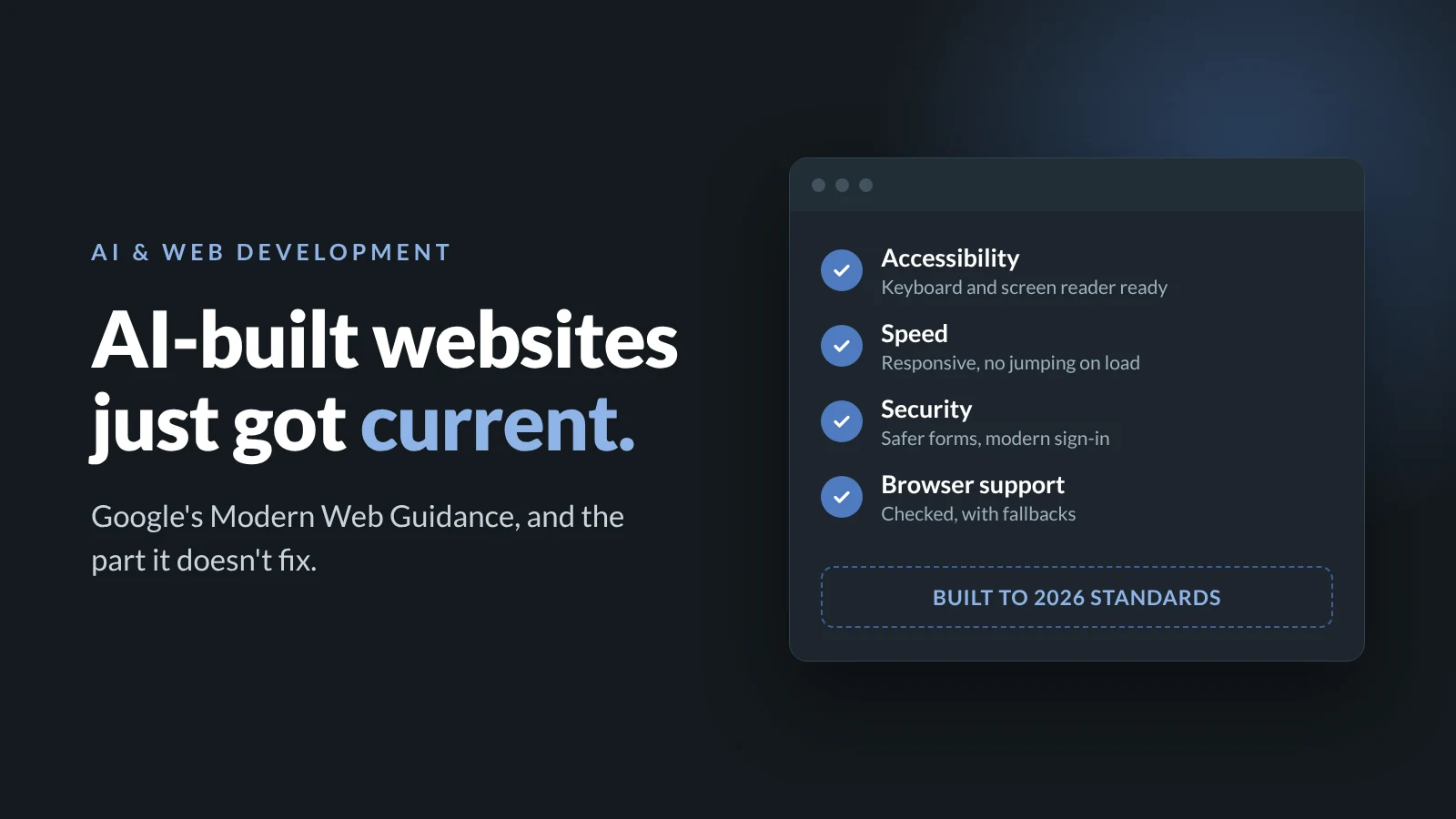
In plain terms, it is a library of current best practice that AI coding tools read before they write a line of code. It covers the things visitors feel and Google measures:
- Accessibility. Menus and pop-ups that work with a keyboard and a screen reader, forms that explain their errors properly.
- Speed. Pages that stay responsive and don’t jump around while they load.
- Security. Safer handling of anything typed into a form, and modern sign-in such as passkeys.
- Browser support. Each recommendation is matched against which browsers can handle it, with a fallback where one is needed.
The guides are reviewed by specialists, and Google publishes test results comparing AI tools with and without it. In Google’s launch post, the Japanese media platform note reported its pass rate on modern web checks rising from 61% to 94% across 180 test runs on its own codebase.
It is free, and it is public on GitHub.
That last part matters most. The people who build the browsers are now the ones keeping the rulebook current.
Current code is not the same as a website you can run
Here is the part most of the excited posts are skipping.
Modern Web Guidance makes the code current. It does not make the website yours.
A site can be built to perfect 2026 standards and still be something you can’t touch. If every page is hand-coded, changing a phone number, swapping a photo or adding a team member means going back to whoever built it. Or opening an AI tool and hoping.
That is the layer Google can’t write for anyone:
- Can you edit your own pages without breaking them?
- Do your brand colours and fonts live in one place, so a change flows through the whole site?
- Does your phone number update everywhere when you change it once?
- Will the site still make sense to the next person who works on it?
Those answers come from how a site is put together, not from how modern its code is. It is the same thinking behind why your web agency should never own your domain name.
How we’re using it at DeCODE
We build with AI every day, and we have added Modern Web Guidance to our build process. It now sits underneath our own rules.
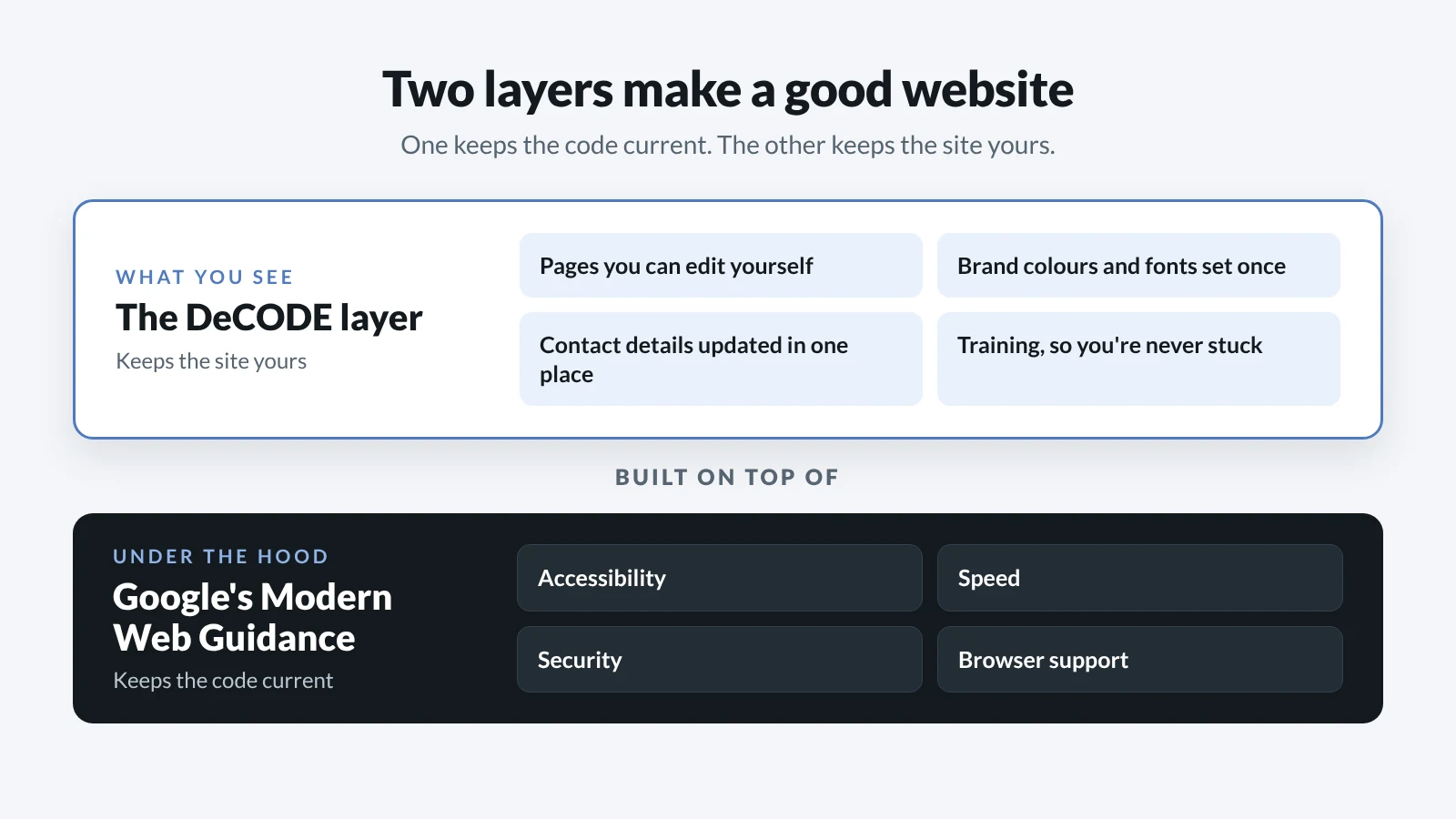
Google looks after the generic layer. Whenever we write code by hand, such as a site’s header, its mobile menu or a custom feature, the AI checks Google’s current guidance first.
We look after the layer that makes the site yours. Every DeCODE website is built in a visual editor you can use yourself. Your colours, fonts and contact details are set once and used everywhere. And we train you on it, so you are never stuck waiting on us for a small change.
For our clients, that means two things:
- The parts of your site you never see are built the way browsers want them built today, not the way they were built five years ago.
- The parts you do see are still yours to edit.
So, is AI ready to build your website?
The “AI writes outdated code” objection just got a lot weaker. That is good news for anyone building this way, us included.
The better question to ask now is who can change the site once it is live. If the answer is “only the person who built it”, the code being modern won’t help you much.
Thinking about a new website, or wondering how yours stacks up? Get in touch and we’ll take a look with you.
Sources
On this page
We’re here to help you DeCODE the Digital World
DeCODE builds breathtaking websites that drive sales for your business without a price that would take your breath away.
We understand that Companies don’t need websites. Companies need a regular stream of high-quality leads. Customers eager, educated, and ready to purchase their products or share their vision. This is the core of a DeCODE build.
In 2026 websites are no longer set and forget, winning an online race is now a marathon, not a sprint. Visually stunning sites with limited back end functionality and no ability to perform in search are redundant.
At DeCODE we build sites that perform.









Ilana is a Web Designer & Development Consultant with 15+ years building websites that actually perform: ecommerce stores, membership platforms, training portals, and SEO rebuilds that turn slow, dated sites into properties that rank and convert.