
SEO & AI Search
Chiang Mai SEO Conference 2026, Day 5:
Five talks and a panel on black hat SEO in the AI era, local search, what AI says about your brand and what gets you cited, plus a wrap-up of the week for Australian businesses.
Chiang Mai SEO Conference 2026, Day 5: Twiddlers, Local Search and What 50 Million AI Answers Tell Us
Our Day 5 recap from the Chiang Mai SEO Conference 2026: black hat SEO in the AI era, Google's twiddlers, the new local search playbook, what AI says about your brand and what 50 million AI answers show gets you cited.
Created: November 13, 2026 | Reading Time: 38 minutes


Day 5 was the last day of the Chiang Mai SEO Conference 2026, and it was a big one: five talks and a panel, back on the single main stage. After Day 4 looked at the business around SEO, the final day went back to the work itself. How Google re-ranks results, what has changed in local search, what AI tools say about a brand once they mention it, and the largest data set of the week on what gets a page cited.
One of the sessions was the most black hat talk of the conference. I’ve labelled it clearly, as I did on Day 2 and Day 4.
The line that tied the day together came up in three separate sessions: AI is not adjudicating the truth. It weighs up what it can find, and what it can find repeated in more than one place, and gives you an answer. That is useful to know if you want to be found. It is also a little unsettling, and I’ll come back to why.
1. Modern Black Hat SEO 2.0 (black hat, not recommended)
Charles Floate, AI SEO Rainmakers
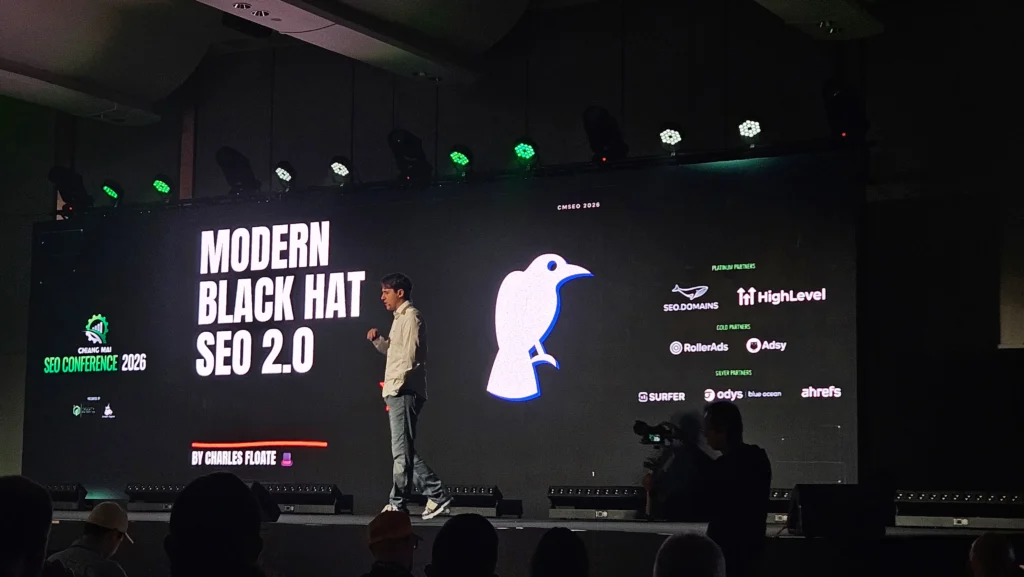
The usual label first: much of this session covered black hat tactics. We don’t use them, we wouldn’t recommend them, and nothing below is advice. I report these sessions because the tactics exist, clients ask about them, and it helps to know where the line sits.
Charles gave a talk called Modern Black Hat SEO at this conference in 2017. This was the same talk through a 2026 lens: what died, what evolved and what carried over into AI search. Mixed in with the black hat material was some of the most detailed research of the week on how Google re-ranks results, and that part is useful to anyone.
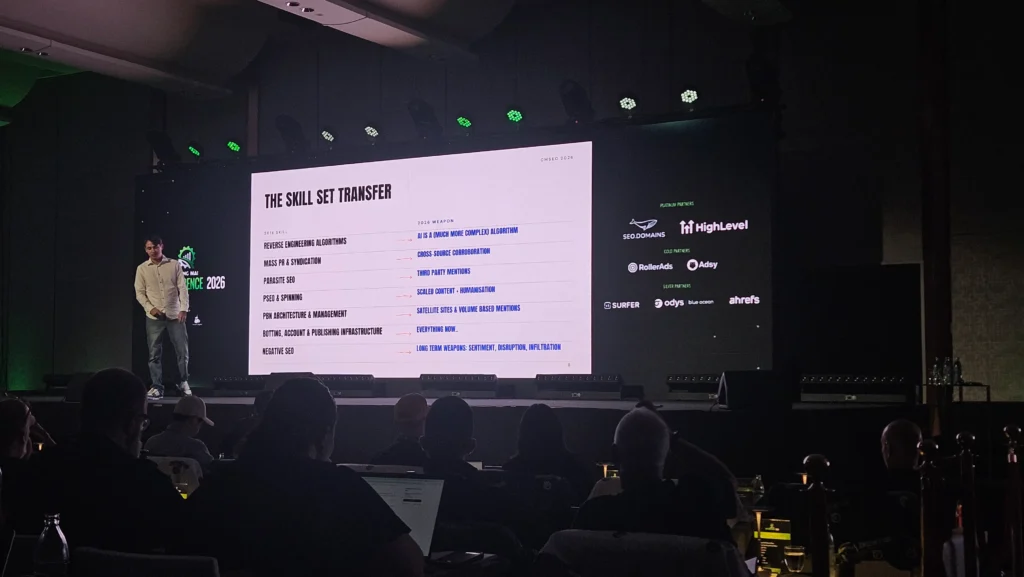
Why AI search suits the black hats
His argument was that the old skills transfer almost directly. Reverse engineering an algorithm became reverse engineering a much more complex one. Mass PR and syndication became getting the same claim repeated across many sources. Parasite SEO became third-party mentions. He gave three reasons AI search is easier to manipulate than most people assume:
- The models can’t verify. They corroborate. An AI tool has no way of checking a claim against the real world. It checks whether other sources say the same thing. His summary: control the sources and you control the answer.
- Consensus is hard-coded. Results get rewarded for resembling what is already judged to be good. Match the consensus first, then be different on top of it.
- Quality at scale is far cheaper than it was. AI can now produce content and pages in volumes, and at a standard, that used to need a team.
One slide said it bluntly: Google’s AI Overviews still cannot validate anything, so trusted sources equal the truth.
Twiddlers: how Google adjusts results after ranking them
This was the part I found most interesting. A twiddler is a piece of Google’s system that adjusts the results after the main ranking has been done. The main ranker scores a few hundred candidate pages, then a series of twiddlers boost, demote, filter or space them out before you see page one. The names come from the Google documentation that leaked in 2024, and Charles credited the French agency Resoneo for much of the published research on them.
He walked through several, with his interpretation of each. These are his readings of leaked attribute names, not confirmed by Google.
- Site boost. Compares the main subject of the host website with the search being made. His example: a casino page on a book review site fails that test, while the same page on a general-purpose site builder passes. He described it as Google’s site reputation abuse policy written as code.
- Consensus. Results are rescored by how closely they resemble results already judged good. Images and video run their own versions.
- Links get you on the list. A second pass picks your rank. Links help you into the few hundred pages the main ranker scores. Several re-rankers then decide where you sit on page one. His line was that the familiar bounce around page one finally has a mechanism.
- Freshness. Google doesn’t just read the date you put on a page. It also estimates a date from the text, the links pointing at the page and related pages. Your stated date is one vote of four.
- Crowding. There are caps on how many results one website can hold on a page, which is why people who try to dominate a results page do it across several different websites.
- Forums and AI. One twiddler lifts forum discussions in the normal results. A separate filter decides what the AI side gets. His figures: user-generated content makes up 41.4% of page one but only 14.2% of AI Overview citations.
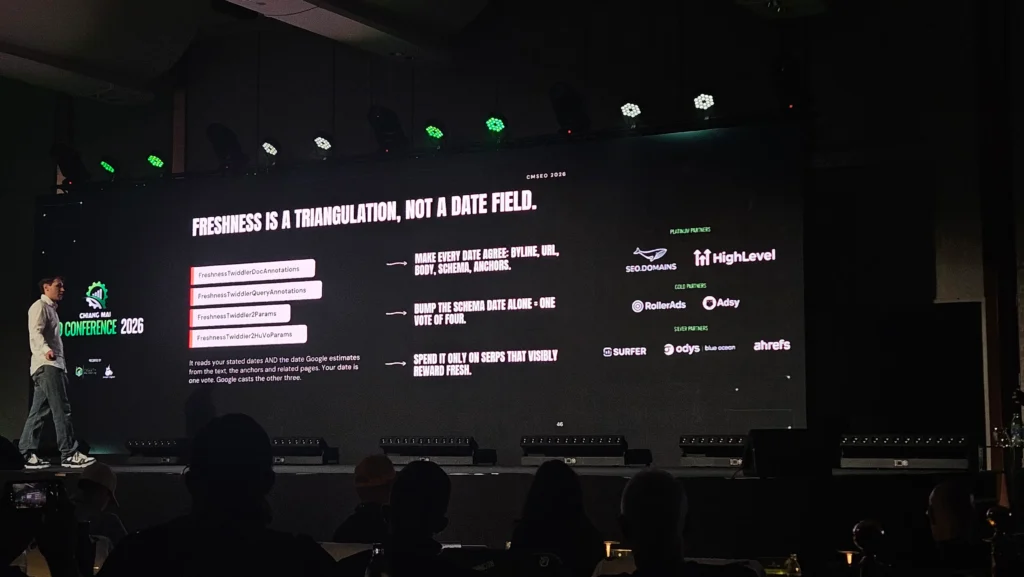
The freshness point is the one every business can use. Changing the “last updated” date on an old article without changing the article is one vote against three. If you update a page, update it properly, and make sure the date in the text, the address, the byline and the structured data all agree.
The update lab
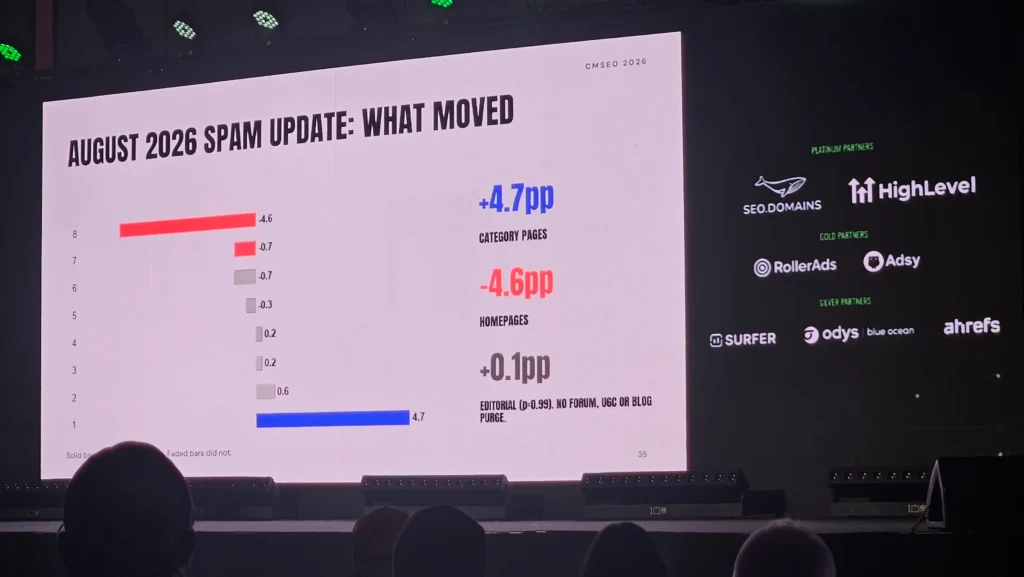
Charles has built what he calls an update lab, an automated system for working out what a Google update changed. He said it was built with AI, in a terminal, and ran while he slept. It is also expensive to run. The numbers on his slide: 21,679 snapshots of search results, 14,027 leaked attributes mapped and seven updates tracked.
The method is worth noting because it is more careful than most update commentary. He captures the pages as well as the positions, before, during and after a rollout. He pairs winners with losers, including two pages on the same website where only one moved. And he adds placebos: fake attributes with no possible effect, which tell him how much movement is just noise. Every finding is discounted by that noise.
What he found:
- August 2026 spam update: category pages gained 4.7 percentage points of share and homepages lost 4.6. Editorial content was flat, and there was no purge of forums, user-generated content or blogs.
- September 2026 spam update: homepages gained 1.3 points and forums lost 1.0. A small fall for e-commerce category pages was not statistically significant.
ChatGPT can’t read your JavaScript
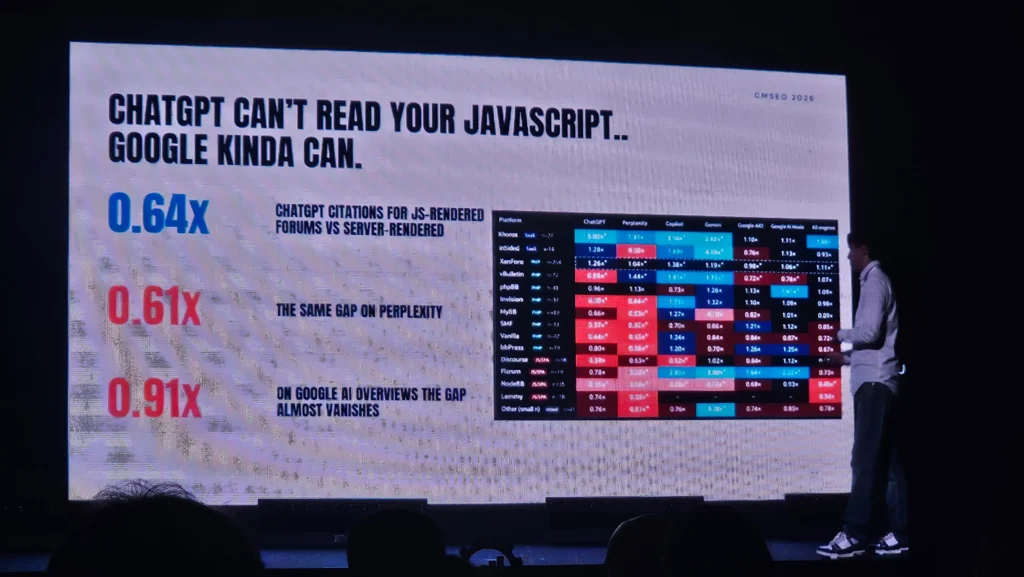
One finding needs no black hat at all. Charles compared forums whose pages are built by JavaScript in the browser with forums that send finished pages from the server. The JavaScript forums were cited 0.64 times as often by ChatGPT and 0.61 times as often by Perplexity. On Google’s AI Overviews the figure was 0.91, so the gap almost vanished. Google can run JavaScript. Most AI tools don’t. Jonathan Kiekbusch made the same point later in the day, with a ten-second way to check your own site.
The black hat side
For the record, these are the tactics he described. I’m naming them, not explaining how to do them.
- Click manipulation. Buying traffic to fake the user behaviour Google measures. He noted that Google stores and scores around 13 months of click data.
- Private networks rebuilt for AI. Expired or aged domains rebuilt as real-looking publications, used for mentions more than links. His line: PageRank was the product, corroboration is the product now. By his own numbers, expired domains worked about 12% of the time and aged domains more than 90%.
- Jailbroken AI models. Models with the safety limits removed, used for the work mainstream models refuse, including writing fake reviews and generating legal-sounding takedown complaints against competitors.
- Seeding training data. Producing documents full of the “facts” you want a model to believe and placing them where AI companies are thought to collect training material.
- Satellite sites. A ring of small websites around one main site, each describing the same person or brand in a different format.
Two of his closing lines are worth keeping. “Buying AI citations is buying links”, meaning the same game with a new name. And “methodology was never the moat”: knowing how something works has never been the hard part.
My view
The research is good. The update lab is a better way to study Google updates than anything else I saw this week, and the twiddler material explains a lot of behaviour we see in client results.
The tactics are another matter. Fake reviews and bogus legal complaints hurt real businesses, and in Australia fake reviews are also a consumer law problem. My position hasn’t changed since Day 4. A real business has one name and one reputation, and none of this is worth risking either.
What I took from it is what these tactics tell us about the systems. If AI answers can be shifted by getting the same claim repeated in enough places, then honest businesses need their true claims repeated in enough places too.
What this means for your business: update pages properly, not just the date. Make sure the important content on your site isn’t hidden behind JavaScript. And know that these tactics exist, because sooner or later someone will offer them to you under a friendlier name.
2. Your New Local SEO Playbook to Dominate Google
Joy Hawkins, Sterling Sky
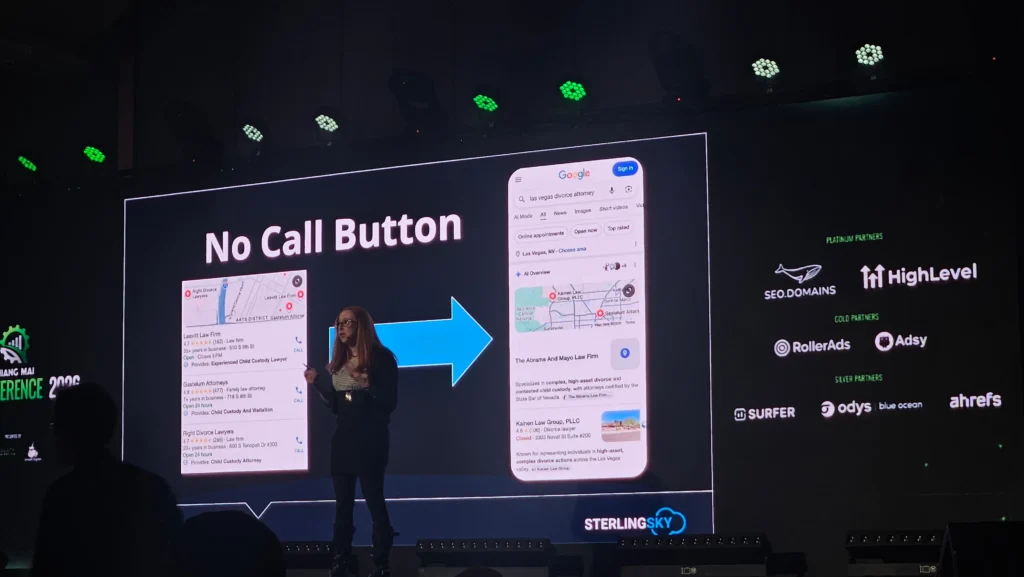
Joy Hawkins is one of the best-known names in local search, and this was the most directly useful talk of the day for the kind of businesses we work with: trades, clinics, workshops and anyone who relies on the map results.
The call button is going missing
Her opening point was that Google’s local results look very different to a year ago. On her research, around 80% of businesses in the three-pack (the three map listings at the top of a local search) have lost their call button since 2025. Clicks to call are falling as a result.
The call button hasn’t gone everywhere, though. It is still there in the ads. Paid listings now appear inside the local pack, and they often look better than the free ones.
So she added ads to local SEO
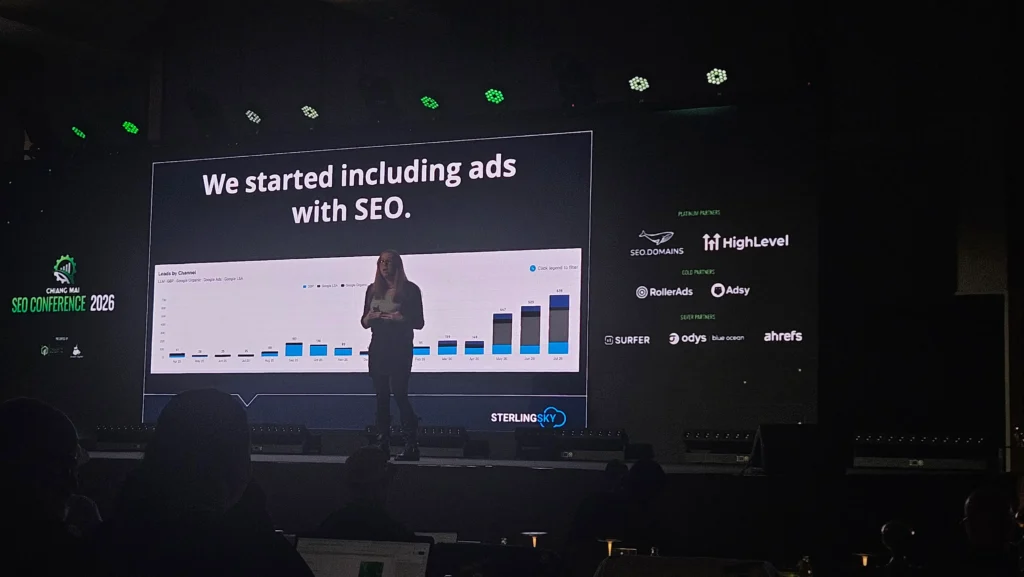
Sterling Sky is an SEO agency, and Joy’s response was to start including ads with SEO. The chart she showed had monthly leads climbing to 447, 523 and then 639 across May, June and July 2026, with the return for clients improving along the way.
Her tips for making an ad look like a local listing:
- Set up location assets, which link your Google Business Profile to your Google Ads account.
- Use the headline and description well, because review stars can now show.
- Quote a real review in the ad description, in quotation marks.
- Check your sitelinks. Her warning was that they can push the call button out of the ad.
Leads from AI tools are real, and small
Joy is now seeing leads arrive from ChatGPT and Claude. One slide put it in proportion: 2,498 leads from Google Business Profiles (61%), 1,536 from Google organic results (37%) and 81 from AI tools (2%). She also said visitors arriving from Claude converted at about twice the rate of visitors from ChatGPT on the sites she monitors.
Two per cent is not nothing, and it is growing. It is also a useful reality check after a week of AI talks. For a local business today, the map listing and the website still do nearly all of the work.
AI local packs
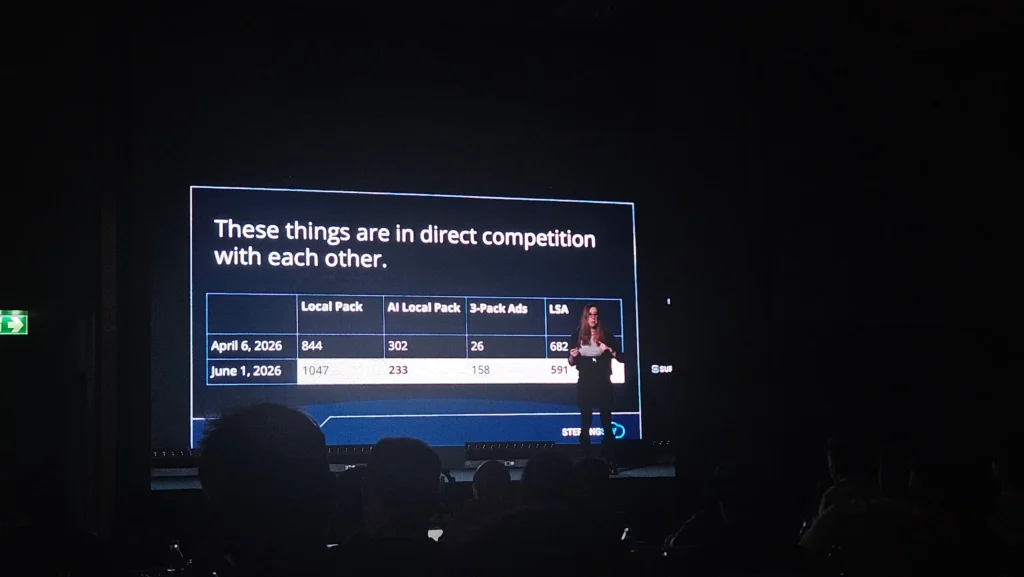
Google is also replacing some standard local packs with AI-written ones. Joy’s point was that the standard pack, the AI pack, ads in the pack and Local Services Ads are in direct competition with each other for the same space. In her tracking, between 6 April and 1 June 2026 standard local packs went from 844 to 1,047, AI local packs from 302 to 233, ads in the pack from 26 to 158 and Local Services Ads from 682 to 591. Ads inside the pack grew sixfold in two months.
What she has learned about the AI versions:
- About 60% of the sources she sees them cite are the business’s own website.
- The outside sources that matter are the big directories that already rank. Her example was Yelp.
- Want to change how you’re described? Change the first text on the page your profile links to.
- Make the name on your Google Business Profile match your website and your real business name.
Reviews, trust and awards
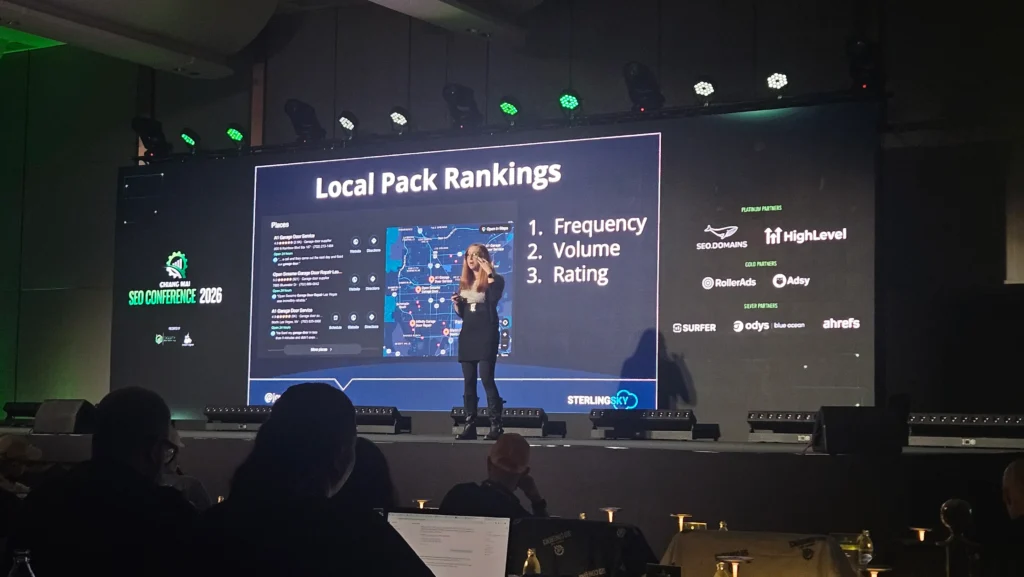
For ranking in the local pack, Joy listed three things about reviews, in order: how often you get them, how many you have and your rating. Frequency first. Her advice was to compare yourself with the top five competitors in your area on each one. Her example business had a 4.8 rating, which was excellent, and about half the review count and half the monthly review rate of the leaders. The rating wasn’t the problem.
She also said Google keeps internal trust scores. Fake reviews work until they’re found. Then the reviews are removed and the trust score takes the damage.
A few other points:
- Press releases don’t work as well as they did.
- Accreditation counts. Her example was the Better Business Bureau, which is North American. We don’t have a direct equivalent, and the closest thing here is membership of the industry association that fits your trade, such as the Motor Trade Association of WA for an automotive business.
- Go and win awards, then promote them everywhere. Look up the ones your competitors hold and enter those too.
- On her data, the May 2026 core update brought 48% more volatility in search results, and Google has stopped showing a local pack at all for some searches. You can lose in local and gain somewhere else on the page, such as an AI Overview.
What this means for your business: if phone calls from your Google listing have dropped this year, it may be the missing button and not your ranking. Ask for reviews steadily, every month. And think about SEO and Google Ads as one plan for the same results page, which is how we’ve always preferred to run them.
3. One System for the Traffic You Own and What Happens Next
Jeremy Burgos, HighLevel
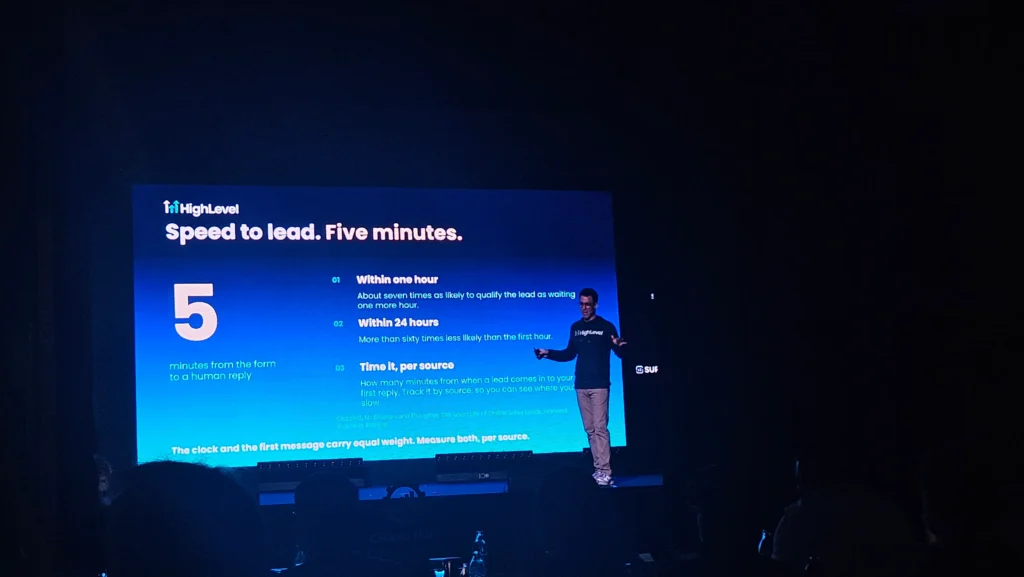
Jeremy’s talk paired SEO fundamentals with the most practical data of the day: how much the speed of your reply decides whether an enquiry turns into a customer.
His framing was a good one: you own the traffic. You don’t own what happens next. Everyone in marketing is measured on revenue and almost nobody controls it.
The SEO half was a five-step system: work out what each page is for, decide which single page owns each search, plan the changes one row per page, fix and re-check, then compare the pages you changed with the ones you didn’t. His rule was that if you can’t show the before and after, it didn’t happen.
The half that matters to most businesses was about follow-up. He cited a Harvard Business Review study which found that a business that responds to an enquiry within an hour is about seven times as likely to have a proper conversation with that lead as one that waits another hour, and more than sixty times as likely as one that waits a day. His target is five minutes from the form to a human reply. And the first message should ask one question the person can answer in a few seconds, in place of the usual “thanks, please book a time here”.
This is where I see a real opportunity for a lot of businesses. When leads feel like poor quality, it’s natural to look at where they came from. This data says to look at the clock as well. The same enquiry answered in five minutes and answered the next morning can look like two very different leads. Replying faster costs nothing in advertising, and it’s fully within your control.
What this means for your business: time how long it takes you to reply to a website enquiry. Most businesses have never measured it. If your leads haven’t been converting the way you’d like, this is the first place to look, and often the cheapest to fix.
4. Panel: What Moves Rankings in 2027
Kasra Dash (The Masterminders), Kyle Roof (IMG Courses) and David Quaid (Primary Position), moderated by Niels Zee
Three people who test for a living, and a good conversation with plenty of short, sharp points.
- On testing. Use controls and make it repeatable. Re-test other people’s results before you trust them. And test the opposite: if adding something is meant to help, check what removing it does. That is Emilio Takas’s Day 4 message from three more voices.
- On links. Buying links still works, the panel said, for rankings and for AI. Relevance matters far more than volume. I’ll note that buying links is against Google’s guidelines, and it isn’t something we do.
- On exact-match anchor text, meaning links whose clickable words are your target search phrase. Yes on a few, not on everything. For a new website, build the brand first.
- On E-E-A-T, Google’s shorthand for experience, expertise, authority and trust. How is it really validated? The practical answer from the panel was to be a real business run by real people, and make that easy to see.
- On behaviour. Pages that let people finish what they came to do tend to perform. Google is watching what users do.
- On AI tracking tools. They all have limits. Also ask the client where their customers say they found them.
- On Microsoft Clarity. David Quaid called it out as a good free tool, including for working on AI visibility.
Arguing with the AI
The most striking point came from Kasra Dash. He described logged-in users sitting with an AI tool, telling it that its answer was wrong and giving it evidence. Within 24 to 48 hours, he said, the answers changed and the brand was being cited.
I haven’t tested that and I’m reporting it as his account. If it holds up, it’s remarkable, and it’s worrying for the same reason. A large enough group of people, inside one organisation for example, could set out to shift what an AI tool tells everyone else.
The King of SEO
A lighter moment. There is a running competition among SEOs to rank number one for “king of SEO”, with everyone trying to knock everyone else off. David Quaid said he was sitting lower down the rankings but did manage to get himself blocked by Bing along the way, which is quite an achievement for a white hat SEO. I had to laugh. I checked afterwards however, and Google’s AI Overview for the search does name David Quaid as the King of SEO so he can’t be doing that bad.
AI is not an SEO tool
The panel point that hit closest to home was this one. The temptation for a business owner is to paste their website into ChatGPT and ask what’s wrong with it. It will always give an answer, usually a long one, because producing a plausible answer is what it’s built to do. It predicts the most likely next word. That is not the same as understanding your market and doing SEO.
David Quaid put the problem well: “It’s a game of displacement. You have to push someone else down for you to rank up. How do you do this with generic SEO audits from LLMs?”
We’ve seen this first hand. Multiple clients have come to us asking for changes to their websites based on what was plainly an AI-generated audit, and they’re easy to spot even after someone has tidied them up. Some came from the clients themselves. Others, as far as I can tell, came from SEO providers who passed the output straight on.
There are two problems with them. They generate a huge list of work with no sense of which items matter, so the job gets expensive quickly. And they’re often wrong. As the saying goes, AI is amazing and accurate on every subject except the one you’re an expert in, where it seems to be right about 60% of the time.
We could simply do the work. It would be an easy way to bill hours. We won’t, because spending a client’s money on changes that won’t get them a result isn’t something we’re prepared to do. What we do is go through the list with them, say which few items are worth doing and explain why the rest aren’t.
What this means for your business: use AI to help you think, by all means. If it hands you a 40-point SEO audit, get someone with experience to tell you which three points matter before you pay for any of it.
5. Perception Engineering: Getting Cited Is the Easy Part
Jonathan Kiekbusch, SwishDM
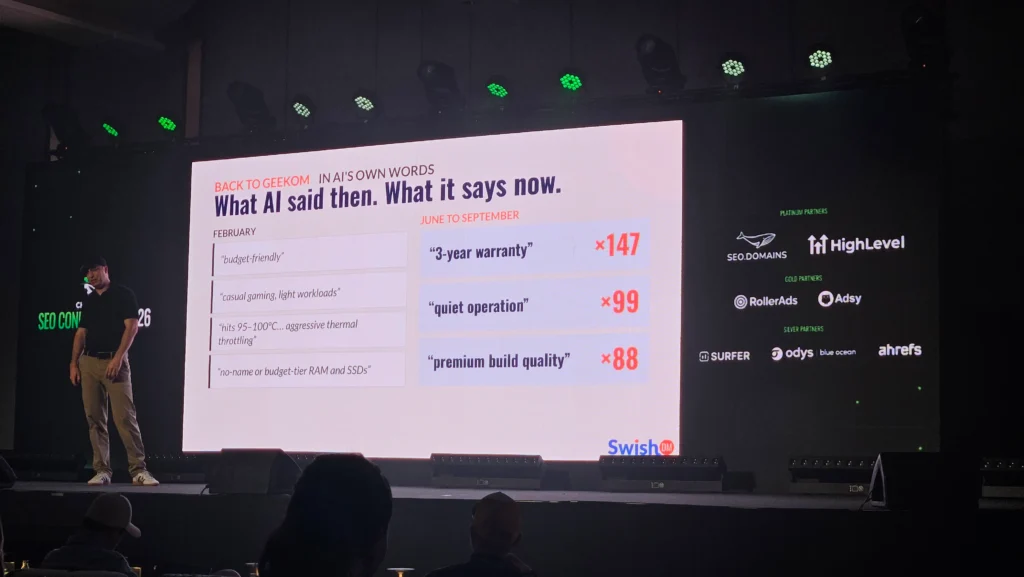
All week the question has been how to get mentioned by AI. Jonathan asked the next one: once you’re mentioned, what is it saying about you?
His case study was GEEKOM, a mini PC brand. It had plenty of visibility in AI answers. The trouble was what the answers said: “budget-friendly”, “casual gaming, light workloads”, running hot and slowing down under load, cheap components. Some of that may have been fair two years ago. It didn’t describe the products on sale today. If that’s what the answer says, he argued, you may be better off not being mentioned at all.
He calls the fix perception engineering, in five stages: discover, diagnose, design, distribute and defend.
Discover: start with data you already own
Before buying a tool, look at what you have: Google Search Console, Microsoft Clarity, the AI performance report in Bing Webmaster Tools, and your support tickets and live chat. The Bing report shows the searches AI tools run in the background before they answer, which is as close as you’ll get to seeing the questions being asked. Then look at where buyers already ask questions: product Q&A and reviews, Reddit and forums, Google’s “People also ask”, and competitors’ reviews.
Sort the questions into three buckets. Branded (“is GEEKOM premium or budget?”), which you can nearly always win. Category (“best mini PC for the office”), which is the battlefield. And jobs to be done (“can a mini PC handle video editing?”), which is where competitors forget to show up.
Diagnose: one answer is a sample of one
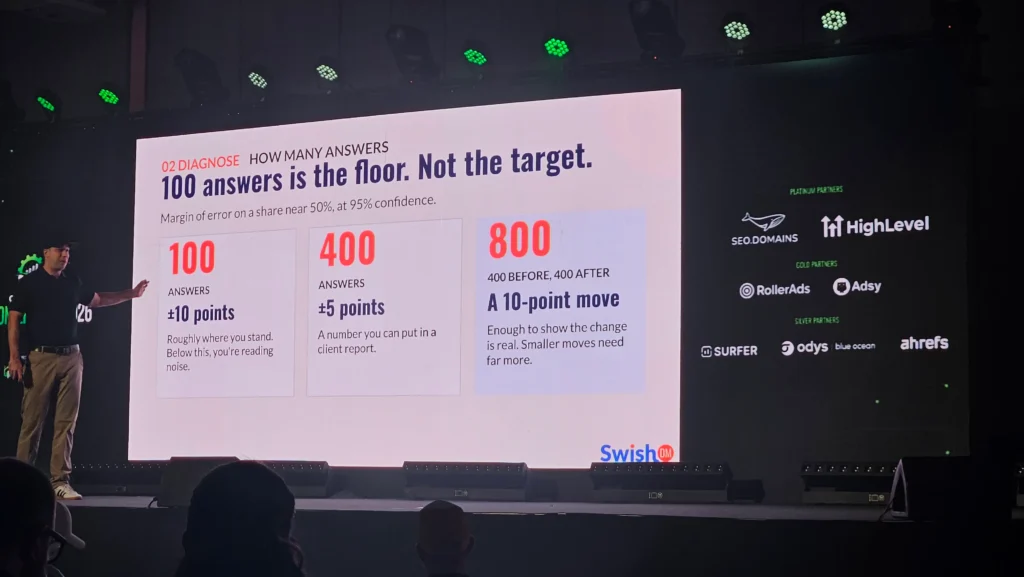
Ask an AI tool the same question twice and you get two different answers. So fix your list of questions, run them on a schedule, keep the full answers and count the phrases that come up.
He put numbers on how many runs you need. With 100 answers your margin of error is about plus or minus 10 points, which tells you roughly where you stand. Below that you’re reading noise. With 400 it’s about plus or minus 5, a number you can put in a report. To show that a 10-point change is real, you need 400 before and 400 after. That’s the same discipline Manick Bhan argued for on Day 2, with the arithmetic attached.
Design: three problems that look the same
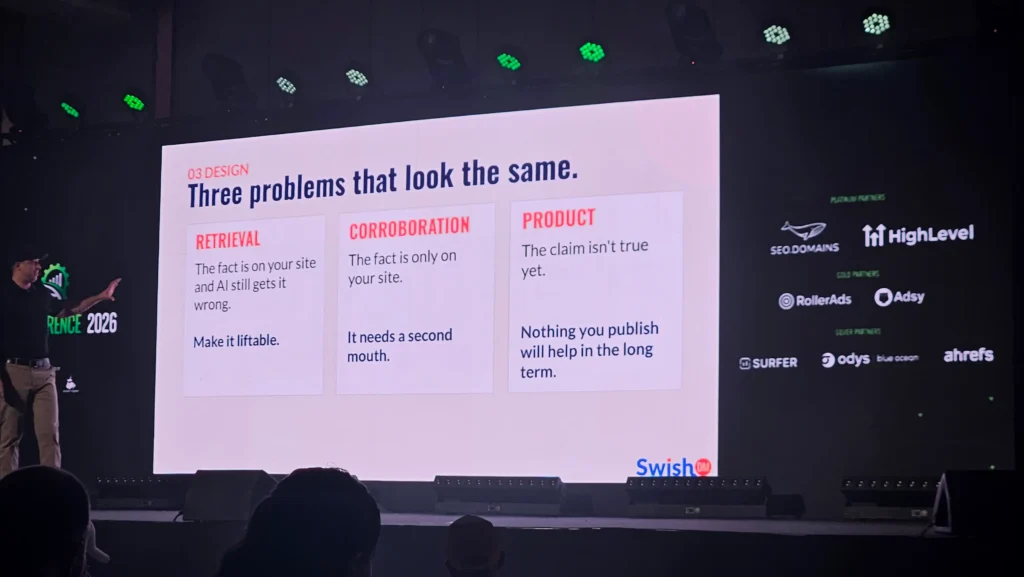
When AI gets something wrong about you, it is one of three problems:
- Retrieval. The fact is on your site and AI still gets it wrong. Make it easier to find and lift.
- Corroboration. The fact is only on your site. It needs, in his words, a second mouth.
- Product. The claim isn’t true yet. Nothing you publish will help for long.
GEEKOM had the first two. The overheating criticism was a retrieval problem. The thermal test data existed, so they put it on the product page and the AI picked it up. Being left out of “best mini PC for gaming” was a corroboration problem. A model with a proper graphics card had shipped in 2024 and AI didn’t know, so other sites had to say it. His line: every criticism is a content brief.
This is also where the day’s main message came from. AI isn’t adjudicating the truth. When a model looks something up, it may find one old forum thread, one paywalled review, a specification table and your page. Where almost nothing exists, whatever exists wins. That is why a single good page can change an answer.
The ten-second JavaScript check
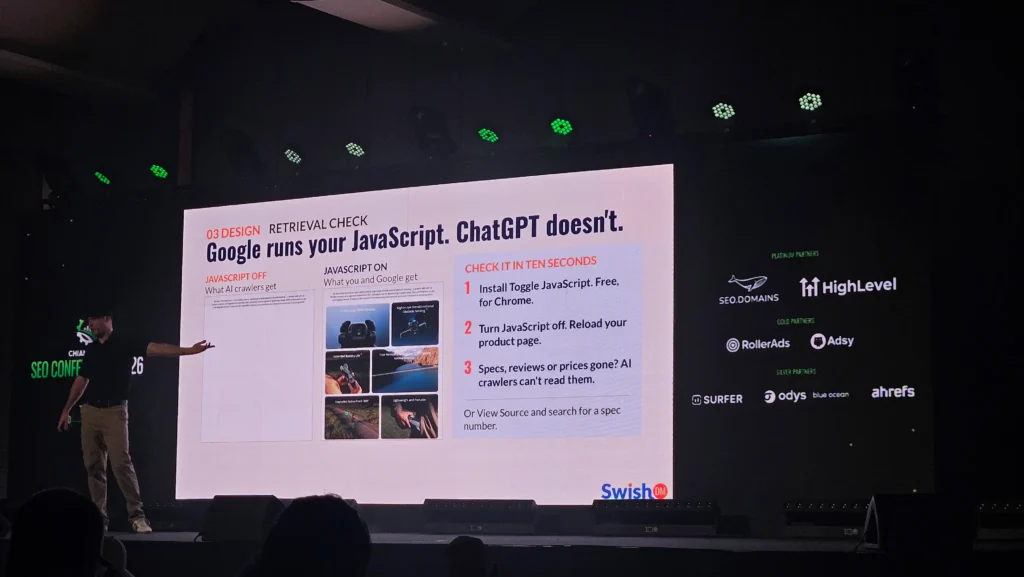
Jonathan had the clearest slide of the day on this. Google runs your JavaScript. ChatGPT doesn’t. If your specifications, reviews or prices are loaded by JavaScript, most AI crawlers get a near-empty page.
To check: install a free browser extension that switches JavaScript off, turn it off and reload your page. If the content you care about has gone, AI can’t read it either. Or view the page source and search for a number you know should be there.
Distribute: start where AI already looks
Rank the sources AI already cites for your questions. Start with the ones that praise a rival and criticise you, because they already hold a view of you. Next are the ones where a rival appears and you don’t. Sites that cover your category but have no view of you come last.
Then give everyone who publishes about you the same short sheet: the phrase you want repeated, the proof behind it and who should say it. He covered three channels.
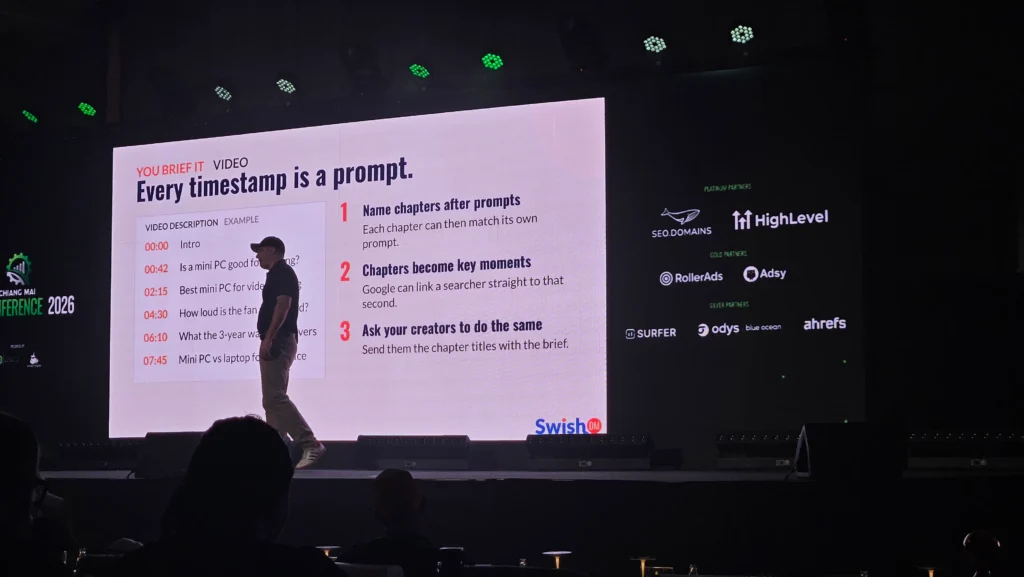
- Video. A video is a document AI can read. The script is text, and so are the title, the description and the captions. Upload your own captions, because automatic ones mangle product names. And every timestamp is a prompt: name your chapters after the questions people ask (“Is a mini PC good for gaming?”) in place of “Part 2”. If you already have a library of videos, go back and add or rewrite the timestamps.
- Q&A and forums. Answer every question on your own product pages and marketplace listings. On forums, reply as the brand and say so. One question per thread, with the answer in the first line.
- Reviews. Brief reviewers on what to test, such as “measure fan noise at full load”. Choose review sites AI already cites. Paid reviews are disclosed as paid.
Own the source
As an experiment, SwishDM built a review site of its own on a brand-new domain, with real hands-on reviews of action cameras. It had no citations before 4 September. In the 30 days to 10 October it was cited in 49% of ChatGPT’s answers across the questions they track, and by 33 of the 45 questions. On his slide that was more than Wired.
How they chose what to test is the clever part. They counted which specifications came up in 1,221 ChatGPT answers: stabilisation in 88%, price in 84%, resolution in 72%, low light in 65%, battery life in 60%. As he put it, AI is telling you what it needs to make you number one. Prove those things.
The rules they wrote for the site would improve most websites:
- Never invent a figure. If it isn’t in the test sheet or the verified specifications, it doesn’t go on the page.
- “Not published” is content. Say what the maker won’t tell you. Never leave a blank and never estimate.
- Every page concedes something. A named rival wins a named test.
- Every page says how it knows: a named reviewer, dates, how the product was obtained and a “how we test” page.
He also covered buying an established review site, or an old YouTube channel, in place of building one. I’d put that at the grey end of things. For clarity, Jonathan’s own client work is with larger and often publicly listed companies, and it sits firmly on the white hat side.
The result
For GEEKOM, the February answers said “budget-friendly” and warned about overheating. Between June and September the phrases showing up were “3-year warranty” (147 times), “quiet operation” (99) and “premium build quality” (88).
Two other things he said stayed with me. E-commerce is going to get harder for smaller businesses, because the bigger players are getting very sophisticated at this. He balanced that by saying that being small and local is an advantage for being found. And people who ask an AI tool to compare products are well on the way to buying.
My view: the canary in the coal mine
Put Jonathan’s talk next to Charles’s and you have the same fact from both ends. AI answers reflect what is published and repeated. They don’t reflect what is true. One speaker uses that to correct an outdated picture of a real product. The other uses it to manufacture a picture that was never real.
We spent the week learning how to influence which mini PC or which plumber gets recommended. The same methods work on any subject. Think about what that means once it’s applied to politics and public messaging by governments and large PR organisations with real budgets. People in SEO are the canary in the coal mine here. We can see what’s possible with these models well before most people can, while the public largely trusts the answers they’re given. That gap concerns me.
What this means for your business: ask a few AI tools what they say about you, more than once. If the answer is wrong or out of date, work out which of the three problems it is. Check your key pages with JavaScript off. And if you have videos, fix the timestamps.
6. The Story Scraped 50M LLM Answers
Michał Suski, Surfer
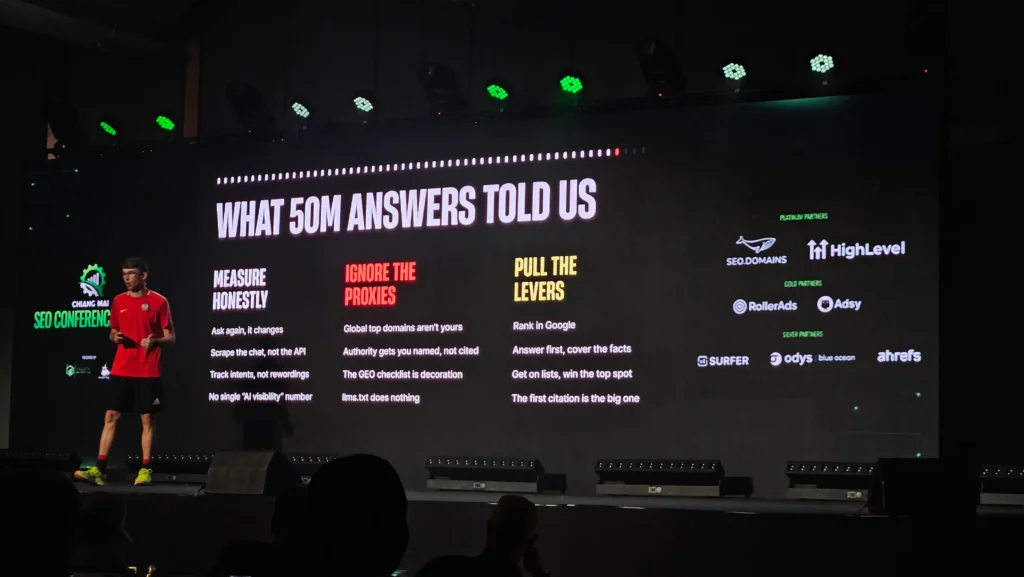
The last talk of the conference was the most data-heavy, and a good one to finish on. Michał is a co-founder of Surfer, whose AI tracking product runs around 100,000 prompts a day across five AI engines and has done since March 2025. That adds up to more than 50 million answers. Slide after slide was a takeaway.
A note on the data before the findings. His slides say the answers are scraped from the real interface and not the API, which matters because he showed the two give different results. He didn’t go into the setup. My understanding of how the industry generally does this is that the prompts are run fresh, without a logged-in account, over and over. Nobody outside the AI companies can see inside logged-in conversations or follow a long chat thread. So this is a picture of what the engines say to a new, anonymous question. That doesn’t make it less useful. It makes it indicative, which is how I’d read every figure below.
He split the talk into three acts.
Act one: what moves an AI answer
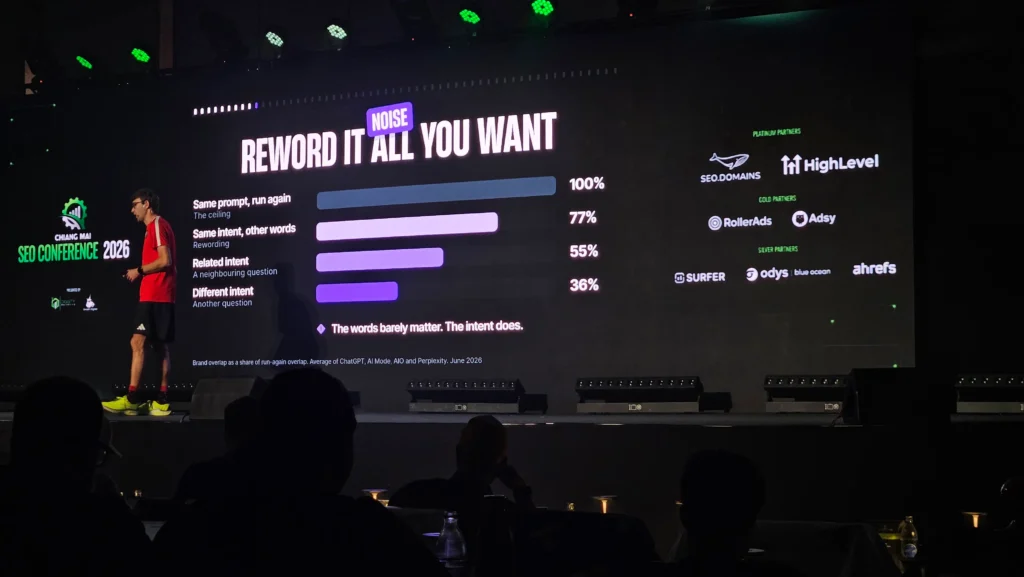
Rewording a question barely changes the answer. Taking the overlap you get from simply running the same prompt again as the ceiling, a reworded version of the same question returned 77% of the same brands. A related question returned 55% and a different question 36%. His summary: the words barely matter, the intent does. So track intents, not exact phrasings.
Engines don’t agree with each other. Google’s AI Overviews and AI Mode were the closest pair at 0.70 on his scale. Gemini sat near them. ChatGPT’s agreement with any of the others was between 0.32 and 0.38. Being visible in one tells you little about another.
One more from this section: brands stay fairly steady over time, while the sources behind them drift.
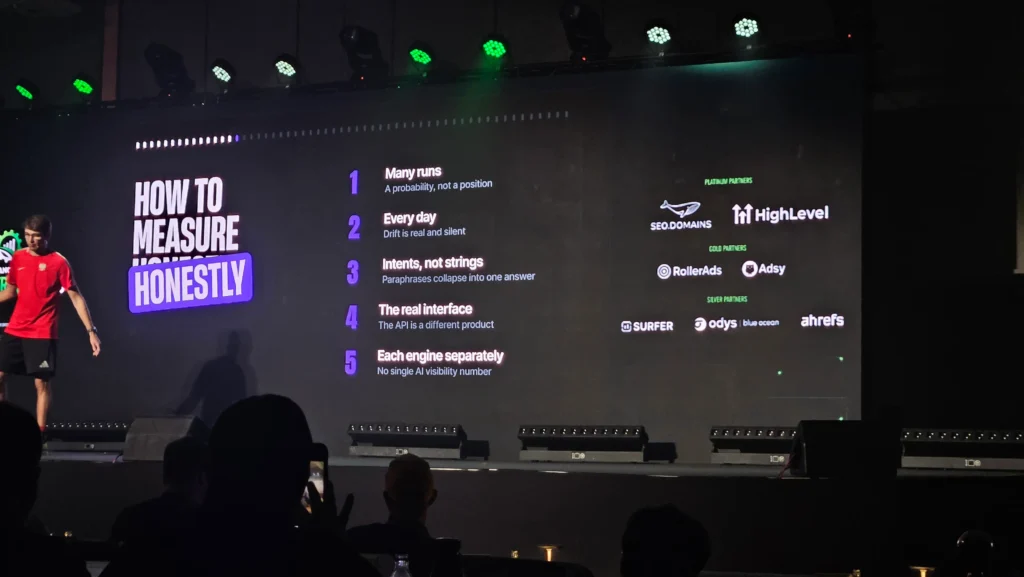
His five rules for measuring honestly:
- Many runs. You’re measuring a probability, not a position.
- Every day. Drift is real and silent.
- Intents, not strings. Different wordings collapse into one answer.
- The real interface. The API is a different product.
- Each engine separately. There is no single “AI visibility” number.
Act two: false signposts
This act went through the things people assume get you cited. His phrase: authority is a proxy, not a factor.
- Link authority. A page’s PageRank-style score had essentially no relationship with being cited (about -0.01 across all engines).
- Harmonic centrality, which Stephen Burns explained on Day 2. It helps, barely (+0.02 for citations).
- Traffic. It gets you named, not cited. A busy website is somewhat more likely to have its brand mentioned in the answer (+0.10) and no more likely to be the page the answer links to (+0.01).
- Domain age. Websites more than 30 years old get about 2.5 times the citations of websites under a year old, but that’s because they have far more pages. Within a single question, age hardly matters.
- The big names. Only 8.9% of the results in a niche come from the big global sources. The sites that matter in your field are not the ones on the general “most cited” lists.
- Linking out to Wikipedia or other trusted sources from your article. A correlation of 0.031, which is nothing.
- llms.txt, a file some have promoted as a way to guide AI crawlers. No effect.
- Schema. Slightly positive on every engine, with his own caveat that pages with schema may simply be better-kept pages. His advice was to keep structured data on the pages you actually maintain.
A note for anyone following the series. On Day 2, harmonic centrality was presented as what Common Crawl ranks the web by, and Common Crawl is a source AI companies use. Michał’s data is about something narrower, whether a page gets cited in an answer, and on that it shows very little effect. Both can be true. Being included in what a model learns from and being quoted in today’s answer are different things.
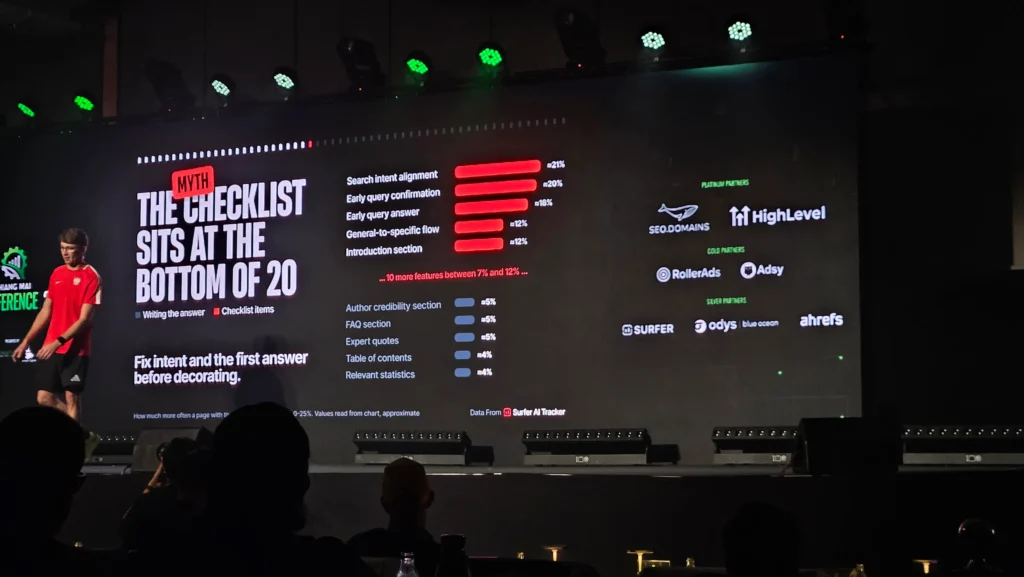
Then the checklist. Surfer scored pages on 20 features and measured how much more often pages with each feature were cited. The top of the list was all about answering the question: matching the search intent (about 21%), confirming the question early (20%) and answering it early (18%). The bottom five were the items on every “optimise for AI” checklist: an author credibility section, an FAQ section, expert quotes, a table of contents and statistics, each at around 4 to 5%.
His line: fix intent and the first answer before decorating.
Act three: what gets you cited
Rank in Google. 95% of the domains cited by Google’s AI rank in Google’s top 10 for at least one keyword. Google AI is still Google.
The first citation is the big one. Across 2,685 brands, visibility rose about 25% after a brand’s own website was cited for the first time. Later citations added little on top.
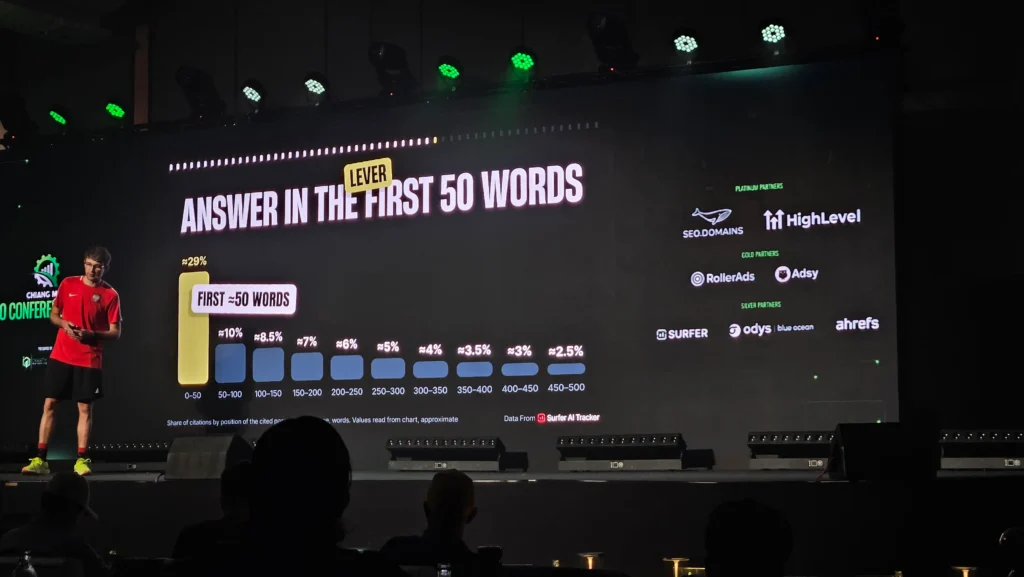
Answer in the first 50 words. About 29% of cited passages came from the first 50 words of the page. The next 50 words accounted for about 10%, and it falls away from there.
Match intent or don’t bother. Pages that matched what the person was asking were used as a source 42% of the time. Misaligned pages managed 22%, and misaligned blog posts 13%. We’ve heard it all week: understand what the person is looking for and answer that, as directly as you can.
Write in chunks AI can lift. Paragraphs that make sense on their own, clear definitions, a general-to-specific flow and sensible headings each lifted citations by around 10 to 12%.
Facts win. In a new study, the 20 most-cited pages for a prompt covered about 35% of the relevant facts and the 20 least-cited about 25%. On ChatGPT the gap was 31% against 18%. Page length didn’t explain it.
Have a specific angle. A unique angle had a small positive effect on every engine (0.12). The most common trait of the pages that stood out was concrete specifications and detail, at 46%. His example was a shoe page that says the shoe weighs 300 grams. Be specific more than original.
Older content still gets cited. Between 57% and 74% of citations in AI Mode, AI Overviews, ChatGPT and Perplexity went to pages more than six months old. Gemini was the exception and leaned towards newer pages.
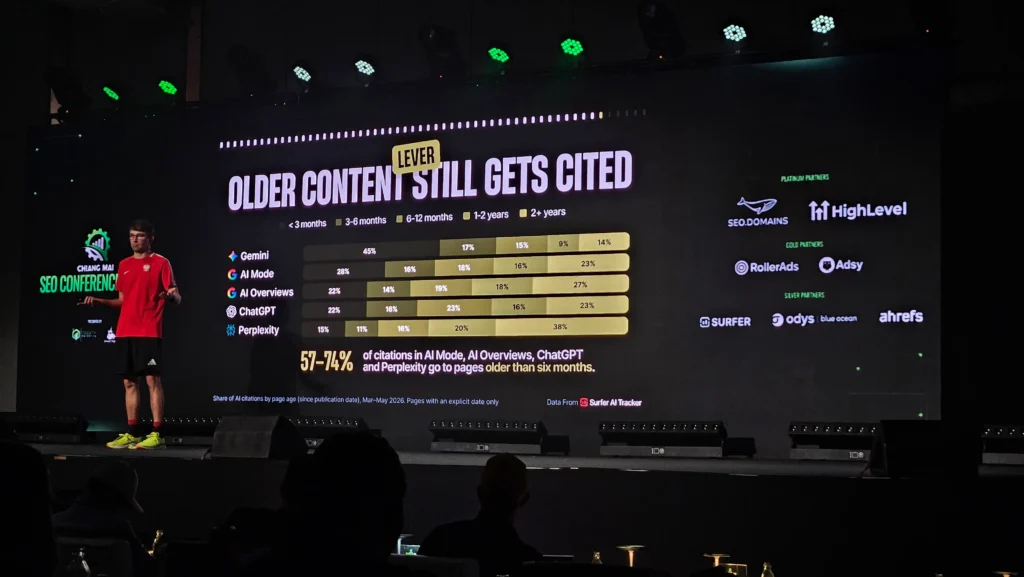
Put those together and there’s a job in it for any business with a long-standing blog. Old articles are still eligible to be cited. Most were written with a slow introduction and the answer halfway down. Now is the time to rewrite them, or at least to add a short direct answer at the top and tidy them into sections that stand on their own.
The listicle story
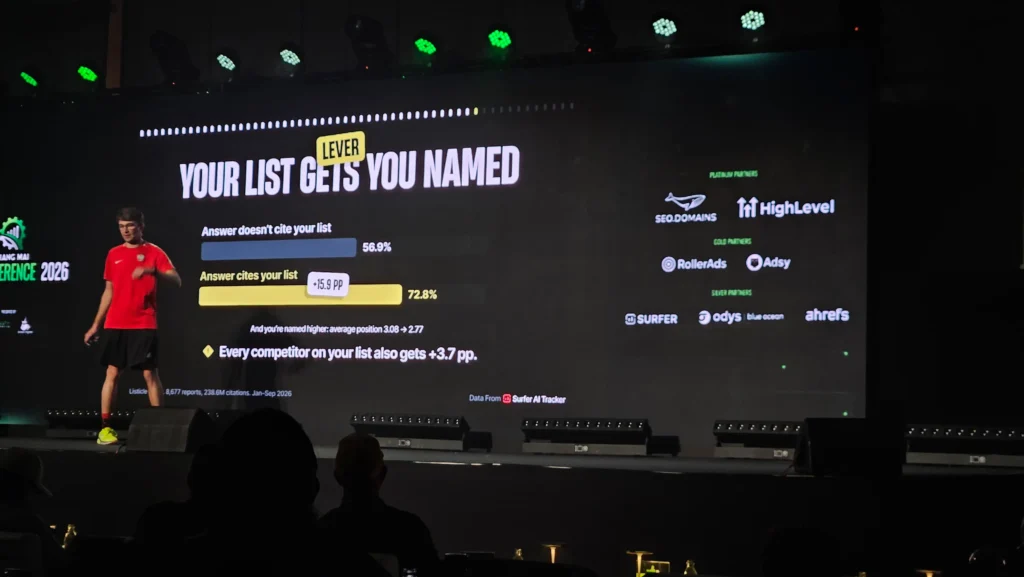
“Best of” lists have been one of the arguments of the year in SEO, so this was the part of the room’s attention he had fully. From a study of 8,677 reports and 238.6 million citations:
- Lists aren’t losing ground. Through 2026, a brand’s own lists held steady at 10 to 12% of citations and other people’s lists at 21 to 24%.
- Your own list gets you named. When an answer cites your list, you’re named in 72.8% of those answers, against 56.9% when it doesn’t. Every competitor on your list gets a lift as well, of about 3.7 points.
- Position matters. Brands listed first on their own list were named 38% of the time, against 26% when listed elsewhere. On other people’s lists, first place was named 52% of the time, falling steadily to 13% at tenth and below.
- More lists, more presence. Brands with four or more cited lists of their own were present 38% of the time, against 28% for brands with none. His advice was to build a set of comparison pages, not one.
- Leave “best” out of the title when the list is on your own website.
- The page fades. The name stays. Eleven weeks after AI first cites your list, the page is cited only 26% as often as in its first month. Your brand is still named 83% as often. Use the list to earn the mention, and refresh it to keep the citations.
I’ll add my own caution. A list of “the best providers” published by one of the providers, with themselves at number one, is a format readers have every right to be sceptical of, and I wouldn’t be surprised to see the engines treat it differently over time. Jonathan’s rule from earlier in the day is the right guard rail. If you publish a comparison, make it honest, show how you know, and concede where a competitor is better.
His closing slide summed up 50 million answers in three lines: measure honestly, ignore the proxies, pull the levers.
What this means for your business: rank in Google first, because it’s still the way in. Put the answer in the first two sentences. Fill your pages with specific, checkable facts. And go back through your old articles before you write new ones.
The common thread from Day 5
- AI isn’t adjudicating the truth. It repeats what it can find and what it finds repeated. That’s an opportunity for honest businesses and a risk for everyone.
- Being mentioned is only half of it. Check what’s being said about you, and whether it’s still true.
- Answer first. Match what the person is asking and answer it in the first 50 words.
- Facts beat decoration. Specific, provable detail does more than FAQ blocks, author boxes and llms.txt.
- Google is still the way in. 95% of the domains Google’s AI cites already rank in its top 10 for something.
- JavaScript can hide you. Google copes with it. Most AI tools don’t.
- Local search has changed. Call buttons are disappearing from free listings, ads are moving into the map pack, and steady reviews matter more than ever.
- AI is not an SEO tool. It will always give you a list. It can’t tell you which items matter.
- Measure honestly. Many runs, every engine separately, and no single visibility number.
Five days in summary
That’s the Chiang Mai SEO Conference done for 2026. If you only take one thing from each day:
- Day 1: AI tools choose what to cite in ways you can study. Showing up starts with being a clear, well-described business that other sites talk about.
- Day 2: Most of what AI reads never appears in the search results you see, and unique, provable content is what gets picked out of it.
- Day 3: Make life easy for the machines. Say exactly who you are, in a form they can cross-check.
- Day 4: Every playbook has a clock on it. Test, don’t copy, and keep the business underneath sound.
- Day 5: AI repeats what it finds, so make sure what it finds about you is true, specific and easy to lift.
What strikes me, looking back over the week, is how consistent the honest advice was, from people who don’t otherwise agree on much. Be a real business. Say clearly what you do. Prove it with specifics. Get other credible people to say it too. Measure what happens. None of that is new. What has changed is who is reading: alongside your customers, there are now machines summarising you to people who may never visit your website.
I wrote these recaps as much to capture my own learning as to share it, and there’s a lot here we’ll be testing over the coming months. My thanks to the organisers and to every speaker for a generous week.
If you’d like a straight conversation about what any of this means for your business, get in touch with the DeCODE team.
This is the final part of our five-part series from the Chiang Mai SEO Conference 2026. Read Day 1, Day 2, Day 3 and Day 4.
Sources
- Chiang Mai SEO Conference 2026
- Charles Floate, AI SEO Rainmakers – presentation. His twiddler readings draw on leaked Google documentation and research he credited to Resoneo, not checked by us directly
- Sterling Sky – Joy Hawkins’s presentation and data
- HighLevel – Jeremy Burgos’s presentation
- Harvard Business Review: The Short Life of Online Sales Leads (Oldroyd, McElheran and Elkington) – cited on Jeremy Burgos’s slide
- Niels Zee – panel moderator, with Kasra Dash, Kyle Roof and David Quaid
- SwishDM – Jonathan Kiekbusch’s presentation and case study
- Surfer – Michał Suski’s presentation, data from Surfer AI Tracker. Several chart values were marked approximate on his slides
On this page
We’re here to help you DeCODE the Digital World
DeCODE builds breathtaking websites that drive sales for your business without a price that would take your breath away.
We understand that Companies don’t need websites. Companies need a regular stream of high-quality leads. Customers eager, educated, and ready to purchase their products or share their vision. This is the core of a DeCODE build.
In 2026 websites are no longer set and forget, winning an online race is now a marathon, not a sprint. Visually stunning sites with limited back end functionality and no ability to perform in search are redundant.
At DeCODE we build sites that perform.









Adam is a digital marketing specialist, business strategist, and Partner at DeCODE Digital, with 20+ years across marketing, sales, business strategy, and commercial transformation. He works with businesses that need more than a marketing plan: a clear strategy, stronger market position, and a digital presence that drives real commercial growth.