
SEO & AI Search
Gemini 4 Hydrogen is now in Google Search:
Google's biggest model upgrade to Search yet understands longer questions, runs more searches behind each one and answers with more images and tables. Here's what Australian businesses should do about it.
Gemini 4 Hydrogen Is Now in Google Search: What It Means for Your Website
Google has rolled Gemini 4 Hydrogen into Search worldwide. Here's what's changing, why your website now needs to answer the follow-on questions as well as the first one, and what to do this month.
Created: November 14, 2026 | Reading Time: 14 minutes


This week, Google rolled out Gemini 4 Hydrogen in Google Search, worldwide and for all users. Robby Stein, Google’s VP of Product for Search, called it “the biggest model upgrade to Search yet”.
For business owners, the short version is this. People can now ask Google long, detailed questions and get a genuinely useful answer back. To build that answer, Google runs a batch of extra searches behind the scenes, draws on a wider range of websites and presents the result with more images, comparison tables and tools.
That changes what a good website looks like. It’s no longer enough for a page to answer the obvious question. It needs to answer the next five as well.
What is Gemini 4 Hydrogen?
Gemini 4 Hydrogen is the newest model in Google DeepMind’s Gemini 4 family, announced on 12 November 2026. Google positions it as the fast, cost-efficient model for everyday work, sitting alongside its heavier frontier models, Gemini 4 Carbon and Gemini 4 Argon.
That positioning is the reason it matters for search. Hydrogen is quick and cheap enough to run at Google’s scale, so rather than sitting behind a paid subscription, it now powers the AI answers in Search for everyone. Google’s side-by-side examples compare it with the previous model, Gemini 3.5 Flash.
Google has published plenty of benchmark scores for coding and agentic tasks. For a business owner, the more useful part is what it does to Search.
What’s changing in Google Search
Google lists four improvements:
- It understands what people mean. Search can now handle complex, multi-part questions, typos and very specific requests. Google says better instruction following means each part of a question gets a relevant answer.
- It searches more widely. Hydrogen strengthens query fan-out, the technique where Google breaks one question into related subtopics and searches them all at once. Google says this surfaces a wider range of links, including sites people might not have found before.
- Answers are more visual. Expect more images, structured layouts, comparison tables and custom tools tailored to the question.
- Better answers in more languages. Responses should be more nuanced in every language AI Mode supports.
All of Google’s examples come from AI Mode, the conversational tab in Google Search. The announcement doesn’t spell out how the upgrade changes AI Overviews (the AI summaries at the top of normal results), so we’ll keep an eye on that.
Google’s own comparisons show the difference better than the description does.
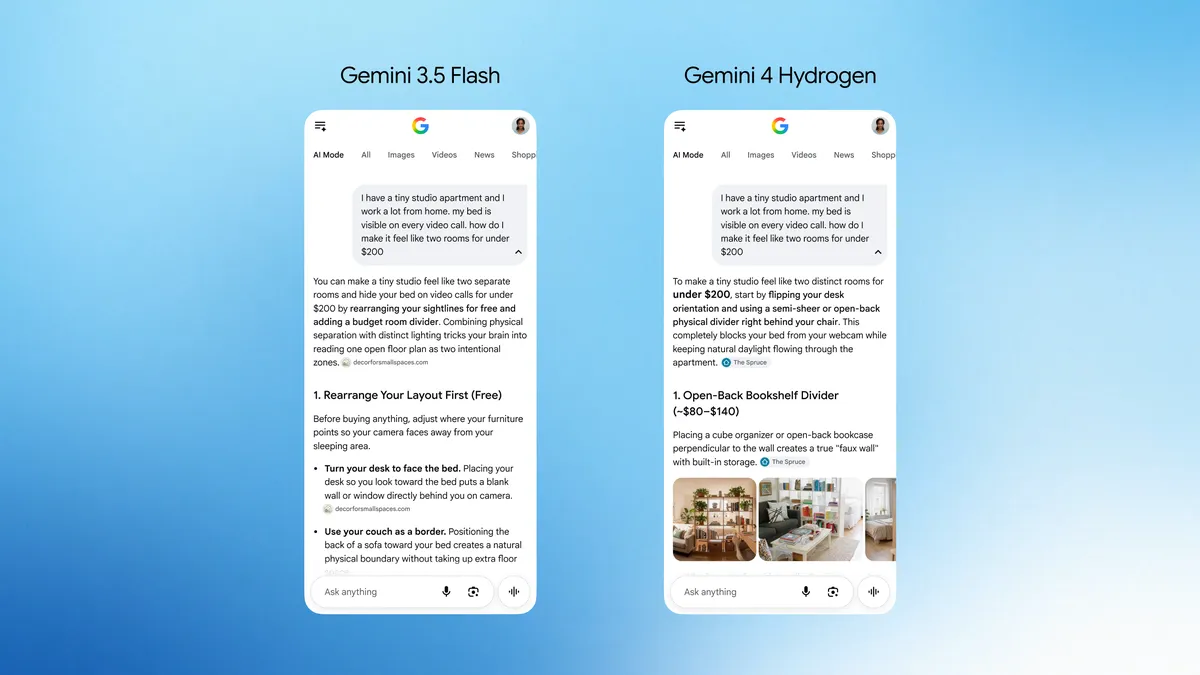
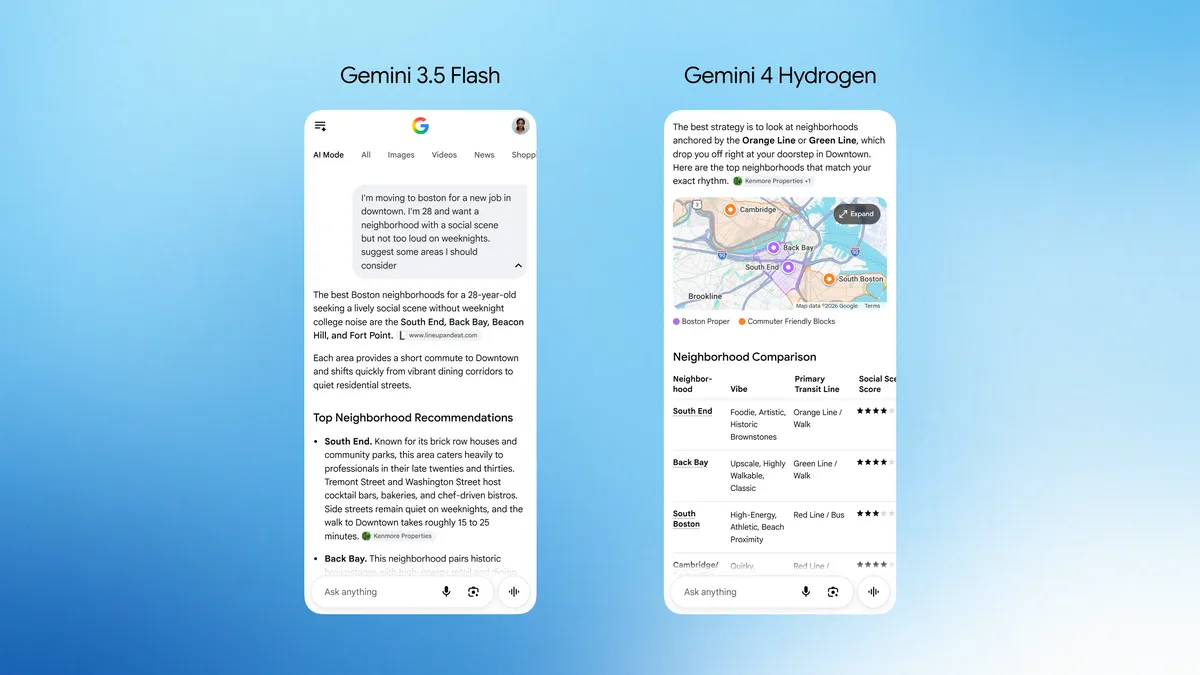
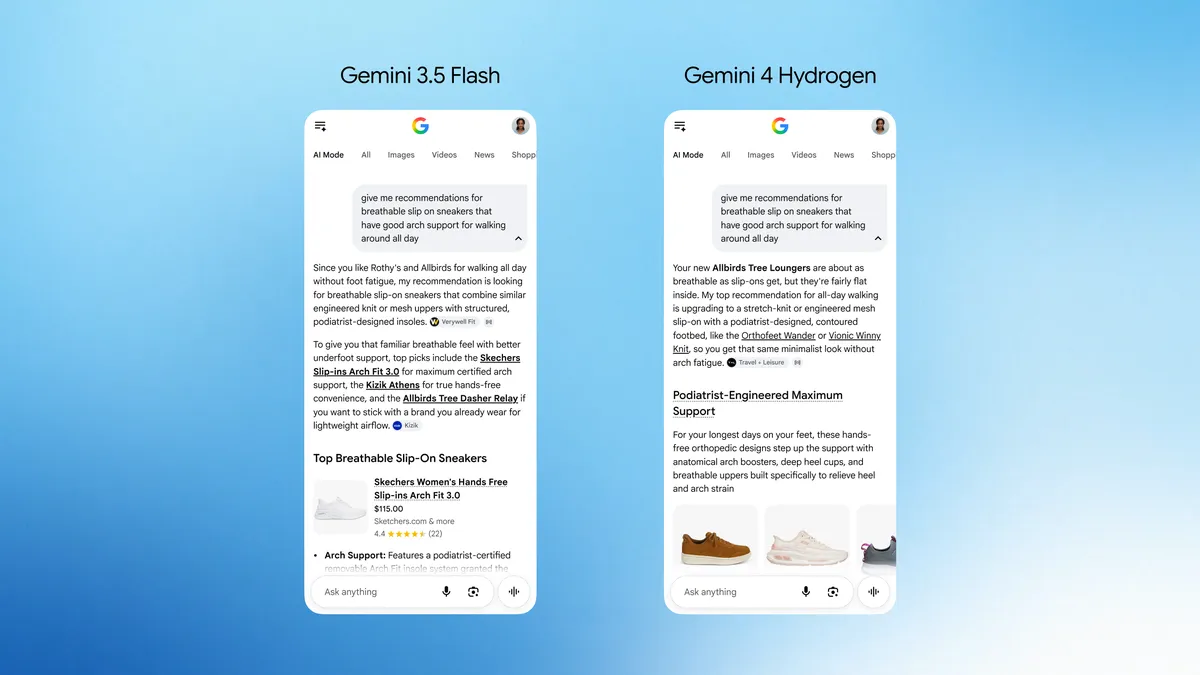
Three things stand out in those examples:
- The answers are built around the person’s situation, not just the topic. Budget, location, lifestyle and what they already own all shape the response.
- Specifics win. The Hydrogen answers lead with a product and a price range, a train line, a particular type of footbed. General advice gets pushed further down.
- Visuals carry part of the answer. Product photos, a map and a comparison table appear inside the response itself, before anyone clicks through to a website.
What this means for your website
1. Your customers’ questions just got longer
People used to type three or four words into Google. Now they ask the way they’d ask a person, with all the detail. At the Chiang Mai SEO Conference this week, Jabez Reuben put the typical AI prompt at 23 words or more. We covered his talk in our Day 1 recap.
Here’s the kind of question a Perth homeowner might ask:
“Our 10-year-old ducted air conditioner is blowing warm air in half the house. Is it worth repairing or should we replace it, and can someone come out this week?”
That’s at least four questions in one: what’s likely wrong, whether to repair or replace, what each costs and who’s available nearby. Hydrogen is designed to answer every part. If your service page only says “We service and repair all brands of ducted air conditioning”, you’ve answered none of them.
Your pages need to speak to real situations: the age of the system, the symptoms, the budget, the suburb, the deadline. That’s what customers are typing, and it’s what Google is now trying to match.
2. Plan for the fan-out, not just the first question
When someone asks a question like that, Google doesn’t run one search. It splits the question into smaller ones, searches each of them at the same time, then combines what it finds into one answer.
Google doesn’t publish its fan-out queries, but researchers have measured them. When Seer Interactive ran 501 prompts through Gemini 3 last November, each prompt triggered an average of 10.7 fan-out searches, and 95% of those searches had no measurable search volume. In other words, most of the searches that decide which websites appear in an AI answer will never show up in a keyword tool. Google says Hydrogen strengthens this technique, so if anything, expect more of them.
Here’s how our air conditioning question might fan out. This is our illustration, not Google’s actual queries:
- causes of a ducted air conditioner blowing warm air in one zone
- ducted air conditioner repair cost in Perth
- how long ducted air conditioning systems last
- repair or replace a 10-year-old ducted system
- ducted air conditioner replacement cost
- ducted reverse cycle brands compared
- same-week air conditioning repairs in Perth’s northern suburbs
- reviews for local air conditioning companies
Each of those is a chance for your website to be one of the sources Google draws on. Each one your website doesn’t answer is a chance for a competitor, a directory or a forum to answer it instead.
So the question to ask about every important page on your site isn’t “does this answer the search?” It’s “does this answer the searches around the search?”
3. Map the questions along the whole buying journey
Customers don’t ask everything at once. Their questions change as they get closer to buying, and AI search now follows them the whole way.
At the conference, Brie Moreau showed that ChatGPT is already preparing likely follow-up questions before people ask them (more in our Day 3 recap). A conversation with an AI branches quickly, even on simple topics. The suggested follow-ups at the end of an answer are the next branch, and you want to be the answer there too.
A simple way to plan for it is to map your customers’ questions against each stage of the decision:
| Stage | What customers ask | What your website needs |
|---|---|---|
| Understanding the problem | What’s causing this? Is it urgent? Can I fix it myself? | Clear explanations of common problems, symptoms and causes, written by people who see them every week |
| Weighing up options | What are my options? Which suits my situation? What will it cost? | Comparisons, honest pros and cons, price ranges and what affects them |
| Choosing who | Who does this near me? Are they licensed? What do other customers say? How soon can they start? | Service areas, licences and accreditations, reviews, real project examples, lead times |
| Going ahead | What happens next? How long will it take? What’s included? | Process steps, timeframes, inclusions and exclusions, warranties |
| Afterwards | How do I look after it? What if something goes wrong? | Care guides, warranty and support information |
Most small business websites cover the third row reasonably well and say very little about the rest. They explain who the business is and what it does, but not much that helps a customer work out what they actually need.
4. Use FAQs that do real work
FAQs are one of the simplest ways to cover follow-on questions, but only if they’re real.
What works:
- Put them where the question comes up. A short set of questions at the bottom of each service page beats one long FAQ page nobody visits.
- Use the questions customers actually ask. Pull them from emails, quote requests, phone calls and your team’s experience, not from a generic list.
- Answer in the first sentence. Then add the detail. AI systems lift passages from pages, so a clear, self-contained answer is easier to use.
- Be specific. “Most repairs cost between $250 and $600, depending on the part”, with your own figures, is an answer. “Contact us for a quote” isn’t.
- Cover the follow-ons. If you answer “How long does installation take?”, the next questions are usually “Do I need to be home?” and “Can we use it the same day?” Answer those too.
What doesn’t work is dozens of thin, AI-generated FAQs added purely for search. We’ve had several clients bring us website changes recommended by AI-generated SEO audits, and many of them wouldn’t have made any difference. The test for every FAQ is simple: would a real customer be glad they found the answer?
5. Treat your images as part of the answer
Hydrogen answers include more images, and Google’s examples show product photos and a map inside the response itself. If an AI answer is going to show a picture, you want it to be yours.
- Use real photos. Your actual work, products, team and premises. Stock photos make your website look like everyone else’s, and nobody chooses a tradie because of a stock photo of a smiling man with a clipboard.
- Show what the customer is trying to picture. Before and after shots, finished jobs, products in use, different options side by side.
- Name and describe them properly. Use descriptive file names, alt text that says what’s in the image and captions where they help. That’s how search engines understand what a photo shows.
- Keep them quick to load. Compress them, use modern formats like WebP and size them for the page.
- Don’t hide important facts inside images. At the conference, Brie Moreau showed how AI can misread information that only exists inside an infographic. Put prices, specifications and key facts in the text as well, and use images to support them.
6. Publish the specifics
Look at what Hydrogen leads with in Google’s examples: a price range, a specific product, a train line, a named feature. Answers built on specifics need sources that publish specifics.
Many businesses are reluctant to put prices on their website, and we understand why. Every job is different. But you can almost always publish a range and explain what moves the price. If you don’t, the AI answer will still give your customer a number. It’ll just come from somebody else.
The same goes for timeframes, service areas, the brands you work with, warranties and licence details. If a customer would want to know it before calling you, it belongs on your website.
7. Build comparison content
Hydrogen likes comparison tables. In Google’s Boston example it builds one, comparing neighbourhoods by vibe, train line and social life. Your customers make comparisons too: repair or replace, this brand or that one, the premium option or the budget one.
Honest comparison pages help customers decide, and they give Google well-structured information to draw on. Build them as real tables in your page’s text, not as images. In research presented at the conference, tables were quoted in ChatGPT answers at 1.5 times their share of the page.
Good news for smaller businesses
Google says Hydrogen surfaces a wider range of links, including websites people might not have found before.
Look closely at the Boston example. Both versions of the answer cite Kenmore Properties, a Boston rental agency, for a question about which neighbourhoods suit a young professional. A local specialist answered a specific part of the question well enough to be cited alongside much bigger publishers.
That’s the opportunity. You don’t need to outrank national websites for broad terms. You need to be the best answer to the specific questions in your area of expertise, and Hydrogen is built to go looking for those answers.
What hasn’t changed
- The basics still count. Your website still needs to be fast, secure and easy for Google to crawl.
- Your wider presence matters. Your Google Business Profile, reviews and listings need to agree with your website. AI tools lean on what multiple trusted sources say about you.
- Real expertise still wins. The pages that hold up are written by, or with, the people who do the work.
- AI answers still vary. Ask the same question twice and you can get different sources. As we noted in our Day 5 recap, judge your visibility across many questions and many runs, not a single screenshot.
And one thing not to do: rewrite your whole website in a panic. Most of what Hydrogen rewards is what good websites have always done. It just rewards it more.
What to do this month
- List the questions. Sit down with whoever answers your phone and emails, and write down the 20 to 30 questions customers ask before they buy.
- Map them to your pages. For each of your main services, note the first question and the follow-ons. Mark which ones your website already answers.
- Fill the gaps on the pages that matter most. Start with your top two or three services. Add the answers in plain text, under clear headings, with the answer first.
- Add prices, timeframes and service areas wherever you can, even as ranges.
- Swap stock photos for real ones, with descriptive file names and alt text.
- Add a comparison table where customers weigh up options.
- Check what Google says about you. Ask AI Mode the questions your customers ask, a few times each, and note which businesses it recommends and which websites it cites.
How DeCODE approaches this
This is how we plan websites at DeCODE. Before we write a page, we work out what customers are trying to decide, what they’ll ask along the way and what they need to see. Then we build the website content, structure and imagery around that, and use Google Ads and search data to learn which questions actually lead to enquiries.
If you’d like us to look at how well your website answers your customers’ questions, get in touch with the DeCODE team.
Quick answers
What is Gemini 4 Hydrogen?
It’s Google’s newest fast, cost-efficient AI model, announced on 12 November 2026. It now powers the AI answers in Google Search, and it’s also available in the Gemini app and to developers.
Is Gemini 4 Hydrogen available in Australia?
Yes. Google says it’s rolling out in Search globally, for all users.
What is query fan-out?
It’s the technique Google uses to answer complex questions. Search breaks one question into related subtopics, runs searches for each of them at the same time and combines what it finds into one answer.
Does this affect AI Overviews or just AI Mode?
Google’s announcement describes an upgrade to Search and names AI Mode, and all of its examples come from AI Mode. It doesn’t say specifically how AI Overviews will change.
Do I need to rewrite my website?
No. Start with your most important service pages and fill the gaps in the questions they answer. Most businesses will get more from improving five key pages than from adding fifty new ones.
Will adding FAQs help?
Yes, if they answer the questions your customers actually ask, on the pages where they ask them. Generic or AI-padded FAQs won’t.
Sources
- Google: Gemini 4 Hydrogen in Google Search (Robby Stein, 12 November 2026)
- Google: Introducing Gemini 4 Hydrogen (Koray Kavukcuoglu, 12 November 2026)
- Seer Interactive: Initial Research: Gemini 3 Query Fan-Outs
All images in this article are from Google’s Gemini 4 Hydrogen announcements and are credited to Google.
On this page
We’re here to help you DeCODE the Digital World
DeCODE builds breathtaking websites that drive sales for your business without a price that would take your breath away.
We understand that Companies don’t need websites. Companies need a regular stream of high-quality leads. Customers eager, educated, and ready to purchase their products or share their vision. This is the core of a DeCODE build.
In 2026 websites are no longer set and forget, winning an online race is now a marathon, not a sprint. Visually stunning sites with limited back end functionality and no ability to perform in search are redundant.
At DeCODE we build sites that perform.






Adam is a digital marketing specialist, business strategist, and Partner at DeCODE Digital, with 20+ years across marketing, sales, business strategy, and commercial transformation. He works with businesses that need more than a marketing plan: a clear strategy, stronger market position, and a digital presence that drives real commercial growth.