
SEO & AI Search
Chiang Mai SEO Conference 2026, Day 1:
Four talks on AI visibility, citations, revenue-first PR and getting recommended by ChatGPT, plus what it all means for Australian businesses.
Chiang Mai SEO Conference 2026, Day 1: Insider Secrets to Showing Up in AI Search
Our Day 1 recap from the Chiang Mai SEO Conference 2026: what 4.3 million ChatGPT conversations reveal, how AI tools choose what to cite, revenue-first digital PR, and how to get AI to recommend your business.
Created: November 9, 2026 | Reading Time: 18 minutes


This week I’m in Thailand for the Chiang Mai SEO Conference 2026, five days of talks, case studies and hallway conversations with around 800 SEO practitioners, agency owners and in-house marketers from around the world.
Day 1 was all strategy. Four sessions, four very different speakers, and one message that kept coming back: AI search doesn’t rank websites the way Google does. It builds an answer from what the rest of the internet says about you.
Here’s what I took away from each talk, and what it means for Australian businesses trying to stay visible as more of their customers ask ChatGPT instead of Google.
1. Artificial Visibility: what 4.3 million ChatGPT conversations reveal
Brie Moreau, White Light Digital Marketing (WLDM)
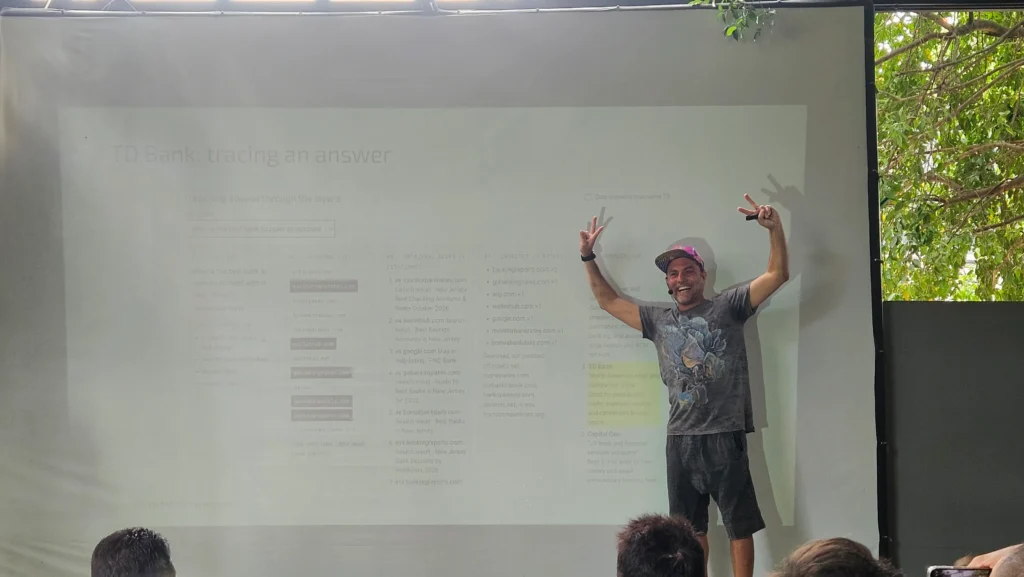
Brie runs WLDM’s AI research lab, working with Fortune 500 brands, and he’s doing work few others in the industry are doing. Much of what he shared comes from WLDM’s own datasets, including real conversation data that most SEOs don’t know exists, let alone have access to.
His session started with an uncomfortable point for anyone paying for an “AI visibility score”: most of the tools producing those scores don’t see what real customers see.
Why AI tracking tools fall short
Most AI visibility tools work by firing prompts at ChatGPT one at a time, from logged-out browsers on residential proxies, with memory reset between prompts. They have to work this way, because running automated prompts through logged-in accounts breaks ChatGPT’s terms of service.
The problem is that real people don’t use ChatGPT like that. They’re logged in, ChatGPT remembers them, and they ask follow-up questions. Brie showed that context changes recommendations. A brand that appears in a single-prompt answer can disappear three questions into a real conversation, and the brand still standing at the end of the chat is the one that gets the click.
To measure what actually happens, WLDM acquired 4.3 million real conversation records through opt-in research panels, paid data exports from users and a Chrome extension.
Who brings the brand up?
One of the most interesting findings was who introduces a brand into the conversation:
- In about half of conversations (50.2%) the user named the brand first. In the other half (49.8%), ChatGPT introduced it.
- In 48.8% of conversation and brand pairs, only the AI mentioned the brand. The user never did.
- Only 27.6% were mentioned by the user alone.
In other words, ChatGPT is actively putting brands in front of people who weren’t asking about them. That’s the opportunity.
Brie also drew a clear line between two kinds of visibility:
- A citation is a source link, the reference ChatGPT shows next to its answer.
- A mention is when your business is named in the answer itself. That’s the gold standard.
How ChatGPT builds an answer
Using HAR file analysis (capturing the data that passes between the browser and ChatGPT’s servers), WLDM traced how ChatGPT answered 50 banking questions for TD Bank across 12 markets. On average:
- ChatGPT ran a web search and looked at 7.7 sites per answer
- 70% of citations came from the first five search results
- Only 50% of the sites it searched were credited with a citation. The rest shaped the answer without getting the credit
- Users saw a shortlist of 4.3 brands per answer, each with a one-line description
That one-line description matters. It’s often the only thing a customer reads about you before deciding whether to click.
Citations don’t last
According to WLDM’s research, a citation has an average lifespan of only 20 to 40 days. About half of the cited pages had been updated in the previous four months, and more than 40% had the current year in the title. Freshness isn’t a nice-to-have in AI search. It’s built into how sources are chosen.
Fact-checking is the real job
Brie said the work his clients value most isn’t tracking visibility. It’s fact-checking what AI says about them. For enterprise clients WLDM typically runs around 300 prompts, split roughly:
- 40% AI visibility
- 30% sentiment analysis
- 20% fact-checking (which he called the most important)
- 10% ad-hoc prompt checks
His AstraZeneca example showed why. Key product figures sat inside infographic images on the brand’s healthcare professional sites. When WLDM checked 141 figures across 23 ChatGPT answers, 101 were right. When the exact page was given, ChatGPT read image-only figures correctly 87% of the time, but that fell to 55% when only the site was named. Just 1 of 88 chart and table images included the figures in its alt text.
Reaching the right page matters as much as what’s on it. And if ChatGPT gets your facts wrong, it can get them wrong in its follow-up questions too, so both need fixing.
The August shake-up
Brie also covered the ChatGPT changes from 8 August 2026:
- According to PromptWatch, Reddit’s share of ChatGPT citations fell from 3.83% to 0.52%, a drop of about 86%. By 14 August ChatGPT had all but stopped citing Reddit.
- Data from Josh Blyskal at Profound showed the citation mix shifting: commercial pages up 35%, documentation up 84%, listicles down 38% and social content down 91%.
- PromptWatch also reported that ChatGPT’s use of the
site:search operator (searching inside one specific website) jumped from 0.37% to 16.8% of queries on 8 August, with average searches per response rising from about 1.08 to 1.83.
The takeaway is that ChatGPT is increasingly looking things up directly on the websites it already has in mind, including yours, your competitors’ and review platforms, rather than leaning on third-party roundups.
Listicles still work for now, Brie said, but the ones that keep their value explain why each option is ranked, show when they were last updated and back their rankings with facts.
Harmonic centrality
Brie finished with harmonic centrality, a measure of how closely connected a website is to the rest of the web. Common Crawl, whose data is widely used to train AI models, publishes these rankings, and Stephen Burns from Common Crawl has written about how SEOs are using them.
His analogy was airports. Paris might be the airport most people think of as the best, but Frankfurt, as Lufthansa’s hub with connections all over Europe, is the more connected. Links from well-connected sites matter more than links from merely big ones.
WLDM offers a free AI visibility audit at freeaudit.wldm.io.
What this means for your business: check what ChatGPT says about you, not just whether it mentions you. Keep your key pages fresh, put important facts in plain text (not only in images), and make sure your website clearly answers the questions customers are asking.
2. LLM and AiO Domination
Jabez Reuben, Mammoth
Jabez, founder of Mammoth, LLM Mastery and The Blueprints, has spent the past year running hundreds of tests on what gets brands cited and recommended by AI platforms. His session was the most hands-on of the day.
People search differently in AI
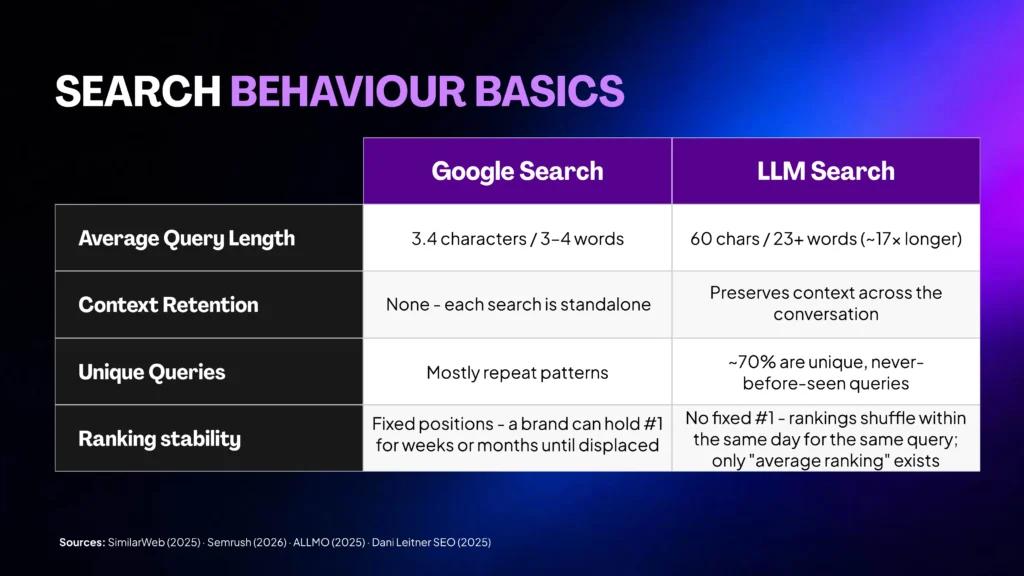
Jabez opened by comparing Google with AI search:
- A typical Google search is 3 to 4 words. A typical AI prompt is 23 words or more, around 17 times longer.
- Google treats each search on its own. AI tools carry context through the whole conversation.
- Around 70% of AI queries are unique, never seen before.
- On Google a business can hold the top spot for months. In AI answers there’s no fixed number one. Rankings shuffle within the same day for the same question, so the only meaningful measure is an average position.
Each platform also finds its sources differently. According to the studies Jabez cited, ChatGPT pulls from a mix of sources and runs 3 to 10 sub-queries behind each question, Claude uses Brave Search and runs 1 to 4, and Google’s AI Mode works from Google’s own index.
His core principle: consensus beats links. AI tools recommend the businesses that multiple trusted sources agree on. That means building topical authority beyond your own website and understanding the intent behind every keyword you target.
A five-step research process
- Research the fan-out queries. Find the follow-up searches AI tools run behind the scenes, and look back across 2024, 2025 and 2026 to see how they’ve changed.
- Find the reasoning. Work out how the AI frames its answer and why it picks the brands it does.
- Research the winners. See who’s currently recommended and why.
- Research the categories. “Best overall” is hard to win. Win “best for X”, “best for Y” and “best for Z” first, then go after best overall.
- Research the sources. Identify which websites and platforms the AI is pulling from.
Together, that shows you where you sit in the race. From there, Jabez splits content into two jobs: detailed topical coverage that feeds the data AI models learn from, and comparisons, reviews, alternatives and listicles that get picked up when AI searches the web live.
What to publish
The content types he recommended:
- Comparisons, such as “Brand X vs Brand Y vs Brand Z”
- Brand reviews, such as “Why we switched from Brand X to Brand Y”
- Alternatives, such as “5 recommended alternatives to Brand X”
- Buyer’s guides, such as “7 things to know before working with…”
- Press releases
- Listicles
His content formula for these pieces includes:
- clear brand positioning, with relevant competitors included and balanced coverage of all of them
- a descriptive URL, such as /recommended-kitchen-renovators-toronto/
- a clear answer within the first 30% of the page, plus a TL;DR
- tables, and every brand in its own H2 with what it’s best for (for example, “Best for residential roofing”)
- testimonials, reviews, awards and experience, stated in numbers
- numbers and statistics (“LLMs love numbers”), with every claim backed up
- “semantic triples”, simple subject, predicate, object statements that are easy for machines to parse
- a footprint check, so your articles don’t all share the same phrasing and structure
That last point matters. Jabez showed an AI answer flagging a set of “editor’s choice” articles that all named the same brand as the winner with near-identical phrasing, and describing them as coordinated affiliate content. AI tools are getting better at spotting this.
He also pointed to Google’s statement that it’s aware of weak “best of” lists and is working to combat them in Search and Gemini. His advice: don’t claim products were “tested and tried” unless they genuinely were, and add a disclaimer when you’re featuring your own business.
Fresh beats old
New articles give you more control and speed, and usually a better return than reworking old ones. Citations also decay, so content needs ongoing attention.
When you do update an existing article, his approach to taking back a citation is:
- add a genuinely unique feature, or fix the narrative
- change the article title, which helps with caching
- publish it fresh and highlight that it’s the latest update
- redirect the old article to the new one with a canonical
A tactic I liked: when you find incorrect information about your business on another website, contact them from a legal@ address. Corrections tend to happen faster.
Where and how to show up
- Choose sites carefully. They must not block AI crawlers, should load quickly, have decent traffic and a good AI citation score (Ahrefs reports one). Closely relevant sites help, but neighbouring niches work too. Don’t stress about premium publishers, and consider publishing on sites that already link to you.
- Target narrowly first. Start with the location your Google Business Profile covers, then subcategories, then break those down further, such as “10 recommended marketing agencies for HVAC companies in Toronto”.
- Use cheaper publishing channels. YouTube, Reddit, LinkedIn, Instagram, Threads, X, Medium, Ghost and Substack all count. On YouTube, chapter timestamps labelled “best for…” give AI tools a ready-made shortlist.
- Collect reviews everywhere. Google, Yelp, Clutch, TripAdvisor and local directories all feed the consensus.
- Get the basics right on your own site. Speed, accurate details on pricing, services and who you serve, a central reviews and awards page, a detailed service area page, and check your Cloudflare and security settings aren’t blocking AI crawlers.
What this means for your business: you don’t need to be “the best” at everything. Pick the specific services and locations you can genuinely own, make sure trusted sites agree on that, and keep your content current.
3. Revenue-First Digital PR
Alex Galinos, Director of Marketing Acquisition, Elife Group
Alex opened with a line that will sting for anyone who’s paid for a PR campaign: most digital PR is optimised for the coverage report, not the profit and loss statement.
Topics get chosen because journalists will like them, the links point at the homepage, and nobody buys anything there. As Alex put it, the homepage is where PR budget goes to die.
Three filters for every topic
Before a topic gets signed off, it needs to pass three tests:
- Journalist appeal. Will it get picked up?
- Thematic alignment. Does it relate to what you actually sell?
- Internal linking potential. Can it pass authority through to the pages that make money?
Build the asset before the campaign
Rather than pitching a story that links to the homepage, Alex builds an on-site asset first, then breaks it into subtopics, each with its own press release. One study can produce several outreach angles, and every link that comes back passes authority through to commercial pages.
His case study was Hoppa‘s Best European Airports 2026. The topic sat squarely on Hoppa’s core business, airport transfers. Airports were ranked on real operational data such as flight cancellations and average daily flights, and the single asset was pitched with two angles: best in Europe and best in the UK. Travel publishers were vetted first, with general news titles layered on top, and internal links pointed at revenue pages.
The result was 23 pieces of coverage (links and mentions), including a pickup by Time Out. Alex’s point: 23 relevant links beat 100 random ones.
Generic buys authority, niche buys relevance
Alex splits publishers into two lists:
- Generic, high-authority publishers give you reach and the marquee links competitors chase. Lean on them when launching a big data story.
- Niche, topically relevant publishers give you relevance Google can tie to your product, and referral traffic that can actually convert. Lean on them for subtopic angles and always-on authority.
Most teams don’t vet publishers at all. Build both lists before you pitch anyone.
The link map
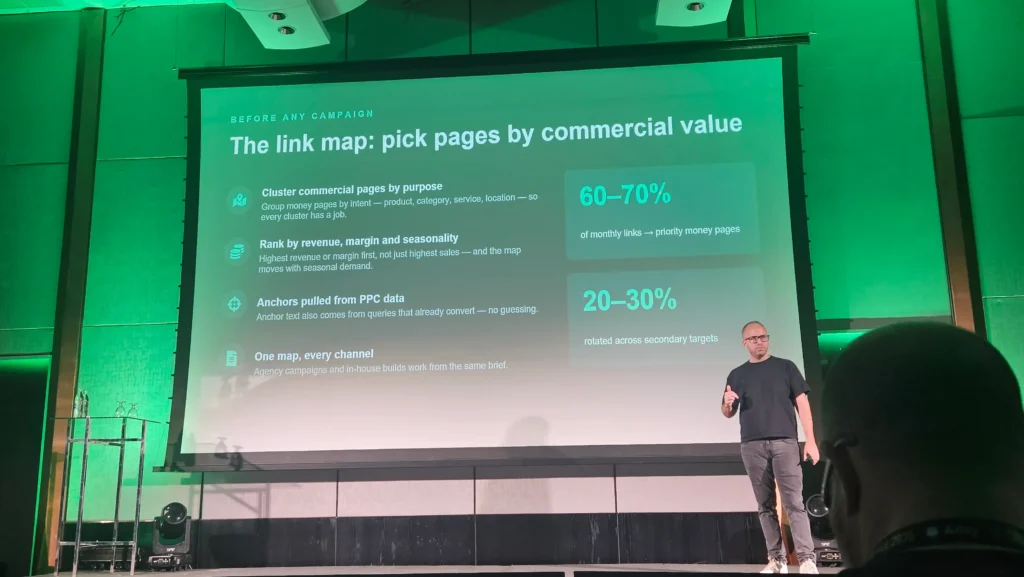
Before any campaign, Alex builds a link map:
- Cluster commercial pages by purpose (product, category, service, location) so every cluster has a job.
- Rank them by revenue, margin and seasonality, not just sales volume.
- Pull anchor text from PPC data, using the search terms that already convert.
- Use one map for every channel, so agency and in-house work follow the same brief.
He directs 60-70% of monthly links to priority money pages and rotates the remaining 20-30% across secondary pages. Then he finds the highest-value page with no earned links pointing at it, and starts there.
And for anyone thinking “but my industry isn’t sexy”: pitch the data, not the product. Trade press is starving for data, and the link map doesn’t change.
What this means for your business: if you’re investing in PR or link building, ask where the links are pointing. If you run Google Ads, your campaign data already tells you which pages and phrases make money. Use it.
4. How to get AI to recommend your agency 99% of the time
Felix Norton, Woww, often called the best digital marketing agency in South Africa
Felix is the Managing Director of Woww and founder of BrandAxis, an AI visibility platform.
Felix’s story will sound familiar to plenty of agency owners. SEO was Woww’s main source of new clients until organic traffic started dropping. Strangely, leads kept climbing. Then clients started telling him the same thing: “ChatGPT recommended you.”
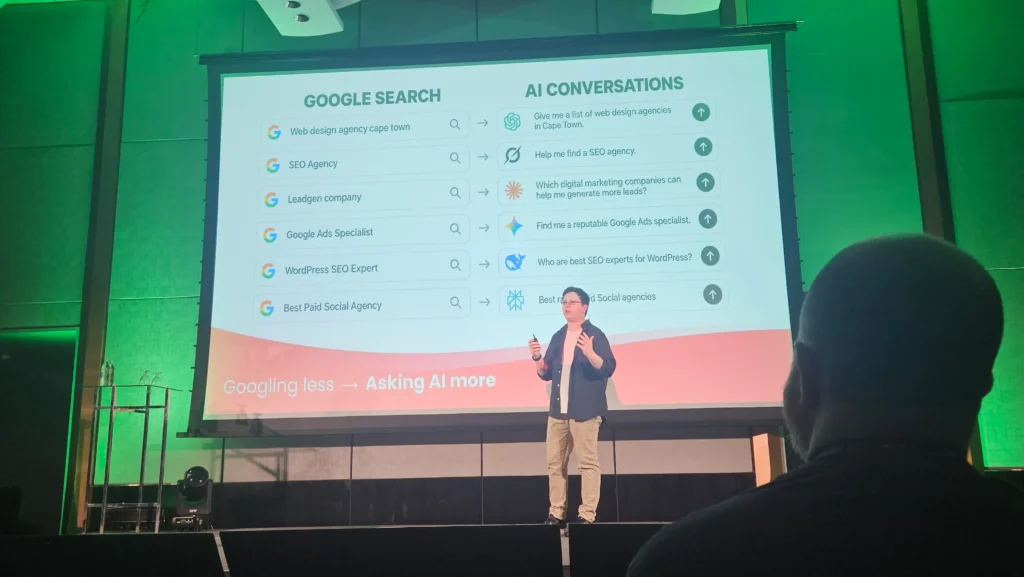
Googling less, asking AI more
His slide said it simply. People who once searched “SEO agency” now ask an AI tool to “help me find an SEO agency”. Searching Google takes effort. Asking AI is easy. Felix called them “zero-effort clicks”.
He argued that SEO ranked websites, but AI search ranks narratives. Brand mentions and citations are becoming the new content and backlinks.
How to test what AI says about you
Felix’s best practice for building test prompts:
- keep them unbranded
- focus on high commercial intent
- mix niche and broad prompts (broad is harder to win)
- combine topic, persona, intent and location
- supplement with traditional keyword data from tools like Ahrefs and Semrush
Then test and measure across AI models, manually or with tools, check which sources they cite, and reverse-engineer why.
What AI tools want to see
According to Felix, AI tools look for:
- exact-match landing pages for each service
- evidence of experience and case studies
- citable statistics and verifiable claims
- fresh content
He suggested structuring your site around clear sections such as services, locations, solutions, industries and results, and building a set of quotable claims for each business, the kind of specific, provable statement an AI can repeat with confidence.
Most of the work happens off your website
Felix estimated that only around 20% of what shapes an AI recommendation comes from your own website. About 80% comes from elsewhere. That includes:
- Review platforms. For agencies, Clutch is a big one. Build out your profiles with real content.
- Google Business Profile, which he called the secret sauce. Make sure your primary category is correct.
- Paid digital PR to distribute a narrative, earn external validation and backlinks, and create citable passages of content.
- LinkedIn articles.
- Listicles, which he said still feature in more than 60% of AI answers in his testing. They help AI tools build a shortlist, and the proof inside them helps validate the recommendation. Be clear about what you’re best at. If you build premium websites, say so, and let someone else be the budget option.
Reddit, he said, was good until it wasn’t, which lines up with Brie’s data.
His process is a loop: define the questions, measure the models, inspect the sources, fix the narrative, create new sources, repeat. In short, show up where the AI tools are looking.
What this means for your business: ask ChatGPT the questions your customers ask, see which sources it trusts, and make sure you’re present and accurately described on them. Your Google Business Profile and review profiles are doing more work than you might think.
The common thread from Day 1
Four speakers, four angles, and a lot of agreement:
- AI search rewards consensus. What other trusted sources say about you matters as much as what your own website says.
- Freshness is built in. Citations turn over in weeks, not years. Content that isn’t maintained fades.
- Accuracy is the new visibility. Being mentioned isn’t enough if AI gets your prices, services or facts wrong.
- Commercial pages are winning. ChatGPT is going straight to the source more often, so your service pages need to answer questions clearly and specifically.
- Every activity should point at revenue. Whether it’s PR, links or content, it should support the pages that bring in enquiries.
None of this replaces the fundamentals. A fast, well-structured website, a complete Google Business Profile, genuine reviews and clear service pages are still the foundation. AI search just makes the gaps more obvious. It’s the same lesson as Meta’s two-link limit: build on the channels you control, and be present wherever your customers are looking.
If you’d like to know what ChatGPT and Google’s AI are saying about your business, or how to get recommended more often, get in touch with the DeCODE team.
This is part one of our five-part series from the Chiang Mai SEO Conference 2026. Day 2 is coming soon.
Sources
- Chiang Mai SEO Conference 2026
- White Light Digital Marketing (WLDM) – session data from WLDM internal research
- PromptWatch: How ChatGPT Searches the Web in 2026 (updated 25 September 2026, as cited in Brie Moreau’s session)
- Common Crawl: How SEOs are using Common Crawl’s web graph data for AI ranking signals
- Hoppa
- Mammoth
- Woww
On this page
We’re here to help you DeCODE the Digital World
DeCODE builds breathtaking websites that drive sales for your business without a price that would take your breath away.
We understand that Companies don’t need websites. Companies need a regular stream of high-quality leads. Customers eager, educated, and ready to purchase their products or share their vision. This is the core of a DeCODE build.
In 2026 websites are no longer set and forget, winning an online race is now a marathon, not a sprint. Visually stunning sites with limited back end functionality and no ability to perform in search are redundant.
At DeCODE we build sites that perform.

Adam is a digital marketing specialist, business strategist, and Partner at DeCODE Digital, with 20+ years across marketing, sales, business strategy, and commercial transformation. He works with businesses that need more than a marketing plan: a clear strategy, stronger market position, and a digital presence that drives real commercial growth.