
SEO & AI Search
Chiang Mai SEO Conference 2026, Day 3:
One deep-dive session on Google's TurboQuant, Wikidata, schema and how ChatGPT builds an answer, plus what it all means for Australian businesses.
Chiang Mai SEO Conference 2026, Day 3: TurboQuant, Wikidata and Making Life Easy for AI
Our Day 3 recap from the Chiang Mai SEO Conference 2026: what Google's TurboQuant is, why only one in 383 web pages links to Wikidata, how ChatGPT builds an answer behind the scenes, and what it means for 2027.
Created: November 12, 2026 | Reading Time: 22 minutes


Day 3 of the Chiang Mai SEO Conference 2026 was all about one session, and it was the most technical of the week so far. Where Day 1 covered what AI search rewards and Day 2 covered how AI tools find and choose their sources, Day 3 went under the bonnet: how the machines store what they read, how they work out what your page is actually about, and what happens in the seconds between a question and an answer.
The talk jumped around a fair bit, so I’ve done some reading afterwards to fill the gaps, including Google’s own research papers. Where I’ve added to what was said on stage, I’ve said so.
The message of the day: AI tools can now afford to look much further than page one, so the businesses that win will be the ones that are easiest to discover, understand, cross-check and recommend.
Inside TurboQuant: what a 127 billion data point schema study says about the future of search
Brie Moreau, White Light Digital Marketing (WLDM)
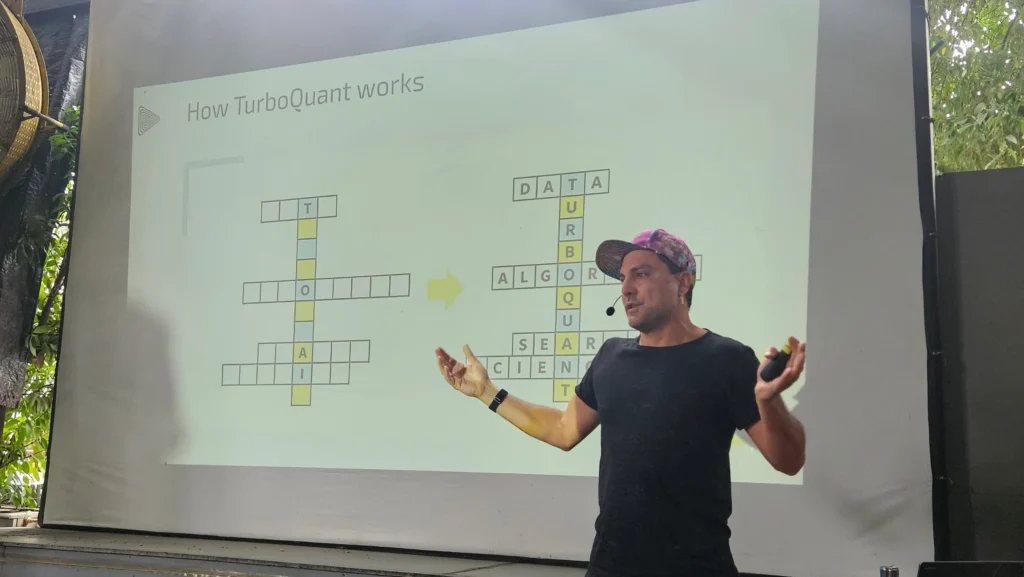
This was Brie’s third session in three days, again at one of the conference’s community events, and it pulled together threads from the first two.
What TurboQuant is
TurboQuant is a compression method published by Google Research. The paper first appeared in April 2025, and Google announced it publicly on its research blog on 24 March 2026. Memory chip shares sold off on the news, which tells you how the market read it. As the session description put it, the market recognised its significance immediately and most SEOs still haven’t.
Here’s the problem it solves, in plain terms.
AI models don’t store words. They store meaning as long lists of numbers called vectors. Every passage a model reads, and everything it’s holding in mind during a conversation, is a pile of these vectors. That working memory (engineers call it the key-value cache) grows with every extra page read and every extra turn in the conversation, and it gets expensive quickly. Memory, more than raw intelligence, is one of the things that limits how much an AI can read and consider before it answers.
The obvious fix is to compress the numbers. The catch is that traditional compression needs to store a small set of instructions alongside every block of data, explaining how to read it back. Google’s post says that overhead can add one or two extra bits per number, which eats into the saving you were trying to make.
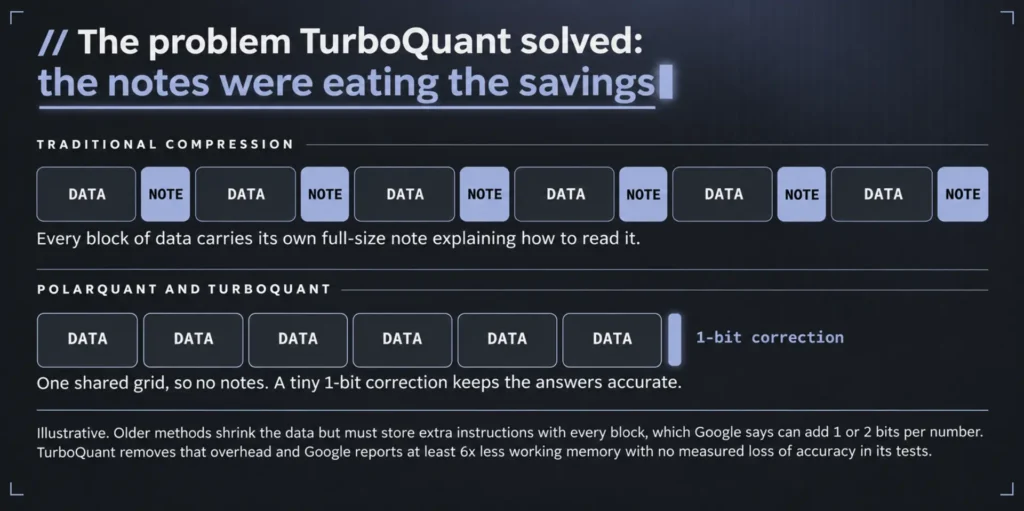
TurboQuant removes that overhead. Google reports it shrinks that working memory by at least six times, down to about three bits per number, with no measurable loss of accuracy on its benchmarks, and speeds up some calculations by up to eight times. It applies the same trick to vector search, which is the technology behind finding the most relevant passages in a very large index.
PolarQuant: the maths behind it
TurboQuant works in two steps, and the first is a method called PolarQuant.
Brie’s point here was that this all happens in a space with far too many dimensions for anyone to picture, so analogies are the only way in. His was that the old approach is like travelling point to point to point, while the new one draws a map and takes an efficient route from start to finish.
Google’s own analogy is the one that made it click for me. The usual way to describe a location is street directions: go three blocks east, then four blocks north. PolarQuant describes the same place as a distance and a direction: go five blocks at a certain angle.
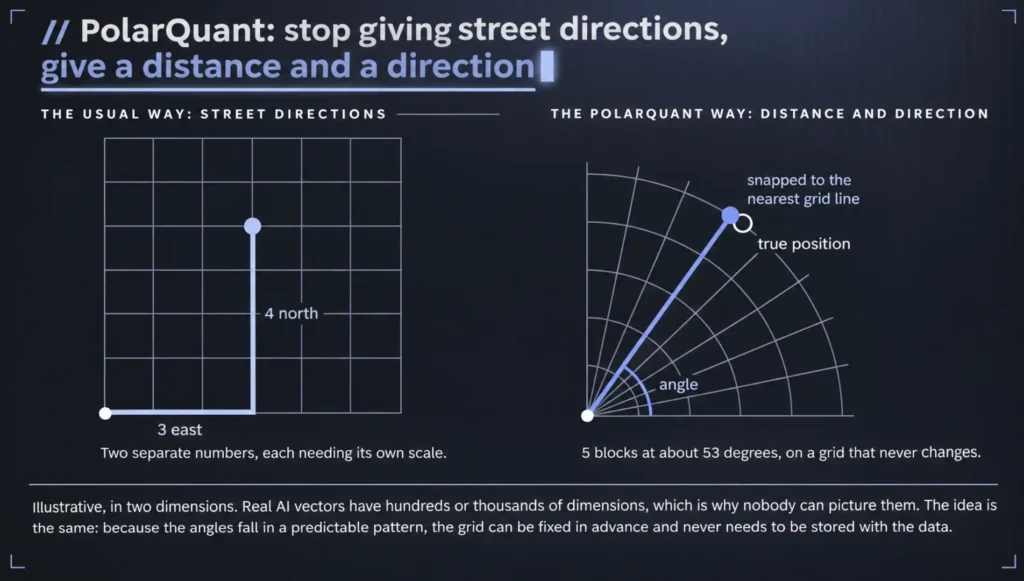
Why does that help? Before converting, PolarQuant gives the data a random spin. After that spin, the angles fall into a very predictable pattern, so they can be rounded onto a fixed, circular grid that is known in advance. Because everyone already knows the grid, there’s nothing extra to store with each block. The instructions that used to eat the savings are gone.
The second step is a one-bit error check. Rounding introduces small errors, so TurboQuant adds a single extra bit per value that corrects the bias. The result is that when the model compares two pieces of content to see how closely related they are, it gets very nearly the same answer it would have got from the uncompressed data.
Two honest caveats from my reading:
- It’s a storage breakthrough, not a new ranking system. TurboQuant doesn’t decide what’s relevant. It makes the existing way of measuring relevance far cheaper to run.
- “Zero loss” is Google’s result on Google’s tests. An independent study by the vLLM project found the gentler settings stayed within a point or two of the original, while the most aggressive settings lost real accuracy. It bends answers slightly. The saving is large enough that the trade is worth making.
Where harmonic centrality fits
On Day 2, Stephen Burns from Common Crawl explained harmonic centrality: a measure of how few steps your website is from the core of the web. I went looking for a technical link between that and TurboQuant, and there isn’t a direct one. They’re different maths solving different problems. But they sit side by side in a useful way, because both are measures of closeness.
- Harmonic centrality is closeness in links. How close is your site to the trusted centre of the web? That influences whether you’re crawled and included in the data AI models learn from.
- Vectors are closeness in meaning. How close is your passage to the question being asked? That influences whether you’re pulled out and used in an answer.
TurboQuant makes the second kind of closeness cheap enough to check across far more content. So the two ideas stack: one helps get you into the library, the other helps get you off the shelf.
Why this matters for search
Who is using it? TurboQuant is published research, and Tether has publicly released an open-source implementation in its own AI software. Google’s post names its Gemini models and “semantic search at Google’s scale” as applications. Beyond that, nobody has confirmed anything. Brie’s view is that the logic is too useful for the other major AI companies to ignore, ChatGPT included. That’s a reasonable assumption, and it is still an assumption.
His evidence for the effect on search was a change in Google’s AI Overviews. In mid-2025, Ahrefs found about 76% of the pages cited in AI Overviews also ranked in Google’s top 10. By early 2026 that had fallen to 38%. Brie’s reading is that cheaper memory lets the AI search deeper and faster, so it no longer needs to lean on page one.
A caveat here too. Ahrefs itself puts the drop down to Google’s move to a newer Gemini model and to the AI running more of its own follow-up searches, and notes that its measurement method also changed. TurboQuant isn’t mentioned. These explanations aren’t in conflict. Cheaper memory is exactly what makes it affordable to run more searches and read more pages. But the direct link is Brie’s interpretation.
Whichever way you slice it, the direction matches what Manick Bhan showed on Day 2 with the Dark SERP: AI is reading well beyond the first page of results.
The practical consequence: if a machine can afford to consider far more pages, being on page one matters less, and being easy to understand matters more. Which brings us to the second half of the talk.
Wikidata: Wikipedia for LLMs
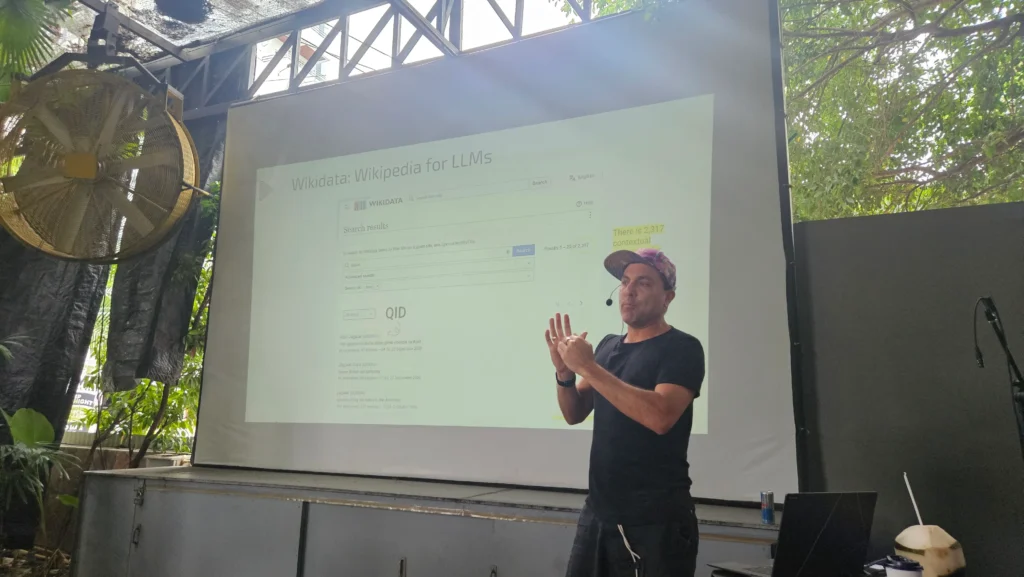
Efficient retrieval only helps if the machine knows what your content means. Brie’s example was the word “jaguar”. Search Wikidata for it and you get 2,317 results, including the car company, the big cat and an Atari games console.
Wikidata is Wikipedia’s sister project, a free structured database of facts. Every “thing” in it, whether a person, place, company or concept, has a unique ID called a QID. Brie called it Wikipedia for LLMs, and showed a decade of AI research using it for exactly this job: OpenAI used Wikidata in 2018 to train a system that tells similar entities apart, and Google Research, Amazon’s Alexa team and Stanford have all published work using it to ground language models in facts. His short version: Wikidata significantly decreases hallucinations.
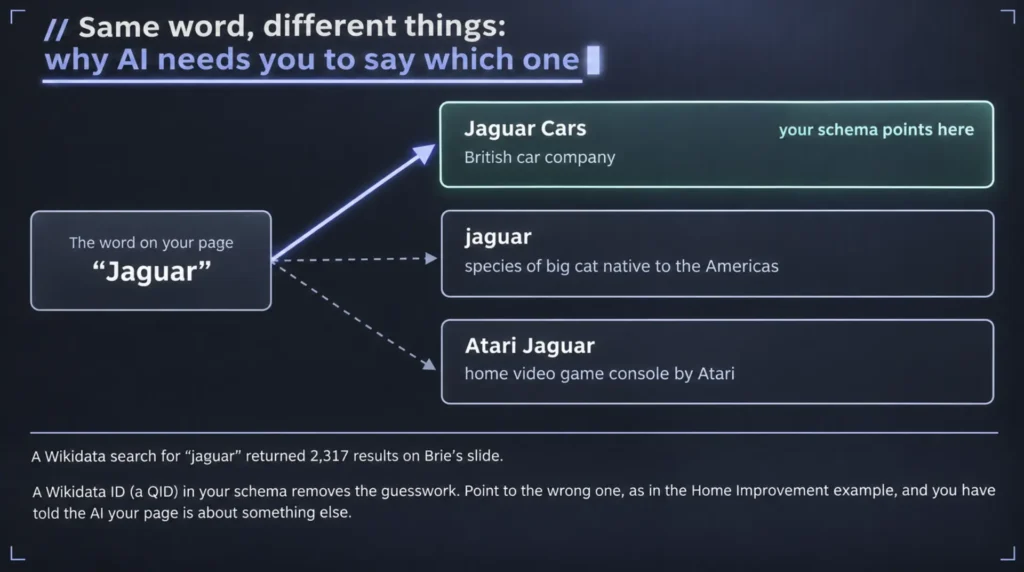
For a website, the way to use this is through schema markup, the structured data in your page’s code that describes what the page is about. Standard Schema.org markup can include a link to the matching Wikidata entry, which says to any machine reading the page: when we say Jaguar, we mean this one.
In code, it’s a small addition:
{
  "@context": "https://schema.org",
  "@type": "WebPage",
  "about": {
    "@type": "Thing",
    "name": "Solar panel",
    "sameAs": "https://www.wikidata.org/wiki/Q774583"
  }
}
Q774583 is Wikidata’s entry for a solar panel. Even here there’s a choice to make. Wikidata has a separate entry for a photovoltaic module (Q217941), and another for photovoltaics as a technology (Q192127). Picking the entry that matches what your page is really about is the whole job.
I think of it as leaving CliffsNotes through your website. The AI can still read every word, but you’ve handed it a verified summary of what each page is about, which makes you quicker and cheaper to cross-check.
The 127 billion data point study
To see how ready the web is, WLDM’s AI Research Lab ran one of the largest Schema.org studies undertaken: 14.78 billion pages analysed, 606.9 terabytes of web data processed and more than 127 billion schema data points extracted.
Partway through the project, in June 2026, Schema.org and Google released their own public dataset showing how widely each schema type is used. Brie’s slide title was “Google stole our Schema data study”, followed quickly by “Kidding!”. It gave WLDM something to check their work against, and the two lined up:
- Google’s dataset listed 958 schema types in use. WLDM’s independent extraction confirmed 905 of them.
- All 47 of the most widely adopted types appeared in both.
- Most schema types are barely used. 485 of the 958 appear on fewer than 1,000 websites.
Brie’s interpretation is that Google publishing this is a nudge. It wants the web using this vocabulary because structured, unambiguous content is easier for its systems to work with.
Then the number that stopped the room.
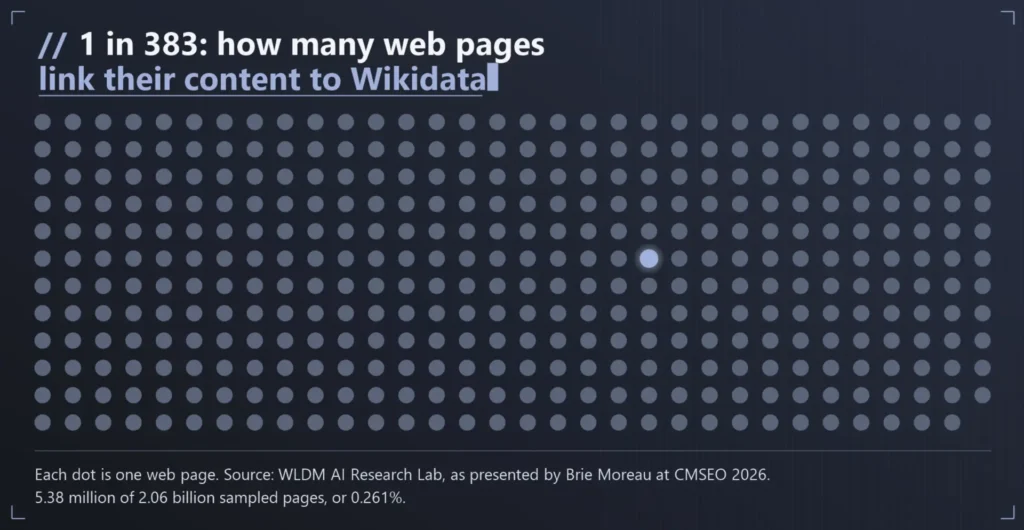
Across 2.06 billion sampled pages, only 5.38 million carried a link to Wikidata. That’s 0.261%, or one page in every 383.
A side note Brie shared with a grin: the analysis was first costed at around US$50,000 and nine days of computing, and his team got it down to about US$2,000. He also admitted you could reach much the same conclusions from a far smaller sample. It’s just more impressive with a big one.
When the schema is wrong
Having schema isn’t the same as having useful schema. Two examples from WLDM’s audits made the point.
The first was a large site with 71,433 URLs crawled, where 99.5% of indexable pages carried structured data. Impressive, until you look closer. Only 21 schema types were in use across the whole site, and nine of them were the same static brand block repeated on almost every page. Not one page had earned a rich result feature, and just 1.9% of indexable pages received any organic traffic.
The second was a client more advanced than most, in that they’d already added Wikidata links. Their schema pointed to “home improvement”. Unfortunately, the Wikidata entry it pointed to was Home Improvement, the 1990s TV sitcom, not the thing you do to your house.
That’s worse than having nothing. The site was telling every machine that read it, in the most authoritative way available, that its pages were about a television show.
How WLDM does it
Brie walked through his team’s process on large sites:
- Start with the top 1,000 pages by traffic.
- Extract the entities from each page, meaning the people, places, products and concepts it mentions, and validate them.
- Map each one against Wikidata and find the defining terms.
- Add the correct data back to the page as schema.
- Check three things agree: what the page says, what the schema says, and what Wikidata says.
For a small or medium Australian business, the top 1,000 pages is more realistically your top 10 or 20. Start there.
He was upfront that he can’t share results yet. These are large clients and several projects are still rolling out. The early signs are positive, and nobody is claiming it’s the one thing that drives results.
For tooling, Brie recommended WordLift, founded by Andrea Volpini, as a good option for businesses that aren’t enterprise-sized. He also noted that e-commerce is furthest ahead on this, particularly for identifying products, and expects it to flow through to the rest of the web. With only one page in 383 doing it today, there’s a real first-mover advantage for anyone who gets it right.
What this means for your business: check that your schema says what you think it says. Then, on your most important pages, look at linking the key things you talk about to their Wikidata entries. Accuracy matters more than volume. One wrong link does more damage than no link at all.
Inside the answer: five layers
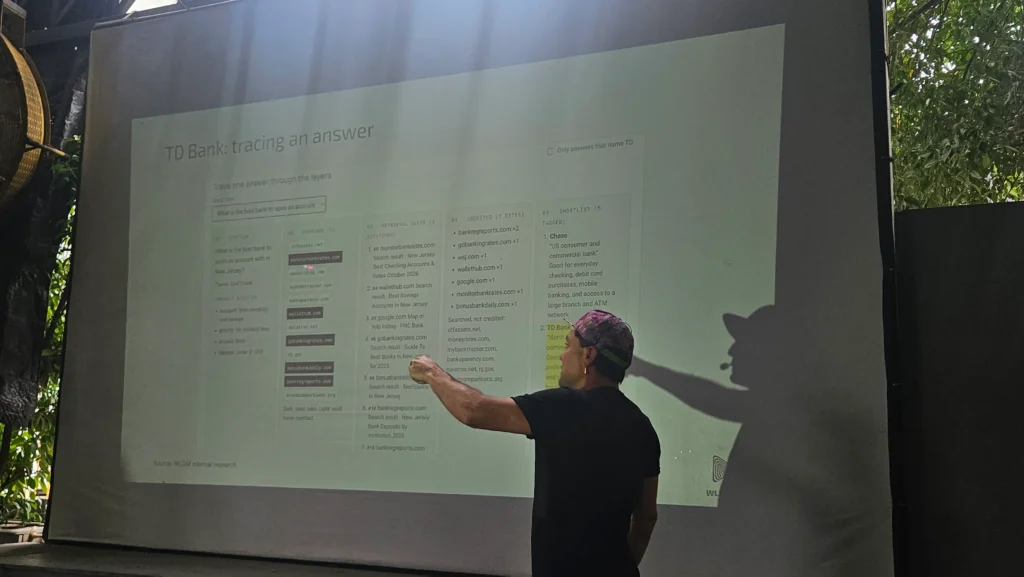
The second half of the session returned to something Brie has been building all week: looking inside ChatGPT’s answers using HAR files. A HAR (HTTP Archive) file is a recording of everything a web browser sends and receives. Capture one while ChatGPT answers a question and you can see the searches it ran, the pages it retrieved and which ones it used.
His worked example was TD Bank, a large North American bank, across 50 banking questions.
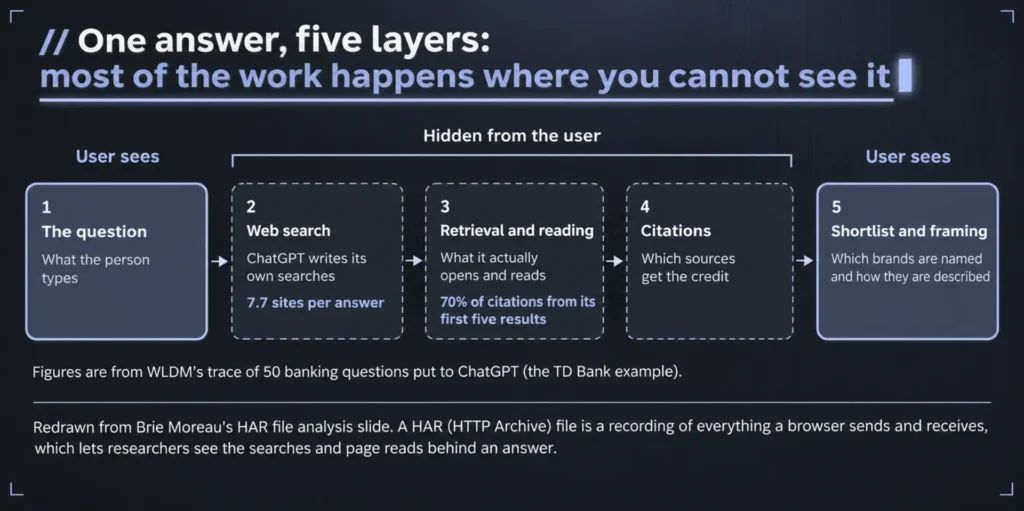
The user sees the first layer and the last. The three in the middle are hidden. In the TD Bank data:
- ChatGPT pulled back an average of 7.7 websites per answer, and 155 different sites across the 50 questions. It writes its own searches and then works only from what comes back.
- 70% of citations came from the first five results of those searches.
- In one traced answer, 12 sites were searched. Five went on to be cited. The other seven were read and never credited.
That last point connects to something that has come up in conversation all week. I can’t point to a study for it, so treat it as anecdotal, but the logic holds. Being retrieved is only round one. An AI isn’t going to pass on something that conflicts with its other sources, or that can easily be shown to be wrong. These models also need to be computationally efficient, and it’s quicker and cheaper to drop a doubtful source than to work out who’s right. If that’s your page, you’re out before the shortlist is written, and you’ll never know you were considered.
AI reads more of the page than you think
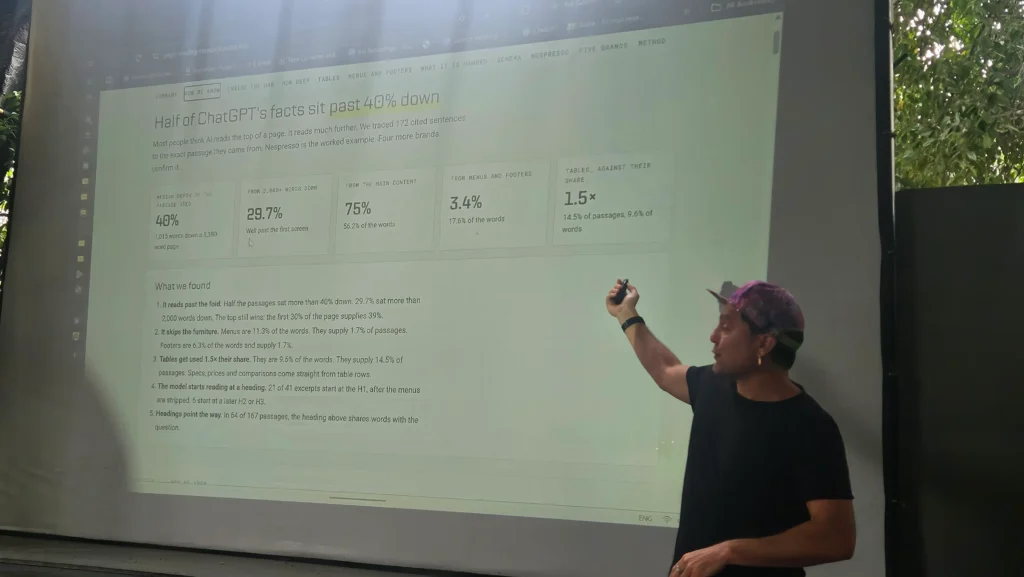
WLDM also traced 172 sentences in ChatGPT’s answers back to the exact passage they came from. The assumption that AI only reads the top of a page didn’t hold:
- Half the facts sat more than 40% of the way down the page, and nearly 30% came from more than 2,000 words in.
- The top still does well. The first 30% of the page supplied 39% of the passages.
- It skips the furniture. Menus and footers made up 17.6% of the words and supplied 3.4% of the passages.
- Tables punch above their weight, supplying 1.5 times their share. Specs, prices and comparisons were lifted straight from table rows.
- Headings point the way. In 64 of 167 passages, the heading above shared words with the question.
That’s consistent with Manick Bhan’s finding on Day 2 that position on the page made no difference to being cited.
Fan-out and the next question
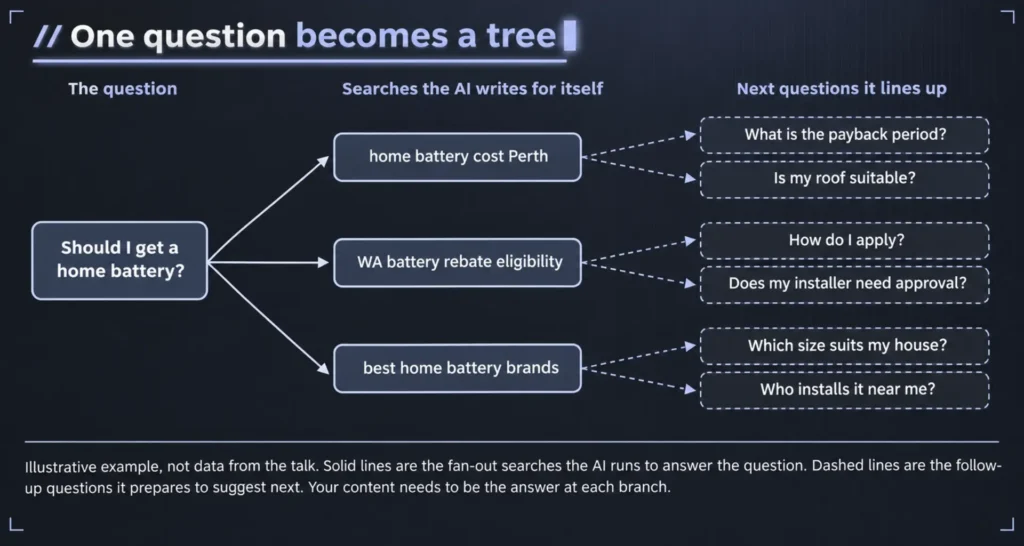
We’ve covered query fan-out already this week: the AI breaks your question into several searches of its own. Brie added a layer. ChatGPT is now also preparing the next questions, the suggested follow-ups you see at the end of an answer.
He likened it to how Spotify made its service feel instant and personal by working out which songs you were most likely to play next and getting them ready in advance.
For a business, the takeaway is that a customer’s journey through an AI conversation is a tree, and it branches quickly even for simple topics. You want to be the answer at each branch. That’s a different exercise from keyword research. Brie’s question for the room: which questions are your customers asking on their way to a purchase? Use those, not just your SEO keywords.
What real conversations show
Brie has been working with a dataset of real ChatGPT conversations all week, and this session added a newer batch. A few findings:
Context changes the recommendation. WLDM compared what ChatGPT recommended mid-conversation with what it recommended when the same question was asked cold. The brands named sometimes matched. The sources cited rarely did, overlapping by between 0% and 40%.
That matters because most AI visibility tools test with isolated, logged-out prompts and a memory that resets every time. Real people have long conversations with context. As we covered on Day 1, those tools are the best the industry has, and they’re a rough guide at most.
People aren’t always asking what you’d expect. In Brie’s data, around half the conversations involving AstraZeneca were about investing: is it a good buy, what are the risks. That’s a job for the investor relations team, not the product marketers. And about 40% of conversations involving Sephora came from influencers creating content about the brand, not shoppers.
Format matters as much as content. Brie’s AstraZeneca example went further. Its site for medical professionals communicates largely through infographics. An AI can’t reliably read an infographic, so it does its best and can get things wrong. It’s a good reminder that if important information on your website only exists inside an image, a machine may misread it or miss it entirely.
As someone who is currently rereading Dan Ariely’s Predictably Irrational, I find this dataset fascinating. Real conversations, combined with the ability to see what the AI retrieved along the way, is a rare window into how people make decisions and how these systems shape them. Brie’s question to the audience was what we’d want to know from it. I have a list.
The August update: Reddit drops out
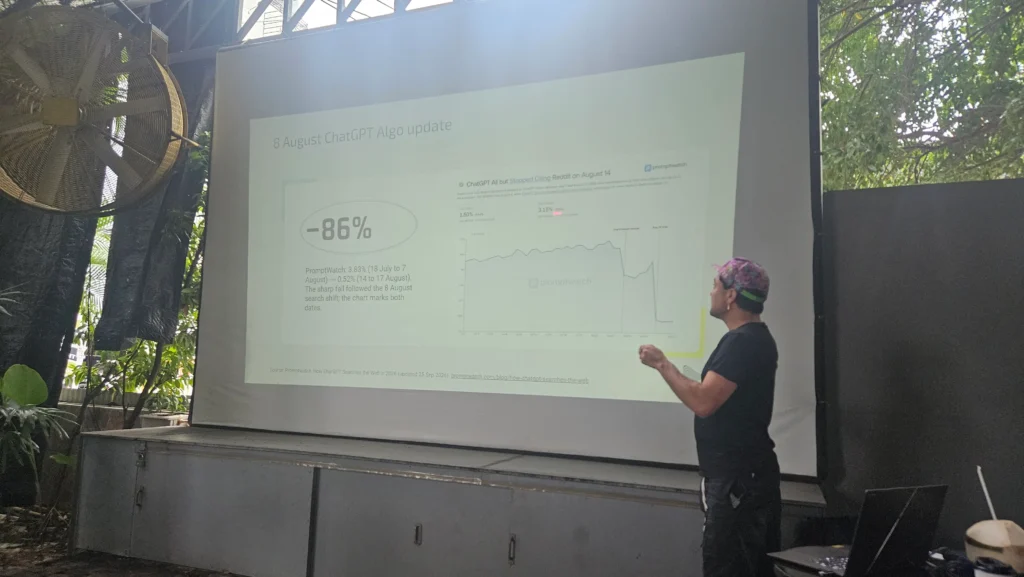
Brie closed with a change that shows how quickly the ground can move. Around 8 August 2026, ChatGPT changed how it searches, and within a week it had all but stopped citing Reddit.
According to Promptwatch, Reddit’s share of ChatGPT citations fell from 3.83% to 0.52%, a drop of 86%. On 8 August, the share of ChatGPT’s searches that look inside one specific website jumped from 0.37% to 16.8%. In other words, ChatGPT started going straight to the sites it already had in mind, such as official websites and documentation.
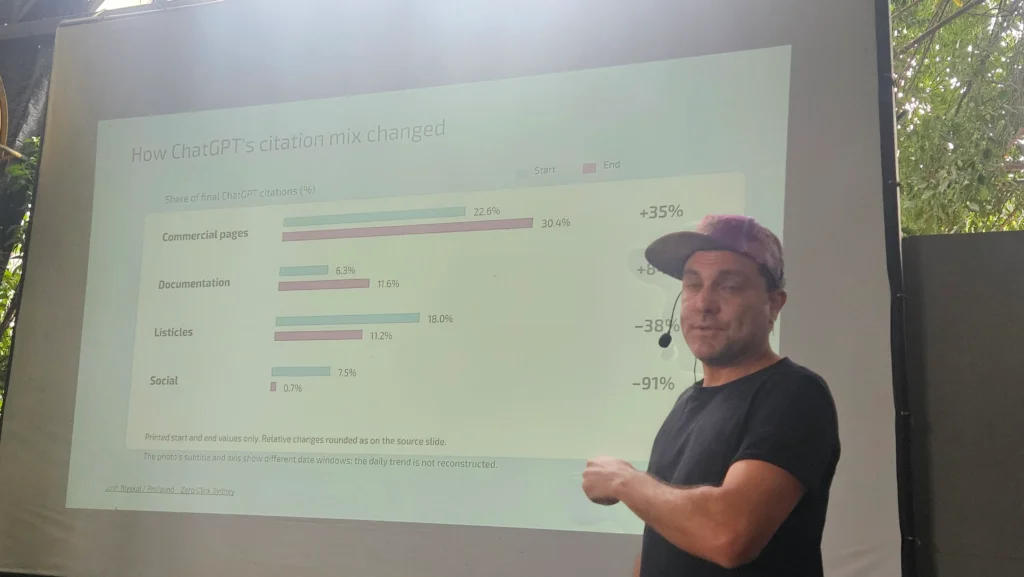
Data from Josh Blyskal at Profound showed the wider shift in what ChatGPT cites:
- Commercial pages: 22.6% to 30.4%
- Documentation: 6.3% to 11.6%
- Listicles: 18.0% to 11.2%
- Social: 7.5% to 0.7%
OpenAI hasn’t explained the change. My read is that Reddit became a victim of its own value. For years it was a rare thing online: genuine human conversation, date-stamped, at enormous scale. Once marketers worked out how much the AI models leaned on it, it filled up with planted posts and AI-written content, and the trust drained away.
Two things follow. Listicles, the tactic of the moment on Days 1 and 2, are already worth less. And your own website just became more important, because that’s where ChatGPT is now looking first.
Before any of this: the training data
One last link back to Day 2. Everything above happens after the model is built. Stephen Burns’ point about Common Crawl still stands: the models learn from a crawl of the web before they ever run a search. If your business is in that data, the model starts with some idea of who you are and what you do. It has to be easier to be found by something that already knows you exist.
What this means for 2027
Brie’s summary of where this is going: the sport for 2027 is making it as easy and efficient as possible for search engines and AI tools to discover you, understand you, cross-check you and then recommend you.
For me that’s the core takeaway from the whole week so far. It’s also not something we can measure precisely yet. The tools aren’t there, the models behave differently at different reasoning levels, and the answers change from one run to the next. For a while, this will be about judgement more than dashboards. We know roughly where north is. The seas are rough and the heading won’t be perfect, but the businesses that keep steering towards it will end up a long way ahead of those waiting for a perfect map.
That matters more than usual right now. Australian businesses are dealing with a tough economy, rising costs and more expensive advertising, at the same time as there are fewer customers in the market. It’s the worst moment to be pouring more money into ads to stand still. Being the business that AI tools find, trust and recommend is one of the few advantages that doesn’t cost more every month.
The common thread from Day 3
- AI can afford to read more. Compression like TurboQuant makes it cheaper for machines to look well beyond page one.
- Being understood is the new battleground. Schema tells machines what your page is about. A Wikidata link tells them exactly which thing you mean.
- Almost nobody is doing it. One page in 383 links to Wikidata.
- Wrong is worse than missing. Check your schema before you add more of it.
- Most of the answer is built out of sight. Searches, reading and choosing all happen before the user sees a word.
- Think in questions, not keywords. Map what your customers ask on the way to buying, and be the answer at each step.
- Your own website is back in the spotlight. ChatGPT is searching inside specific sites far more, and citing Reddit and listicles far less.
- Tips and tricks won’t carry 2027. The tactics shift month to month. Clear, accurate, verifiable information holds.
None of this needs an enterprise budget. A small business with ten well-built pages, accurate schema and clear answers to real customer questions is better placed than a big one with thousands of pages nobody has checked.
If you’d like to know what your website is telling AI about your business, get in touch with the DeCODE team.
This is part three of our five-part series from the Chiang Mai SEO Conference 2026. Read Day 1 and Day 2. Day 4 is coming soon.
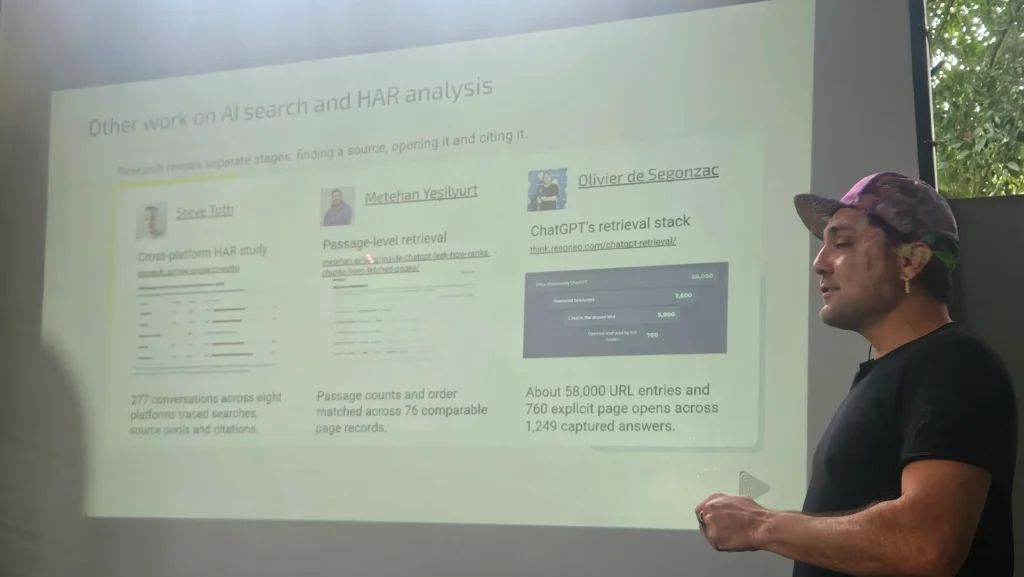
Want to go deeper on HAR analysis? Brie pointed to three people doing interesting work in this space: Steve Toth, Metehan Yeşilyurt and Olivier de Segonzac.
Sources
- Chiang Mai SEO Conference 2026
- White Light Digital Marketing (WLDM) – session data from WLDM’s AI Research Lab
- Google Research: TurboQuant – Redefining AI efficiency with extreme compression
- TurboQuant: Online Vector Quantization with Near-optimal Distortion Rate (research paper)
- PolarQuant: Quantizing KV Caches with Polar Transformation (research paper)
- vLLM: A First Comprehensive Study of TurboQuant
- Tether: QVAC SDK update bringing TurboQuant to everyday devices
- Ahrefs: 38% of AI Overview citations pull from the top 10
- Schema.org: Announcing the Schema.org Usage Statistics Dataset
- Schema.org and Wikidata
- Promptwatch: Why did ChatGPT stop citing Reddit?
- Neo4j: Harmonic centrality
- WordLift
On this page
We’re here to help you DeCODE the Digital World
DeCODE builds breathtaking websites that drive sales for your business without a price that would take your breath away.
We understand that Companies don’t need websites. Companies need a regular stream of high-quality leads. Customers eager, educated, and ready to purchase their products or share their vision. This is the core of a DeCODE build.
In 2026 websites are no longer set and forget, winning an online race is now a marathon, not a sprint. Visually stunning sites with limited back end functionality and no ability to perform in search are redundant.
At DeCODE we build sites that perform.









Adam is a digital marketing specialist, business strategist, and Partner at DeCODE Digital, with 20+ years across marketing, sales, business strategy, and commercial transformation. He works with businesses that need more than a marketing plan: a clear strategy, stronger market position, and a digital presence that drives real commercial growth.