
AI & Web Development
We built a game for the Ningaloo booking queue with
How Reef Buddies went from ChatGPT artwork to a working game in Codex with GPT-6 Astra, then live on the Ningaloo Station website via Claude Fable 5.1 and the DeCODE Bridge.
Reef Buddies: how we built a game for the Ningaloo booking queue with ChatGPT, Codex, and Claude
Ningaloo Coast campers can wait hours in the booking queue, so we built them a game. Here is how Reef Buddies went from ChatGPT artwork to a working game in Codex with GPT-6 Astra, then live on the Ningaloo Station website via Claude Fable 5.1.
Created: September 8, 2026 | Updated: 08/09/2026 | Reading Time: 7 minutes


If you have ever tried to book a campsite on the Ningaloo Coast, you know the drill. Bookings for the most popular stretch of coastline in Western Australia open on a set morning, everyone logs in at once, and you sit in a queue. Sometimes for hours. That waiting room is where Ningaloo Reef Buddies came from, and this is the story of how a small idea turned into a live game on a client’s website, built almost entirely with AI tools and tested by two very demanding junior testers.
Why build a game for a camping website?
Ningaloo Station is a working pastoral station and remote camping destination on the Ningaloo Coast, sitting alongside Nyinggulara National Park. Demand for its beach campsites is enormous, and in 2026 the Department of Biodiversity, Conservation and Attractions moved the whole coast onto a monthly release booking trial designed to make access fairer. Bookings open at 10am on the first Tuesday of the month, an online queue holds everyone in order, and you wait your turn. We wrote up what the trial means for Ningaloo Station campers earlier in the year.
The catch is that the queue can be long. People were telling us they had been sitting there for hours refreshing a page. That got us thinking: what if the Ningaloo Station website gave you something to do while you waited? Something light, a bit cheeky, and unmistakably Ningaloo. A whale shark, a turtle and a manta ray felt like the obvious cast.
So the brief became: a cute, entertaining game people could play in the booking queue, on their phone, with no login and nothing to download.
First pass: assets in ChatGPT, a prototype in Claude
The artwork came first. We used ChatGPT’s image model to create the characters, the reef obstacles, the ocean background and the title screen in a chunky pixel-art style, then cut them into sprite sheets so the buddies could actually swim. The whale shark’s animation set alone is eight frames.
An early version of the game was then built with Claude, before Anthropic released its Fable model. It was playable. You could tap to swim and dodge reef columns. But it did not have the polish, the feel or the styling we wanted for something that would sit on a client’s website with their name on it. We parked it.
Second pass: GPT-6 Astra in Codex
When OpenAI released GPT-6 Astra, we were looking for a real project to test its coding and agentic ability on, rather than another toy benchmark. A small game is a surprisingly good test. It has physics, collision detection, animation timing, audio, save state, responsive layout and a lot of small judgement calls about what feels right.
We packaged up the original assets with a written guide describing the game we wanted, and worked with Astra inside Codex to build it into a proper playable version. This was not a one-shot prompt. It was an iterative loop: build, play it live, note what was wrong, update, play again. Our junior testers Parker and Banks put in the hard yards here, and they were not shy about telling us when something was too hard, too easy, or not fun.
Over those sessions the game mechanics settled into what you can play today. You start as the whale shark. Every reef opening has a coin in it, coins carry over between swims, and at 20 coins you unlock the sea turtle, at 50 the manta ray. The game speeds up as you go, rubbish starts drifting through the reef after a while, and your personal best is kept separately from your coins. All the music and sound effects are synthesised in code rather than sampled, including a gentle 6/8 loop called Sunny Reef that plays under it all.
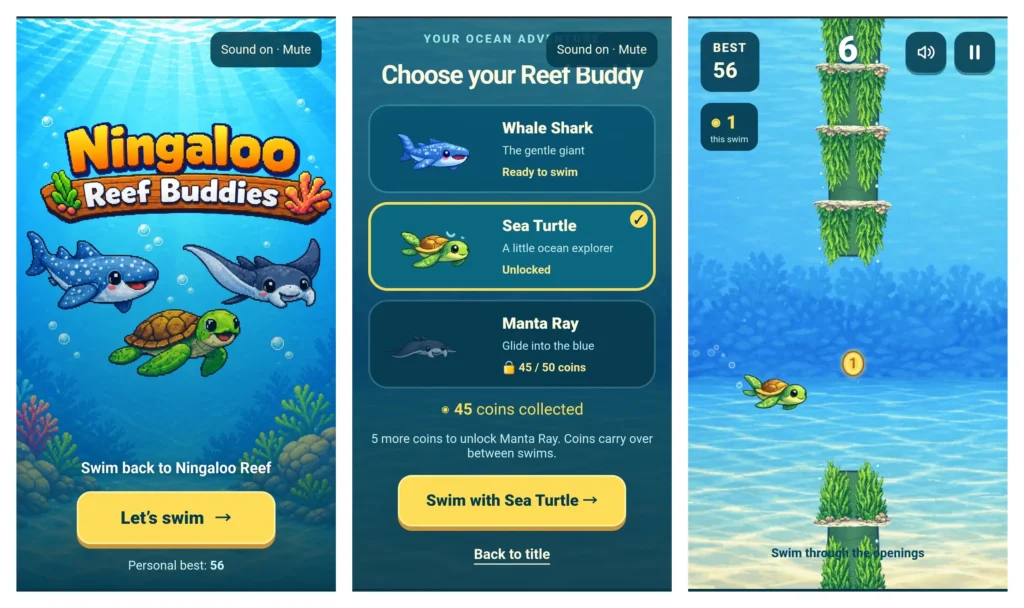
Once it was ready, Codex compiled the whole thing into a development package: a WordPress plugin wrapping the game, the editable source with automated tests, a developer guide, a launch checklist and integrity hashes. Handover notes, essentially, written for whoever was going to deploy it.
Third pass: Claude Fable 5.1 takes it live
The “whoever” turned out to be Claude, running Anthropic’s new Claude Fable 5.1 model, working through the DeCODE Bridge. The Bridge is our in-house control centre that gives Claude working access to the site during deployment.
We gave Claude the handover pack from Codex and asked it to get the game running at ningaloostation.com.au/reef-buddies. Once we had added the site to the Bridge fleet, it read the developer guide, verified the package hashes, linted the PHP and then hit its first real-world problem: the plugin was 16 MB of artwork, too big to push through any of the upload routes available to it. Rather than stop, it compressed the sprite sheets with pngquant, checked the pixel dimensions were untouched so the animation crops would still line up, and got the plugin down to 3.6 MB. That is a better outcome for anyone loading the game on mobile data out at the station anyway.
From there it installed and activated the plugin through the WordPress admin in Chrome, built the page in Beaver Builder with the shortcode in a full-width row, checked that every one of the game’s 22 files was being served over HTTPS with the right MIME type, confirmed the site’s security headers allowed the game to be framed, played a full round in the browser to make sure the coin, the collision and the personal best all worked, then published the page and added it to the site’s Resources menu.
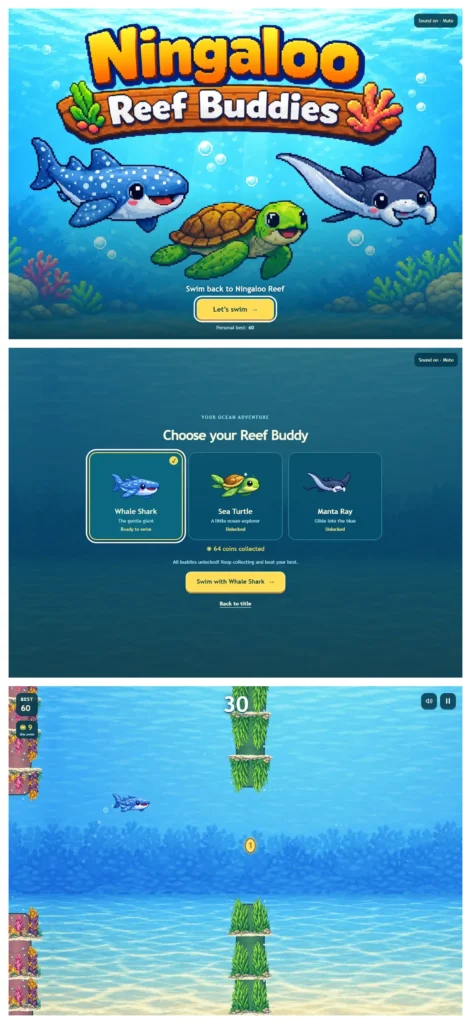
Then the normal post-launch tweaks, the kind that only show up once real people are playing. The game frame was a little cropped on phones, so Claude gave it the full viewport height on portrait screens. The “Sound on” pill was cluttering the title and character screens, so it was hidden there while keeping the in-game mute button. The audio mix was too quiet, so the master gain was raised with a compressor added behind it to stop anything clipping. A “Launch full screen” button went on the page as the main way to play on a phone, and a promo section for the game was added to the bottom of the Ningaloo Station home page. Each change went through the Bridge with a backup taken first, a cache-busted version bump, and a screenshot to check the result.
What we took away from it
Three different AI tools did three different jobs, and the handover between them was the interesting part. ChatGPT drew the pictures. GPT-6 Astra in Codex turned a brief and a folder of images into a working, tested game with proper documentation. Claude Fable 5.1 read that documentation and did the deployment, including the unglamorous bits like MIME types, cache headers and a plugin that would not fit through the door. The written handover pack was the glue. Good notes made the whole chain work, which is not a bad lesson for humans either.
It also reinforced something we keep seeing with agentic tools: the value is not in one big prompt, it is in the loop. Play, notice, adjust, play again. Parker and Banks would have told you that for free.
Go and have a swim
Reef Buddies is now a fun and slightly unexpected part of the Ningaloo Station website, and a resource that brings people to the site for a reason other than checking a booking date. Whether you are sitting in the Park Stay queue at 10am on a Tuesday or on the other side of the world dreaming about the Ningaloo Reef, you can play Ningaloo Reef Buddies here. It is free, there is no login, and it works on your phone. See if you can beat Banks’ high score.
If you have an idea for your own website that does not fit the usual template, whether that is a calculator, a tool or a game, send us a brief. We like the odd ones.
On this page
We’re here to help you DeCODE the Digital World
DeCODE builds breathtaking websites that drive sales for your business without a price that would take your breath away.
We understand that Companies don’t need websites. Companies need a regular stream of high-quality leads. Customers eager, educated, and ready to purchase their products or share their vision. This is the core of a DeCODE build.
In 2026 websites are no longer set and forget, winning an online race is now a marathon, not a sprint. Visually stunning sites with limited back end functionality and no ability to perform in search are redundant.
At DeCODE we build sites that perform.





Adam is a digital marketing specialist, business strategist, and Partner at DeCODE Digital, with 20+ years across marketing, sales, business strategy, and commercial transformation. He works with businesses that need more than a marketing plan: a clear strategy, stronger market position, and a digital presence that drives real commercial growth.