
SEO & AI Search
Chiang Mai SEO Conference 2026, Day 4:
Six talks on equity deals, parasite SEO, agency margins, what buyers pay for and testing over copying, plus what it all means for Australian businesses.
Chiang Mai SEO Conference 2026, Day 4: Equity, Margins and the Death of the SEO Playbook
Our Day 4 recap from the Chiang Mai SEO Conference 2026: trading SEO fees for equity, why good agencies lose margin as they grow, what buyers pay for, parasite SEO and why every SEO playbook has a clock on it.
Created: November 12, 2026 | Reading Time: 26 minutes


Day 4 of the Chiang Mai SEO Conference 2026 was the first day of the main program. The strategy track and community sessions gave way to a single stage, one speaker at a time, and the subject shifted with it. Day 1, Day 2 and Day 3 were about how AI search works. Day 4 was about the business around it: how SEO work gets paid for, priced, bought, sold and, in a couple of cases, abused.
Six talks, and they could not have been more different. Two were excellent. Two covered tactics we would never use or recommend, and I’ve labelled those clearly. One was unlike anything I’ve seen on a conference stage.
The message that tied the day together came from the last speaker: every playbook has a clock on it. What worked for someone else, last year, on a different website, is not a plan. That turned out to apply to pricing, to shortcuts and to SEO itself.
1. The Last SEO Play: how to trade rankings for equity
Dennis Yu, Local Service Spotlight
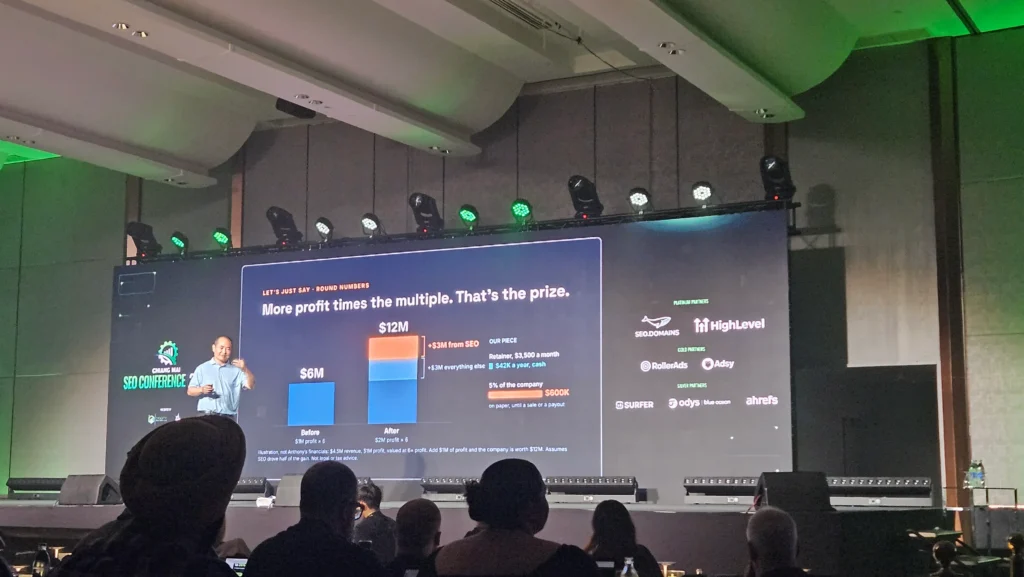
Dennis opened the main program with an argument about how SEO people get paid. His quote of the session: “Stop renting your multiplier. Own a piece of what you multiply.”
The logic runs like this. A business is usually valued at a multiple of its profit. If your marketing adds profit, you’ve added that profit times the multiple to the value of the company, and a monthly retainer captures very little of it.
His worked example, in round numbers and clearly marked as an illustration, was a lawn and landscaping business with $1 million in profit, valued at six times profit, or $6 million. Add another $1 million of profit and the business is worth $12 million. If SEO drove half of that gain, the marketer added $3 million in value. On a retainer of $3,500 a month they were paid $42,000 for the year. Five per cent of the company would be worth $600,000 on paper, at least until a sale or a payout.
He has done versions of this before. He told the room his SEO work for the Golden State Warriors moved from a fixed fee to a percentage of revenue, and that with the landscaping client he moved from a retainer to a stake in the business, then spun out an agency selling the same approach to other operators in that trade. He also talked about phantom equity: a share of the upside agreed on paper, with a defined exit, without formally going on the share register.
My take: the right structure for the right situation
I’ve done equity and partnership arrangements before, so I’ll add a caution Dennis’s slide only hinted at in its fine print (“not legal or tax advice”).
It can be the right answer. It has to be the right solution for the right situation, and many people who enter these deals don’t see the landmines until they’re standing on one. Paper value is not cash. You’re now exposed to every other decision the owner makes, not just the marketing. You need agreement on how value is measured, what happens if the business never sells, and how either side gets out. None of that is a reason to never do it. It is a reason not to run straight at it.
The molecule, and a team of AIs
Two other ideas from the session are worth recording.
The first was what Dennis calls the molecule. Your business, your people and your proof (case studies, videos, press, reviews, the things you’ve actually done) should all point to one clearly defined entity, so that search engines and AI tools agree on who you are. That’s the same destination Brie Moreau reached from the technical side on Day 3: make yourself easy to understand and easy to cross-check.
The second was how he works with AI. Dennis runs what he calls a shared harness: a GitHub repository that holds the shared context, with several AI models (he named Claude, Grok, ChatGPT and Perplexity among them) working through a job together, checking each other’s output and coming back to him once they agree. His rule of thumb was “cheap models sweep, expensive models judge”: use inexpensive models for the bulk of the reading and sorting, and save the costly ones for decisions. A human still signs off anything involving money, sending or access.
It’s an interesting way to work, and I can see the appeal of having models argue it out before anything reaches your desk. It’s more interesting if compute is effectively unlimited. Running several models over every idea adds up, and if token prices rise it becomes a real line in the budget. His cheap-then-expensive routing is the sensible answer to that. For most small businesses, one well-briefed model and a human check will get you most of the way.
What this means for your business: if an agency or adviser proposes a share of revenue or equity in place of fees, it isn’t automatically a red flag or a bargain. Ask how value will be measured, what happens in a bad year, and how the arrangement ends.
2. The Parasite SEO Playbook (black hat, not recommended)
Ivana Flynn, DMCA Boss
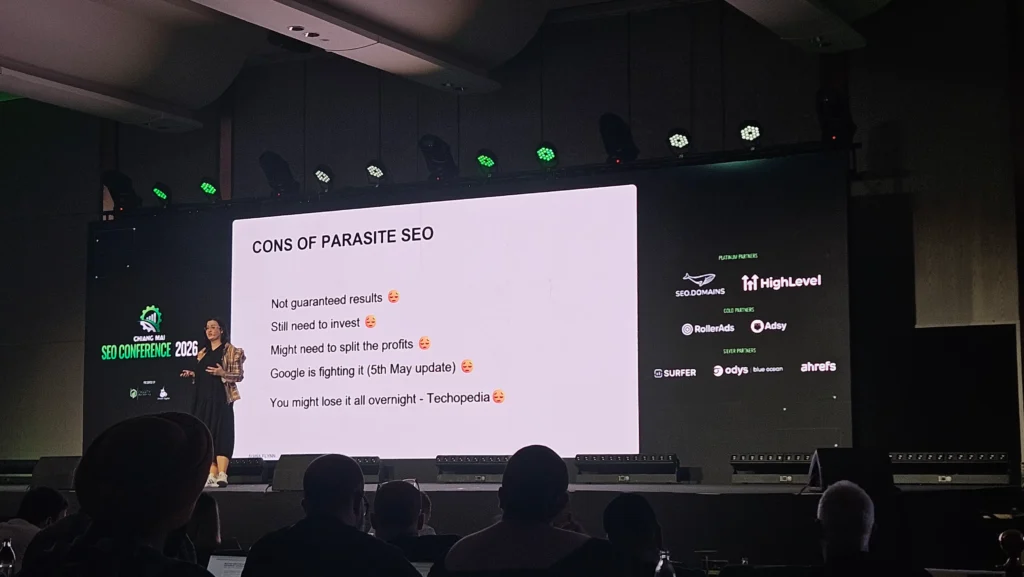
A clear label before we start: this session covered black hat tactics. We don’t use them, we don’t recommend them, and nothing below is advice. I’m reporting it because clients do ask “could we do this?”, and it helps to know exactly where the line sits.
Parasite SEO means ranking content on somebody else’s established website, borrowing that site’s reputation, so you never have to earn your own. Google’s name for it is site reputation abuse. Ivana works in online gambling, where these tactics are routine, and she was frank about what she does and what it costs.
She walked through the main forms and gave her view on whether each will still work in 2027:
- Subdomain placements on strong domains. Her verdict: dead.
- Publisher partnerships, where an operator takes over a section of an established publisher’s site and splits the revenue. Her verdict: stable. Her own slides listed the downsides: revenue sharing cuts margins, poor recommendations damage both brands, and the publisher can end the deal whenever it likes.
- Individual paid posts on someone else’s site. She shared a 30-day test of paid placements in which some paid for themselves and several lost money.
- Reddit. She described building karma across multiple accounts, buying aged accounts, and using anti-detect browsers and proxies as accounts kept getting suspended. Her verdict: works in 2026, unlikely to in 2027.
- YouTube. Keyword-stuffed titles and AI-generated videos that currently rank and get picked up in AI Overviews. Her verdict: still working.
- Buying existing websites and repurposing them. Her example was a sports site bought by a gambling company, where adding betting content held up and adding casino links went too far and drew a penalty.
To her credit, her “cons” slide was honest: no guaranteed results, you still have to invest, Google is fighting it, and you might lose it all overnight.
The EEA policy change
One part of her talk matters beyond gambling. In late August 2026, Google updated its site reputation abuse policy for the European Economic Area. After discussions with the European Commission, which has been examining the policy under the Digital Markets Act, Google said manual actions for site reputation abuse would no longer affect rankings for users inside the EEA. Outside the EEA, including Australia, they still apply.
Ivana’s read was that she and others will now do a lot more of this in Europe. She also noted you can still be hit by Google’s other spam policies and automated systems.
My view
Unfortunately, some of this is working right now. That’s not a reason to do it.
If a tactic isn’t going to work over the longer term, stay away from it, unless you’re in the business of burning through domains, and no real business with a name and customers is. A plumber in Perth has one brand. They can’t throw it away and start again next quarter.
My bigger objection is to what it does to everyone else. Flooding Reddit, YouTube and publisher sites with planted content adds more garbage to an internet that already has plenty, and most of it exists to push people towards gambling. I find that hard to defend. We saw on Day 3 where it leads: ChatGPT all but stopped citing Reddit once it filled up with this material.
My hope is that Google, the AI companies and anyone else putting recommendations in front of people take the time to see through the manipulation and protect their users. They have every commercial reason to.
What this means for your business: if someone offers you fast rankings on “high authority” sites you don’t own, this is what they’re selling. It can vanish overnight, and it takes your reputation with it.
3. I Own a Piece of the Internet. Your Brand Can Grow There, Rent-Free
Kalin Karakehayov, SEO.Domains and GigaLinks
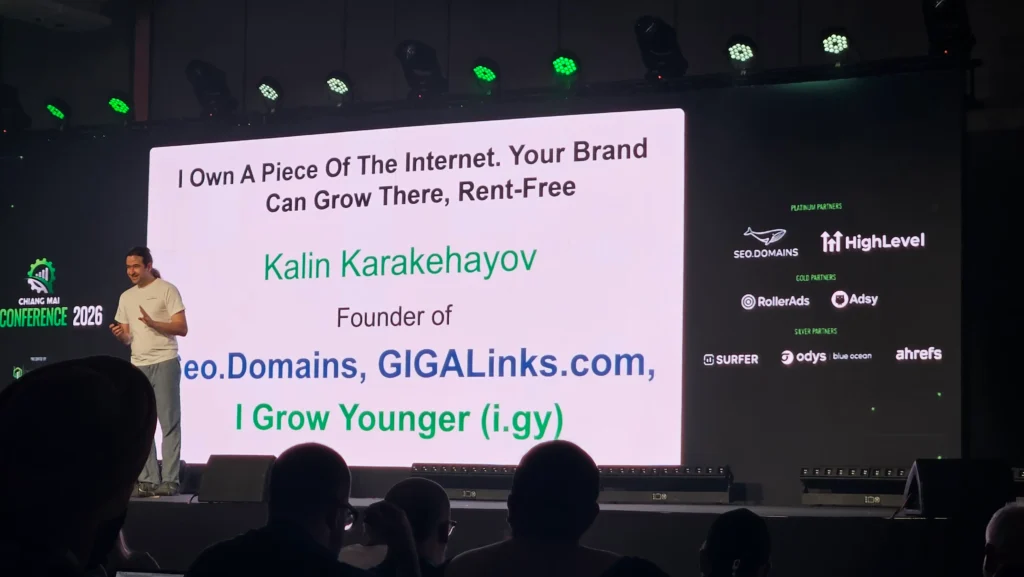
This was the most unusual talk I’ve seen at a conference.
Kalin’s company, SEO.Domains, was the event’s platinum sponsor, and it owns one of the largest portfolios of websites in the world, more than 200,000 domains. He opened by telling the room that his companies are running out of cash. Domains are an illiquid asset, he said, and the business now needs to shift to selling links. He even noted that the only reason he was up there and sponsoring the conference was that it had been paid for well in advance. If it hadn’t been prepaid, he said, they wouldn’t be sponsoring at all. He did sound hopeful that he can fix it.
He then spent around twenty minutes on something else entirely: a personal framework about self-love, attraction and fear, how the brain works, and seeing “flows” instead of “boxes”. There were pyramids, magnets and a slide titled The Love Triangle. It was sincere, and it was a long way from SEO.
He brought it back at the end with an offer: links placed across his network, homepage links included, sold in packages of $25,000 at the stand outside, that day only. His own slide described some of the inventory as “not exactly quality”.
He was also open about what is happening to the network itself. Sites are being converted to casino sites, and his example was a former restaurant website that now is one. The message to the room was that it’s open slather. Gambling and casino links are welcome, and by the sound of it so is anything else that will pay.
That’s the hard part. The fix he described is a fire sale of links into the one market that will happily take them, and it comes at the expense of the domains underneath.
Two things from me.
First, the same label as above. Buying links in bulk across a private network of websites is not something we do or recommend. Google’s policies treat it as link spam, and the risk sits with the buyer’s website.
Second, before DeCODE I ran Icarian Advisory for about eight years, helping companies in trouble and turning businesses around, so I listened to that opening differently to most of the room. When a founder says on stage that the company is short of cash, a large prepaid package you have a year to use is a risk in its own right, whatever you think of the product.
Third, there’s a risk for anyone already there. If a reputable business has links or placements across that cluster of domains today, it’s in a high-risk position. Once a network is opened up to gambling, casino and whatever else will pay, its value to anyone genuine falls quickly, and those links stop being an asset and start being a liability. If that’s you, it’s worth knowing exactly where your links sit.
Mostly, though, I was thinking about his team. Kalin has a large workforce back in Bulgaria. They’re the ones turning up each day to do the work and support their families, and they have the least say in how this plays out. I hope he gets the business through this, for their sake.
4. Why Good Agencies Fail: building the operational systems nobody taught you
Jacob Kettner, First Rank
Jacob gave one of the best talks of the day, and easily the most useful for people who run an agency. It’s less about SEO and more about the numbers underneath any service business, so if you run a trade, a practice or a consultancy, stay with me.
He opened with his own figures. In all of 2025 First Rank turned over $3.2 million at 12% net profit, about $380,000. In the first nine months of 2026 it turned over $2.7 million at 21%, about $580,000. More profit in nine months than in the whole previous year, on less revenue. The rest of the talk was how.
Every hire pulls you underwater
His first chart showed a small agency’s revenue and costs. Costs rise in steps, because you hire a whole person at a time. Each hire puts you under water, and you sell your way back to the surface. That pattern feels normal, so owners assume the fix for any margin problem is more sales.
His line: you can’t fix a margin problem by selling more.
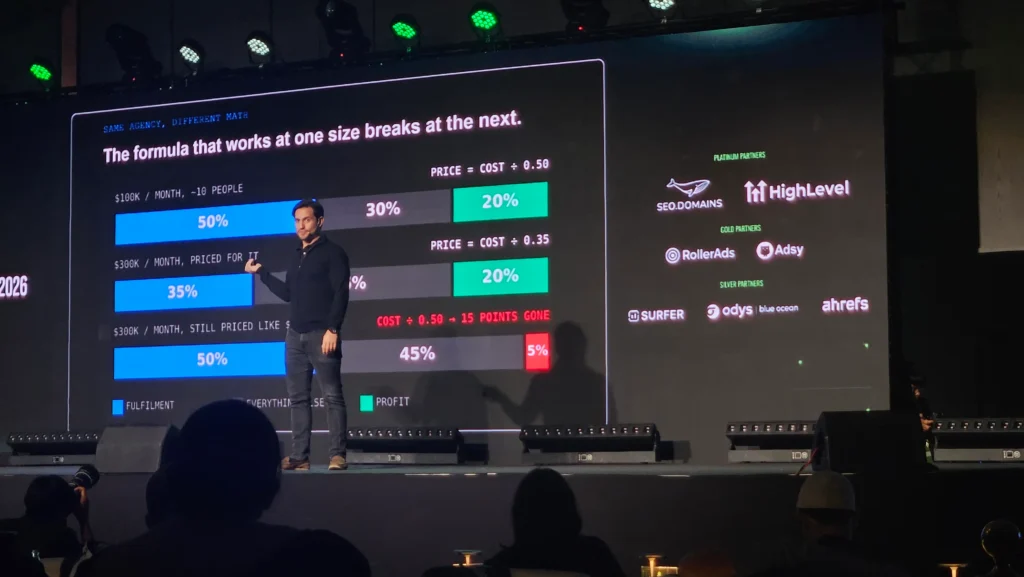
The formula that works at one size breaks at the next
This was the centre of the talk.
A small agency at around $100,000 a month and ten people can price its work at cost divided by 0.5. Half of revenue goes to delivering the work, 30% to everything else, and 20% is profit.
Grow to $300,000 a month and “everything else” is no longer 30%. You now have managers, account managers, a sales team and more software, and that share is closer to 45%. If you’re still pricing at cost divided by 0.5, fulfilment still takes half, and profit falls from 20% to 5%. Fifteen points gone, with nobody doing anything wrong.
To hold 20% at that size, fulfilment has to come down to 35% of revenue, which means pricing at cost divided by 0.35.
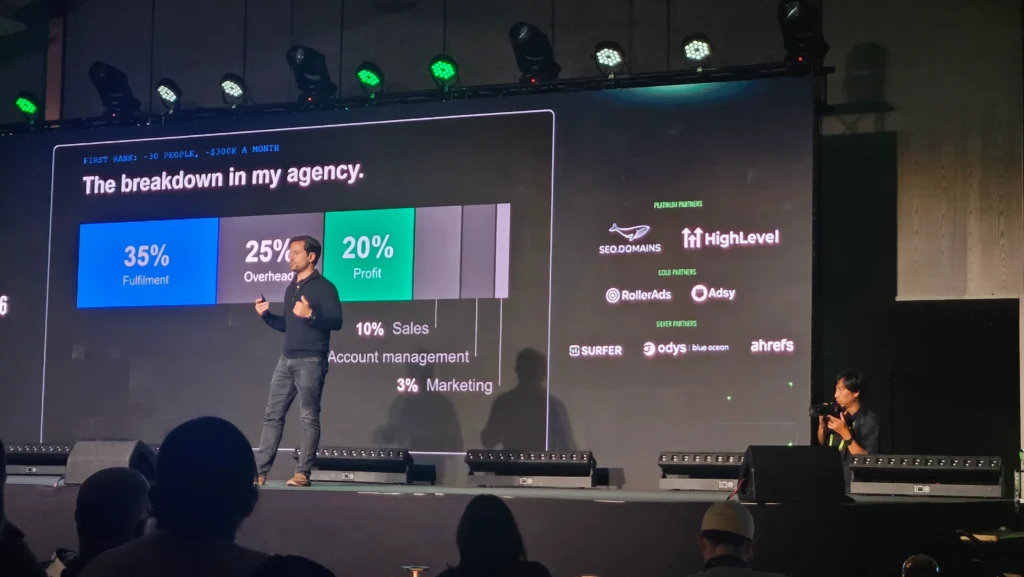
He listed three ways out once you’re in that position, and didn’t pretend any of them were pleasant: accept the lower profit, raise prices on long-standing clients, or shrinkflation, where the price stays the same and the client gets less. His fourth option is the one to act on early: price for where you’re going, not where you are.
His own targets, for an agency of about 30 people: 35% fulfilment, 25% overhead, 10% sales, 7% account management, 3% marketing and 20% profit. He was clear these are his numbers and every business should set its own.
Three margin killers
When fulfilment runs over target, Jacob looks for one of three causes.
1. Pricing. The work costs more to deliver than the price allows.
2. Utilisation. His example: a team member costing $5,500 a month, across 143 hours. Divide by 0.35 and you get $110 an hour. That only works if every hour is billable, and nobody bills every hour. Assume 55% and the rate needs to be $200. He also showed why small teams struggle here. You can’t hire half a person, so a team of one or two swings well below target whenever work is light. As he put it, small teams aren’t broken. The maths puts them under target.
3. Over-delivery. The team does more than the client is paying for. In one month his two-person paid media team had half its hours budgeted to client work and delivered far more than that. “Too busy, or not busy enough?” was his slide title, and the answer was neither. They were giving work away.
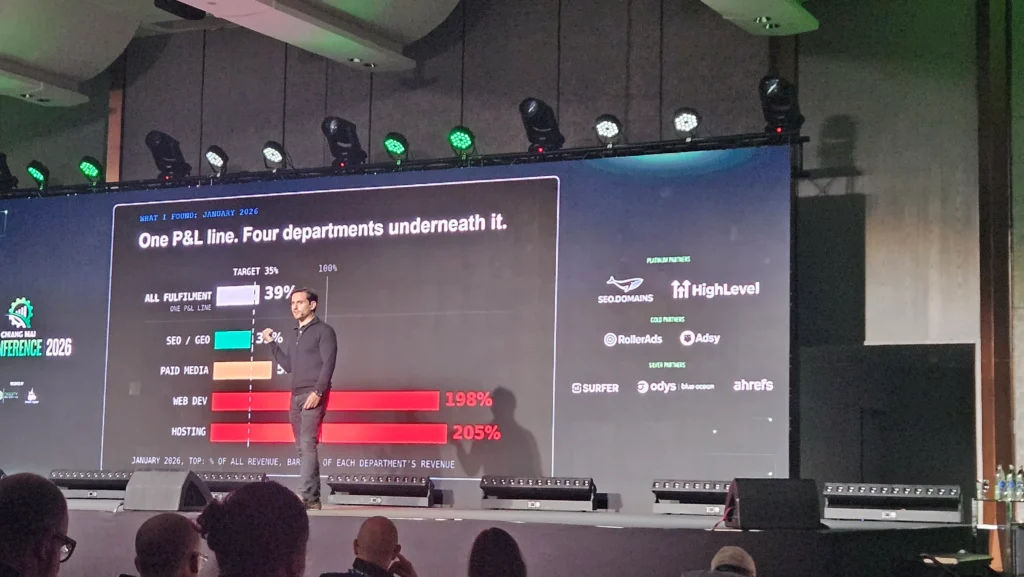
When he broke his own January 2026 figures down by department, fulfilment overall was 39% of revenue against the 35% target. That looks like a small miss. Underneath it, SEO was on target, paid media was costing 53% of its revenue, and web development and hosting were each costing around twice what they brought in. One line on the profit and loss was hiding four very different stories. With a monthly department dashboard in place, the same two people in paid media went from a 7% loss in February to a 15% profit by August.
Two closing lines I wrote down:
- You can’t delegate what you can’t measure, and you can’t improve what you don’t measure.
- Put prices up by at least 3% a year, or you’re going backwards.
Jacob also gave attendees the working toolkit behind the talk: an employee cost calculator, a pricing calculator, a client summary and the full financial model. That’s a generous thing to hand a room full of competitors.
What this means for your business: the same maths applies to any business that sells time. If you’ve grown and your profit hasn’t, look at pricing, utilisation and over-delivery before you look at sales. And if your marketing agency puts its prices up a little each year, that’s usually a sign of one that plans to still be around.
5. $50bn in online business sales: where I’d build, what I’d buy, what I’d avoid
Thomas Smale, FE International
Thomas co-founded FE International, an advisory firm that handles the sale of online businesses, particularly software, e-commerce and content companies. He’s seen more of these deals from the inside than almost anyone.
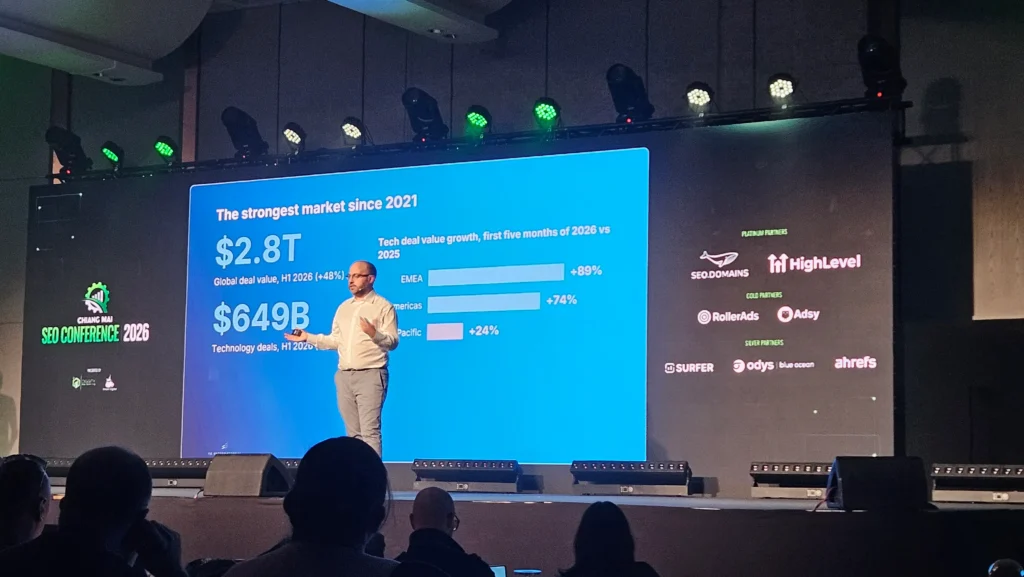
His opening slide called this the strongest market since 2021. The figures he presented: US$2.8 trillion in global deal value in the first half of 2026, up 48%, with US$649 billion of that in technology. Tech deal value in the first five months of the year was up 89% in Europe, the Middle East and Africa and 74% in the Americas against the same period in 2025. Private equity interest in software and AI businesses is strong.
What buyers want to see hasn’t changed much:
- Year-on-year growth
- Annual recurring revenue
- Net dollar retention, meaning existing customers spending more over time, not less
- Low customer churn
His point on growth was blunt. Consistent growth is what earns a strong multiple. A business that is flat or going backwards will probably still sell, but at a significant discount to what it could have fetched.
He finished with his own lists.
He’d build: an AI-native agency with recurring revenue, a software product small enough for a single developer to run, or simply something he’s interested in.
He’d buy: creator and influencer businesses where the founder can be replaced, bloated agencies and service businesses that haven’t yet adopted AI, and businesses with a distribution moat, meaning an audience or a channel competitors can’t easily copy.
He’d avoid: businesses that are already AI-native, businesses that rely entirely on organic search traffic, and anything he’s only looking at because someone told him it was good.
The first item on each list is the same idea seen from both sides. He’d happily build an AI-native agency. He wouldn’t buy someone else’s, because the uplift has already been taken. The opportunity for a buyer is the business that hasn’t adapted yet: acquire it, bring AI systems in, make it more efficient and lift its value.
One more line worth keeping: doubling down on what you’re good at beats diversifying.
What this means for your business: you may never sell, but it’s worth running the business as though a buyer will look at it one day. Recurring revenue, customers who stay, steady growth and more than one source of leads are what make a business valuable. They’re also what make it resilient. A business that gets all its customers from one channel is fragile, whether that channel is Google, Facebook or one big referrer.
6. The Death of SEO Playbooks
Emilio Takas, Campeon Gaming
Emilio works in online gaming, so I was expecting another talk on casino links. It was nothing of the sort. For me this was the talk of the day, which surprised me given the niche he works in. It was rigorous, useful and interesting from start to finish.
His opening: you read the search results properly, you built the better page, and by every standard the industry teaches, you won. Then a thinner page beat you, and a forum thread from 2014 beat both of you. And you blamed your own execution.
Why copying fails
He gave three reasons that copying someone else’s case study doesn’t work.
Case studies only publish what worked. That’s survivor bias. As his slide put it, nobody ever sold a course called “Here’s what didn’t work for me”.
There’s no control group. He cited a study of 100 six-figure blogs that had followed much the same playbooks between 2022 and 2026. The median change in traffic was a fall of 85%. Forty-nine lost 80% or more, twelve are at zero, and 21 grew. If the tactics were what decided it, those 21 couldn’t have grown.
Every playbook has a clock on it. A tactic works for one site, once. A year later the winner writes it up. Two years later it’s a course. By the time it reaches your feed, the edge has gone. His summary: a playbook is last year’s result, written by someone else.
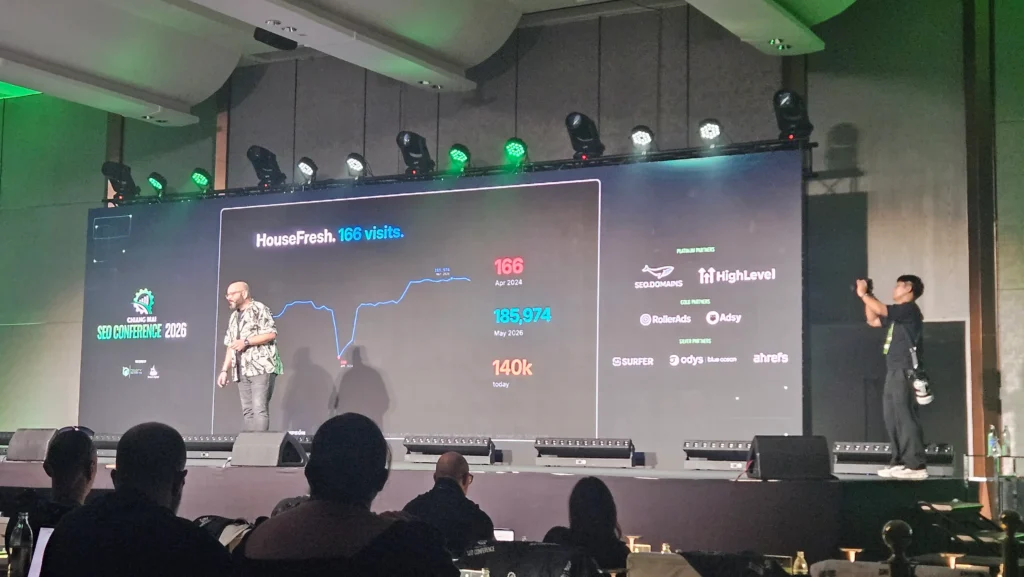
His contrast case was two sites over the same two years. Forbes Advisor, the largest affiliate operation of its kind, went from an estimated 15.8 million monthly visits in April 2024 to about 22,000 by January 2025. HouseFresh, a small independent air purifier review site, fell to 166 visits in April 2024 and has since recovered to around 140,000 a month and the number one spot for “best air purifier”. Same period, opposite results. The playbook didn’t decide it.
Being known gets you in. Being better moves you up.
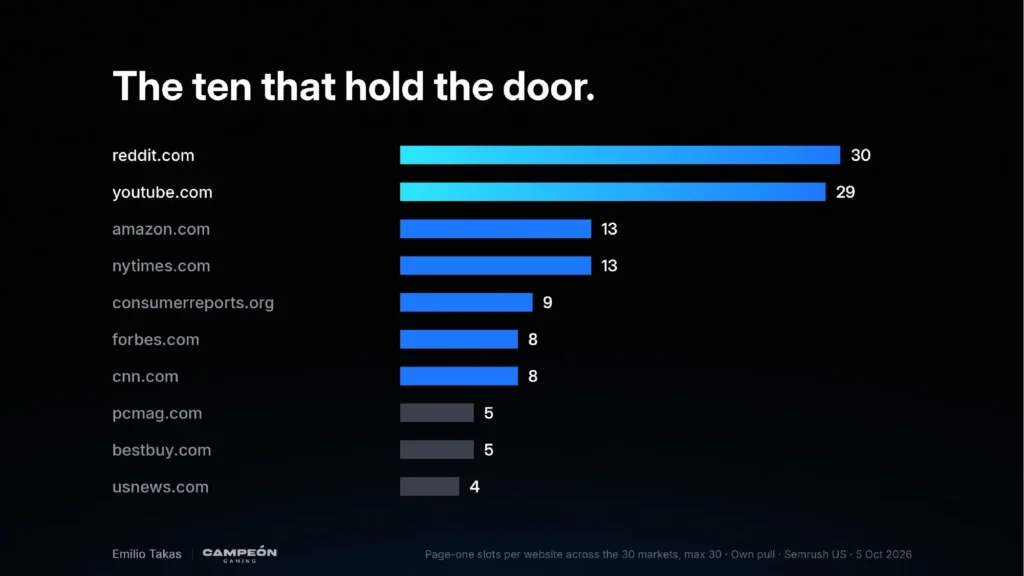
Emilio then tested his own assumption, that the bigger the brand, the higher it ranks. He pulled page one of Google for 30 unrelated “best” searches in the US, from hiking boots to web hosting: 300 results across 153 websites. He compared each site’s position with how many people search for its name each month.
The correlation was +0.06. In plain terms, no relationship. Thirteen of the 30 number one results belonged to brands almost nobody searches for by name.
What he found instead was concentration. Ten websites hold 41% of all those page one positions. Reddit held 30 of the 300 positions and YouTube 29, followed by Amazon, the New York Times, Consumer Reports, Forbes and CNN. He calls these the gatekeepers.
His conclusion: being known doesn’t decide where you rank. It decides whether you’re on the page at all. Better is how you move up. Known is how you get in.
He was careful about what his data doesn’t prove. It only looks at page one, so it can’t see who never got in. It’s a correlation. And brand searches are a stand-in for being known, not a measure of it. I’d like to see more speakers put up a slide like that.
He then repeated the exercise for AI search, using other people’s published research:
- An Ahrefs study of 75,000 brands found the things most associated with being cited by AI were mentions on YouTube and mentions of the brand across the web. Backlinks were the weakest of the factors tested.
- Seer Interactive found brands were cited 53% of the time when they were named in the answer, against 11% when they weren’t.
- The share of Google AI Overview citations that come from the organic top 10 fell from 76% to 38% in a year. That’s the same Ahrefs figure Brie Moreau used on Day 3, and the caveats we covered there still apply.
The Door Audit
Emilio pointed out that SEO has always been a testing industry. Google’s own figures for 2023 show 719,326 search quality tests and 4,781 launches. That’s 0.66%. Nearly everything Google tried didn’t ship.
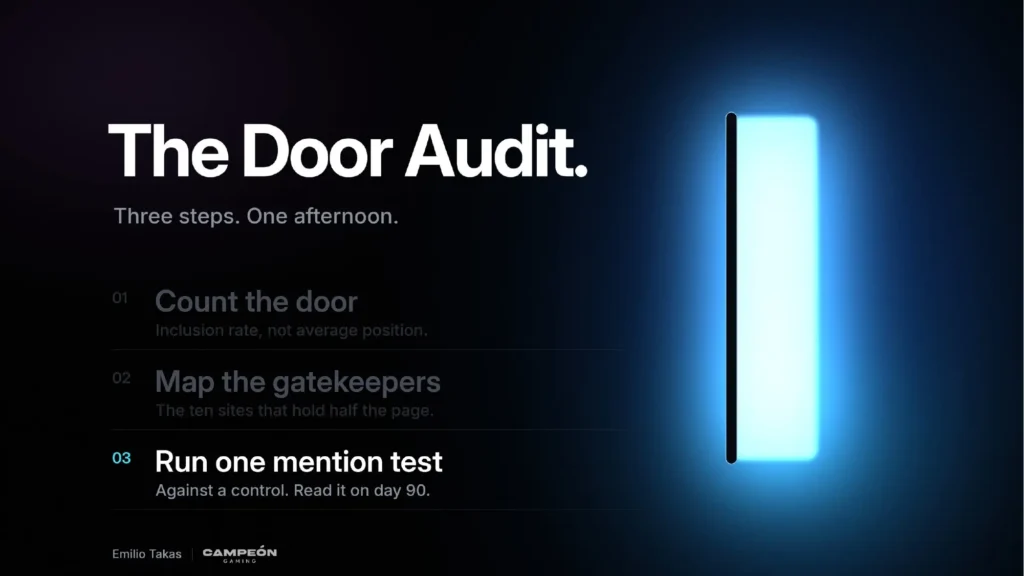
So his alternative to copying is a test anyone can run, which he calls the Door Audit. Three steps, one afternoon to set up.
- Count the door. Take the 50 searches that matter most to you and count how many you appear on at all, anywhere in the top 10. That’s your inclusion rate. Not average position.
- Map the gatekeepers. Across those same searches, which ten websites hold half the page? You don’t outrank them. You get mentioned on them.
- Run one mention test. Get one mention on a gatekeeper. A mention, not necessarily a link. Leave a matched set of searches alone as your control. Wait 90 days, and read the result on day 90, not before.
His test card even sets the decision in advance: if the test group’s inclusion rate beats the control by five points or more, do more of it. Under two points, stop, write it down and try a different kind of mention.
On HouseFresh he was again honest. It was named by the gatekeepers long before it outranked anyone, and he can’t prove the mentions caused the recovery. The audit is how you’d find out.
This lines up neatly with Manick Bhan’s point on Day 2. Manick’s advice was to measure AI visibility across repeated runs and watch the core of sources that keep showing up, because “the core is the new top three”. Emilio’s inclusion rate is the same idea for search results: stop staring at one position on one day, and count how often you’re in the room.
He also gave a five-question check for any tactic you see online: What was the control? What was the base rate? When did it work, and for how long? What else changed at the same time? And who benefits if you believe it?
Emilio has published his slides, dataset, the Door Audit spreadsheet and the test card for free, with no email required, at emiliotakas.com/chiangmai.
What this means for your business: be wary of anyone selling a guaranteed formula, us included. Ask what was tested and what it was compared against. And count how often you appear across the searches that matter, which tells you far more than where you rank for one of them.
The common thread from Day 4
- Every playbook has a clock on it. By the time a tactic reaches your feed, the edge has usually gone.
- Test, don’t copy. One change, a control group, 90 days, and a decision rule set before you start.
- Known gets you considered. Better gets you chosen. Mentions in the places your customers already trust matter more than another batch of links.
- Shortcuts are borrowed time. Parasite SEO and bulk link buying can work until the day they don’t, and the cost lands on your brand.
- Price for where you’re going. The formula that works at one size quietly breaks at the next.
- You can’t fix a margin problem by selling more. Look at pricing, utilisation and over-delivery first.
- Growth and recurring revenue are what buyers pay for. They’re also what make a business resilient.
- Equity for marketing can work. It needs the right situation, and eyes open.
After three days on how AI search works, Day 4 was a useful reminder that none of it matters if the business underneath isn’t sound. Know your numbers, be honest about what you can prove, and be sceptical of anyone, on a stage or in your inbox, with a formula that worked once for someone else.
It’s also why I describe what I do as digital marketing, not SEO. My background covers sales, marketing, corporate, small business, running my own businesses and eight years in turnaround work, and over that time I’ve tried, tested and used most channels: Google Ads, Microsoft Ads, SEO, radio, TV, guerrilla marketing and now AI search. I’d sooner recommend the thing most likely to work for a business than the one thing I happen to know. Emilio’s talk made the same case with data. Start with what you can test and prove, not with somebody else’s playbook.
If you’d like a straight conversation about what’s worth testing for your business, get in touch with the DeCODE team.
This is part four of our five-part series from the Chiang Mai SEO Conference 2026. Read Day 1, Day 2 and Day 3. Day 5 is coming soon.
Sources
- Chiang Mai SEO Conference 2026
- Emilio Takas: slides, dataset, Door Audit spreadsheet and test card
- Google: Improving Search with rigorous testing – 2023 figures
- Search Engine Journal: Google updates site reputation abuse policy, removes penalties in EEA
- Ahrefs: 38% of AI Overview citations pull from the top 10
- First Rank – Jacob Kettner’s presentation and agency financial toolkit
- FE International – Thomas Smale’s presentation
- Local Service Spotlight – Dennis Yu’s presentation
- Studies cited on Emilio’s slides and not checked by us directly: Ahrefs (75,000 brands, AI citation correlations), Seer Interactive (Feb 2026), Daniel Stanica, “The Great Blogging Collapse” (Monetize Better), and Semrush US traffic estimates pulled 5 October 2026
On this page
We’re here to help you DeCODE the Digital World
DeCODE builds breathtaking websites that drive sales for your business without a price that would take your breath away.
We understand that Companies don’t need websites. Companies need a regular stream of high-quality leads. Customers eager, educated, and ready to purchase their products or share their vision. This is the core of a DeCODE build.
In 2026 websites are no longer set and forget, winning an online race is now a marathon, not a sprint. Visually stunning sites with limited back end functionality and no ability to perform in search are redundant.
At DeCODE we build sites that perform.









Adam is a digital marketing specialist, business strategist, and Partner at DeCODE Digital, with 20+ years across marketing, sales, business strategy, and commercial transformation. He works with businesses that need more than a marketing plan: a clear strategy, stronger market position, and a digital presence that drives real commercial growth.