
SEO & AI Search
Chiang Mai SEO Conference 2026, Day 2:
Four talks on AI citations, harmonic centrality, the Dark SERP, black hat tactics and unique content, plus what it all means for Australian businesses.
Chiang Mai SEO Conference 2026, Day 2: What AI Reads, What It Cites and Where the Line Is
Our Day 2 recap from the Chiang Mai SEO Conference 2026: what 11 million AI citations reveal, harmonic centrality, the Dark SERP, 15 white, grey and black hat tactics, and why unique, provable content wins.
Created: November 10, 2026 | Reading Time: 13 minutes


Day 2 of the Chiang Mai SEO Conference 2026 is done, and it was a big one. Where Day 1 was about what AI search rewards, Day 2 went a layer deeper: how AI tools actually find, read and choose their sources, and how much of that process most of us never see.
Four sessions again. A research deep-dive that ran well over time because the enthralled audience wouldn’t stop asking questions, a framework for writing content AI can cite, a tour of the white, grey and black hat tactics being used right now, and a practical system for producing content nobody else can copy.
The message that tied them together: being found by AI and being chosen by AI are two different things, and what gets you chosen is being close to trusted sources and saying something specific that you can prove.
1. 2,000 hours of research and 11 million AI citations
Brie Moreau, White Light Digital Marketing (WLDM), with Stephen Burns, Common Crawl
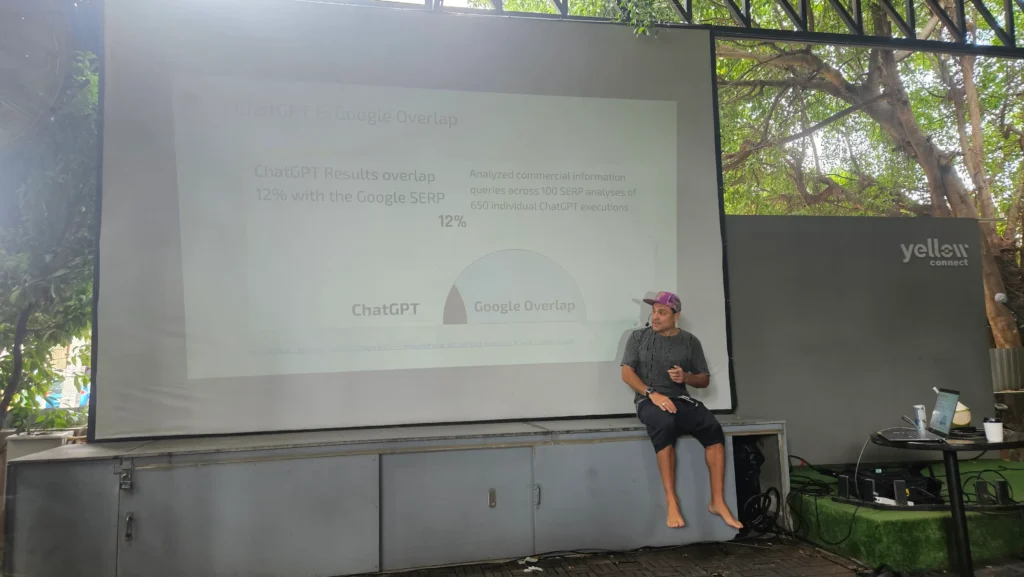
Brie was back for a second day, at another of the conference’s community events. It was scheduled for an hour and ran closer to ninety minutes, largely because the room was full of people running their own research and experiments, and the questions and contributions became part of the session. Some of the best material of the week has come out of exactly that.
His talk drew on WLDM’s analysis of more than 11 million AI citations across ChatGPT and Gemini. The headline finding is that traditional authority signals on their own don’t explain who gets cited. AI tools lean on topical alignment, semantic similarity and what Brie calls co-citation networks.
Everyone says they’re the best
Brie’s starting point was simple. Every business describes itself as “the best” at what it does, so AI tools go looking for external validation instead.
He tied this back to two long-standing Google patents. The Reasonable Surfer model says the links that really matter are the ones people actually click. Topic-Sensitive PageRank says authority is worked out within topical neighbourhoods, not across the whole web. He also pointed to the 2024 Google documentation leak, which showed Google measuring how focused a site is on one topic and how far individual pages stray from it.
The practical version: build links and mentions in areas that are genuinely relevant to what you do. A link from an unrelated site, however big, sits in the wrong neighbourhood.
ChatGPT and Google see different webs
Brie shared data from Josh Blyskal at Profound showing that ChatGPT’s results overlap with Google’s search results by only 12% on commercial queries. The overlap with Bing is higher, which makes sense given ChatGPT uses Bing for its searches. One of the audience participants also noted that Claude’s answers track closely with the top 20 results in Brave Search.
The top tip? Ranking well in Google does not mean you’re visible in ChatGPT.
Stephen Burns and the crawl behind the models
Brie then handed over to Stephen Burns, Web Intelligence Lead at Common Crawl, and this section was exceptional.
Common Crawl is a not-for-profit that crawls the web every month and publishes the data for anyone to use. According to Stephen, a single monthly crawl is around 400 terabytes and 2.1 billion pages. It matters because AI companies train on it. His slide noted that filtered Common Crawl data supplied about 82% of the training tokens for GPT-3.
Common Crawl’s crawler is called CCBot, and whether it can access your site comes down to two lines in your robots.txt file. As his slide put it, “These two lines help decide whether your site reaches AI.”
The more interesting question is how Common Crawl decides which sites to crawl. The answer is a measure called harmonic centrality.
Harmonic centrality: proximity, not popularity
I mentioned harmonic centrality in the Day 1 recap. Stephen gave it the full history.
It starts in 1948 at MIT, where researchers put five people in booths, had them pass notes through slots in different patterns and timed how quickly each group solved a problem. The hub-and-spoke group took about 32 seconds. The chain took about 53. As Stephen put it, “The winners were not the best connected. They were the closest to everyone.”
The maths behind that idea didn’t work on something as messy as the web until 2000, when it was reformulated, and in 2013 researchers showed it was the only major measure that passed every test of a good centrality metric. PageRank didn’t.
Since 2017, Common Crawl has ranked every monthly crawl list by harmonic centrality. One of its engineers described it as “more robust against link spam than PageRank”. Stephen’s summary: “A 76-year-old idea now decides whether CCBot visits you.”
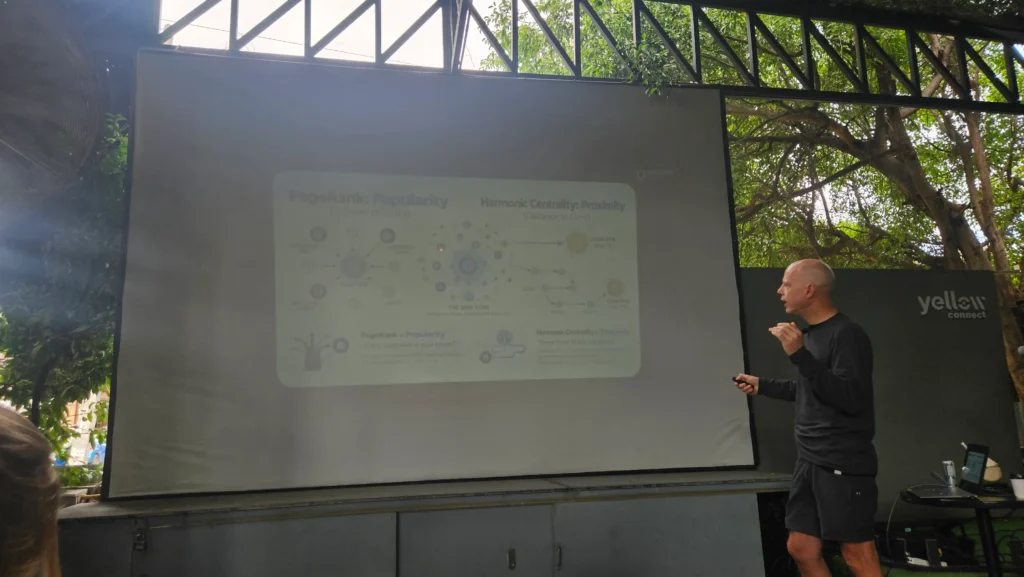
The distinction he drew is the clearest I’ve seen:
- PageRank is popularity. How many links point at you. “Many roads lead to your house.”
- Harmonic centrality is proximity. How few steps you are from the core of the web, meaning sites like Wikipedia, major news outlets and government sites. “Fewer turns to the city centre.”
Stephen tested it on himself. He launched a new website in July 2026 and the August crawl missed it completely. He added one link from his profile on commoncrawl.org, a site very close to the core. The following month his site was in the crawl. One link, from the right place.
You can check whether your own site is included at index.commoncrawl.org.
Most citations are noise
Back with Brie, the data got more confronting. When WLDM mapped which sources get cited together, the bulk of them clustered in one large lump that carried little weight. His estimate is that around 95% of AI citations are “junk”. The small group that matters is the set of sources that keep getting cited together, repeatedly, on the same topic.
Map those co-citation networks and you find a handful of highly connected hubs in each topic. Brie’s advice: if you can get your business mentioned on those hubs, you win. If you can’t, get as close to them as you can. His line was to look for harmonic centrality, not domain rating.
That also explains listicles. Blyskal’s analysis of 177 million citations found comparative listicles made up 32.5% of them, the largest identifiable category by a wide margin. In Brie’s view they work because a list linking to several businesses creates exactly the kind of connections these systems measure.
Two other findings stood out:
- Around 5% of AI citations point to pages that don’t exist. The AI has invented the address.
- Citations come and go. WLDM tracks each one daily for 41 days and only calls it “sticky” if it’s cited on eight or more of those days and is still in the live answer today.
WLDM’s citation workflow
Brie closed with how WLDM acts on all this:
- Export every page AI tools are citing for the questions that matter to a client.
- Filter to the right market and the prompts that match what customers actually ask.
- Check which sources are well connected and which citations stick.
- Work with those sources to add one clear, verified fact about the client, backed by two other credible sources.
- Where no good source exists, create evidence-based content and publish it somewhere well connected to that topic.
Brie is a long way ahead of most of the industry, and the challenge with work like this is translating it into something the rest of us can act on. A futurist I used to follow said you should keep one foot in the present and one in the future, because with both feet in the future nobody can join you. My one-foot-in-the-present version of Brie’s talk is this: it matters less how many sites mention you and more which ones.
What this means for your business: a few mentions on the websites that are central to your industry and location are worth more than dozens on sites that aren’t. Think industry associations, respected local media, suppliers and established directories. And make sure your website isn’t blocking the crawlers AI tools rely on.
2. ATOMS: the framework behind AI citations
Manick Bhan, Founder and CEO, Search Atlas
Manick’s session was the most data-heavy of the day, built on Search Atlas’s own experiments across thousands of AI answers. His “atom” is the smallest useful unit of content, a single passage that answers a single question. Atoms build molecules, molecules build matter, and pages are built the same way.
One engine became many
Search used to mean Google. Manick’s timeline showed ten AI answer engines arriving since late 2022, and the market is still shifting. According to the Comscore and Similarweb figures he shared:
- ChatGPT’s share of US AI prompts fell from 70% to 50% between January and June 2026.
- Gemini rose from 17% to 30%, and Claude from 2% to 11%.
He described the shift as going from SEO, to optimising for two engines, to optimising for many.
Same question, different answers
Manick’s team asked ChatGPT the same question, “best meal kit delivery in 2026”, eight times. They got eight different sets of sources. Not one of the nine websites cited appeared in all eight answers.
Across a wider test of 150 prompts run more than 5,000 times, every engine showed volatility. In the figures he presented, Gemini, Google’s AI Mode and ChatGPT changed their sources most often, and Claude was the most stable.
What does hold steady is what he calls the core. About a third of the sources cited for any question show up week after week, and the rest rotate. His line: the core is the new top three.
Each engine also searches in its own way. ChatGPT runs four or five searches per answer through Bing. Gemini runs two or three through Google. Claude runs about one, through Brave. They even rewrite your question differently. In his data the ChatGPT app adds the current year to a third of its searches, and Gemini leans on exact quoted phrases.
The Dark SERP
This was the idea of the day for me.
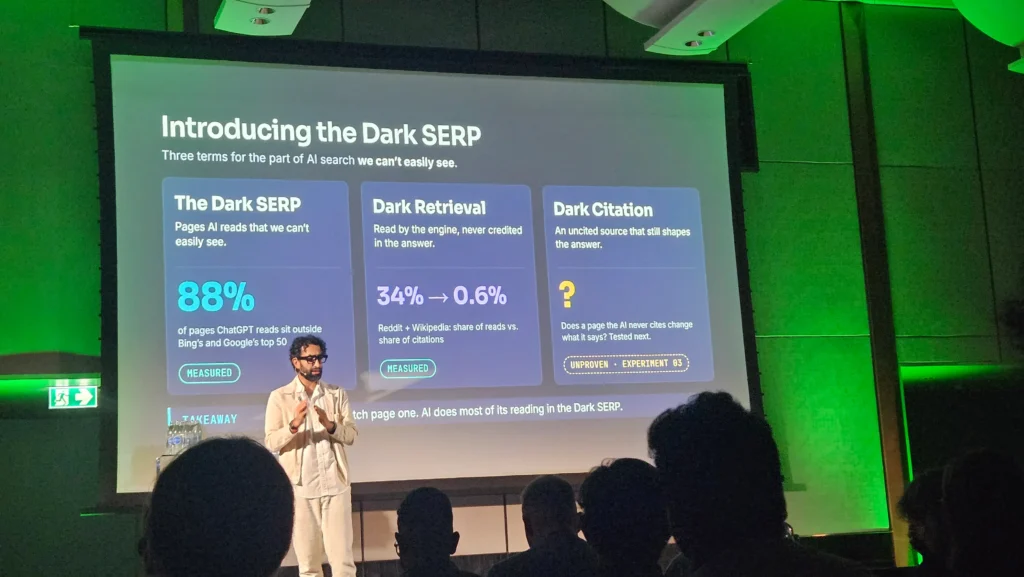
Search Atlas tracked 10,583 pages that ChatGPT read while building its answers. 88% of them were not in the top 50 results on either Google or Bing.
Manick calls this the Dark SERP: the pages AI reads that we can’t easily see. The AI isn’t reading page one. It’s running its own follow-up searches and pulling up deep, specific pages that answer one small part of the question.
He paired it with a second term, dark retrieval, for sources the AI reads but never credits. Reddit and Wikipedia made up about 34% of the pages ChatGPT read in his data, and just 0.6% of the pages it cited.
What wins the citation
Once a page has been read, what decides whether it’s cited? Across 14,401 pages, the strongest factor was whether a passage on the page matched the search the AI wrote for itself, not the question the user typed. Matching the AI’s rewritten search made a page 1.48 times more likely to be cited. Where the passage sat on the page made no difference at all.
That leads to his anatomy of an atom:
- 70 to 200 words, answering one question
- Name the subject in the passage itself, so it makes sense on its own
- Don’t worry about position on the page. Quality matters more
- One passage for each follow-up search the AI is likely to run
- Use the question’s own words, plus specifics
- Measure over repeated runs, never a single answer
His example was a pricing passage: “HubSpot’s Starter plan costs $20/month per seat and includes email marketing, forms, and live chat.” It’s specific, self-contained and easy for an AI to lift.
What didn’t matter
Manick also listed popular ideas his team tested and threw out:
- Fresher pages get cited more (almost no correlation)
- Repeating the prompt in your headings (slightly worse)
- Content lower on the page counts for less
- Each AI engine needs its own approach
If you read our Day 1 recap, you’ll notice the first of those sits awkwardly beside Brie’s findings that citations turn over quickly and that ChatGPT’s own code references a freshness score. We’ve seen this a few times this week. Different researchers are running different experiments on different data and landing in different places. Neither is necessarily wrong. It’s a reminder of how early this field is, and a good reason to be wary of anyone selling certainty.
Manick finished with a model his team has trained to predict whether a passage will be cited before it’s published, and a demonstration of a product page improving itself over six rounds, one change at a time, lifting its conversion rate from 2.6% to 9.2%. His closing thought: the future of marketing is self-improving.
What this means for your business: your service pages should answer specific questions in short, self-contained passages. What does it cost? How long does it take? What areas do you cover? What’s included? Name your business and the service in the answer, and include real numbers.
3. 15 white, grey and black hat tips
Léo Poitevin, CEO, Astrak and co-founder of Linkavista
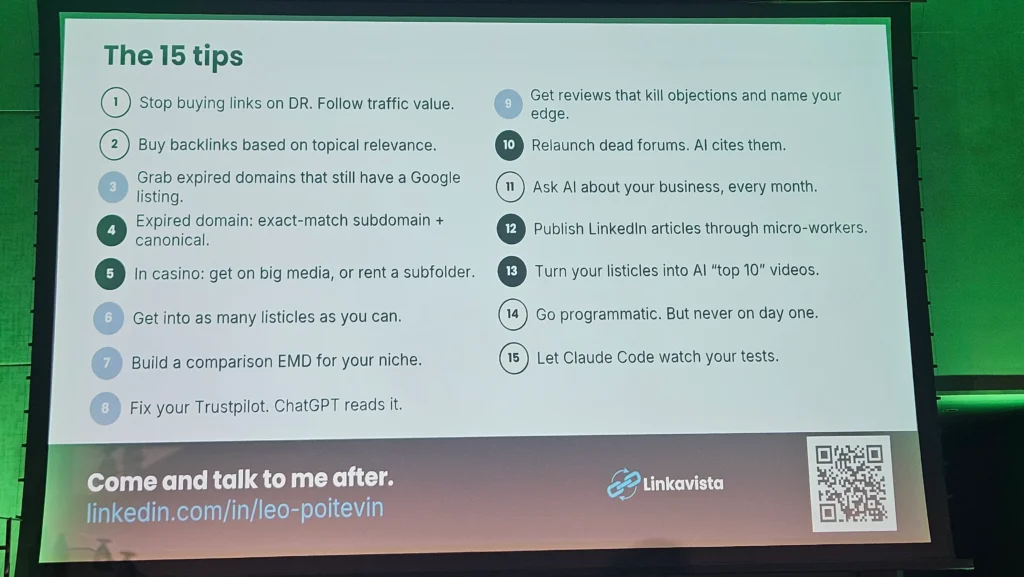
A note before this one. Léo’s session covered tactics across the full ethical range, and he labelled each as white hat (legitimate), grey hat (pushing it) or black hat (against the rules). I’m reporting what he presented because it’s useful to know what’s going on out there. The grey and black hat tactics below are not things DeCODE does or recommends.
It’s also worth saying that Léo wasn’t recommending most of them either. His talk was closer to a warning. He has tested these things, mostly in brutally competitive industries like online casinos, and his message came down to this: I’ve found where the line is, and you want to stay on the right side of it. He was upfront that many of these tactics have become harder with each Google update, including the one in September.
The legitimate ones
Stop buying links on domain rating. Authority scores can be bought and faked, and so can traffic numbers. Léo looks at what a website actually ranks for. His example compared five French HR software sites. The one with a modest authority score of 16 ranked for 207 relevant keywords and cost €22. The sites scoring 33 and 38 ranked for a fraction of that and cost more than twice as much. It’s the same conclusion Brie reached from a completely different direction.
Choose links by topical relevance. Find the keywords you want, look at who ranks for them, and work with the sites that appear most often.
Ask AI about your business every month. Check what it says and whether it’s right. He added that AI models love pricing pages.
Use programmatic content carefully. Generating pages at scale can work on an established site. Four thousand pages on day one of a new site will not.
Let AI agents monitor your tests. Léo’s team uses Claude Code to brief, order and track link placements. He showed a single prompt checking four websites, ordering four articles and logging the results.
The grey ones
Get into listicles. Léo showed a test where six inexpensive listicle placements, €317 in total, took a brand from appearing in none of ChatGPT’s answers for a target question to 21 out of 22. His advice was to go after narrower questions where there’s less competition, such as the best agency for a specific industry.
Fix your Trustpilot. ChatGPT reads it and uses it to cross-check your claims, like shipping speed.
Earn reviews that say something. Reviews that address common objections and name what you’re good at give AI tools the detail they need to describe you accurately.
The other grey tactics involved buying expired domains that still carry a Google listing, and building comparison sites on exact-match domains.
The black hat ones
This is where it gets inventive, and uncomfortable.
- Rented authority. Casino operators have been buying up gaming media sites and converting them, or renting a section of an established website to publish under its name.
- Zombie forums. Forums are hard work to run, so many have died. The tactic is to buy one, restore it and then populate it with AI agents playing the roles of the members, because AI tools cite forums. Morally ambiguous, to say the least.
- LinkedIn articles by proxy. Paying micro-workers to publish listicles from their own LinkedIn profiles, because AI tools trust LinkedIn.
- Manufactured video. Buying old YouTube channels, filling them with AI-generated “top 10” videos and paying workers to click and watch.
- Review sabotage. Léo noted that some operators are paying for negative reviews on their competitors’ profiles.
The ingenuity is fascinating. It’s also a clear picture of how AI answers can be manipulated, and why the AI companies and Google keep changing the rules. Every one of these tactics builds a business on something that can be taken away overnight.
Clients do sometimes come to us with a version of one of these ideas and ask, “Could we do this?” It helps to know exactly where the line sits and what happens to the businesses that cross it.
What this means for your business: if an SEO provider is selling links based on an authority score alone, ask what those websites actually rank for. Earn detailed, genuine reviews. And if someone offers you a shortcut that sounds like any of the black hat tactics above, walk away.
4. How to scale unique content
Georg Richard Aare, Co-founder, RankUp
Georg closed the day with a brilliant talk, and he’s done the research to back it up.
His premise: AI has made producing articles almost free, so generic articles are now worth almost nothing. Google has said as much. Its March 2024 update aimed to cut low-quality, unoriginal content in search results by 40%, and Google later reported it achieved 45%.
Google’s own guidance uses two words for what it wants instead:
- Effort. How much real human work went into the content. Google’s guidance says crediting other sources “doesn’t replace the need for original effort”.
- Originality. Whether the content offers information or perspectives that aren’t already available on other websites.
In practice that means first-hand perspectives, primary sourcing, original data and proprietary assets. Georg pointed to recent research from Lily Ray and Cyrus Shepard reaching the same conclusion, with Shepard’s study finding that 92.9% of winning sites own something competitors can’t easily replicate, compared with 57.1% of losing sites.
What the data says about unique content
“Create unique content” is easy advice to give, so Georg tested it. His study covered seven business software and service markets, 250 Google results pages, 3,106 ranking pages and more than 410,000 individual statements.
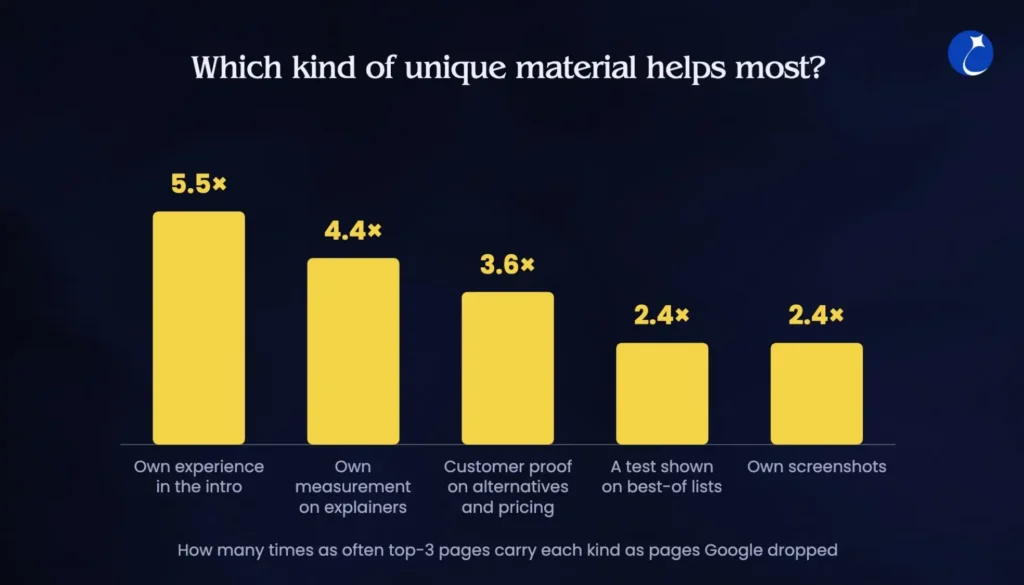
Which kind helps most? Compared with pages that had dropped out of Google’s results, pages in the top three were:
- 5.5 times as likely to share their own experience in the introduction
- 4.4 times as likely to include their own measurements in explainer articles
- 3.6 times as likely to include customer proof on alternatives and pricing pages
- 2.4 times as likely to show a test they ran in best-of lists
- 2.4 times as likely to use their own screenshots
How much do you need? Pages with four to seven kinds of unique material held a top three spot 20% of the time, compared with 11% for pages with two or fewer.
Where should it go? Up front. Putting your own material in the introduction had the strongest effect.
Can a small site beat big brands? Yes. Small-site pages with six or more first-hand statements held a top three position 17% of the time, against 8% for those with none.
Can formatting do the same job? No. Georg tested length, FAQ blocks, fresh dates, section counts and more than 40 other formatting features. Pages with them ranked no better. That lines up neatly with Manick’s list of what didn’t matter.
Don’t be too unique
One nuance I found useful. Georg said the benefit of adding unique elements tapers off, with the sweet spot somewhere around five or six. Beyond that, results went backwards.
His explanation was that a page made entirely of unique material stops looking like the other pages ranking for that search. It no longer covers the basics that Google and readers expect, so it drops out of the contest altogether. His approach is to match what the top pages cover, then add what only you can say.
The system
Knowing this is one thing. Doing it across hundreds of pages without it swallowing your team is another. Georg’s answer is what he calls an agentic knowledge system, in four parts.
- Create a knowledge base. One place to store everything unique to your business: your own tests, customer stories, photos and screenshots, your numbers and your experience. Every fact is recorded with its source and date. Two tips he added: collect the statistics your top-ranking competitors use and find your own answer to each, and pair every claim you make with proof.
- Put unique insights into every new article. Go deepest on the pages closest to a buying decision, such as comparisons, reviews and best-of lists. Where there’s a gap, have the AI agent interview you. It asks a short question, you answer by voice, and your answer goes onto the page and into the knowledge base.
- Improve existing articles. Compare each page with the top result, then have the agent propose specific edits from the knowledge base for a person to accept or reject. In one example, six facts supplied by a client became 16 proposed edits across 14 pages.
- Let it compound. Every answer goes back into the knowledge base, so each new article needs less input than the last. Georg’s estimate is that after 30 to 50 articles the knowledge base carries most of the load.
A person approves every change. The agent drafts and proposes, and a human decides what gets published.
His own results over the past six months: 299 new articles, 481 searches ranking in Google’s top three and 1,208 in the top five.
What this means for your business: you already own the raw material. Job photos, real numbers, customer stories, the questions people ask you every week and the lessons you learned the hard way. That’s the content nobody else can copy, and it’s what both Google and AI tools are looking for.
The common thread from Day 2
- Proximity beats popularity. Whether it’s harmonic centrality or Léo’s link-buying maths, big authority numbers matter less than being connected to the right sources.
- AI does most of its reading where you can’t see it. 88% of what ChatGPT reads sits outside the top 50 search results. Deep, specific pages matter more than ever.
- The passage is the unit that counts. One clear, self-contained answer to one question, with specifics.
- Unique, provable content wins. Your own experience, numbers and customers, stated up front.
- Formatting tricks don’t. Two independent datasets found that length, FAQ blocks and fresh dates made little or no difference.
- Shortcuts have a shelf life. The black hat tactics are inventive, and every update makes them riskier.
- The experts don’t always agree. Everyone is running their own experiments. Treat confident claims about AI search with care, ours included.
None of this is out of reach for a small business. A well-built website with clear answers, genuine reviews, real photos and real numbers, mentioned by the right people in your industry, is exactly what these systems are looking for.
If you’d like to know how your business shows up in AI search, or how to turn what you already know into content that ranks, get in touch with the DeCODE team.
This is part two of our five-part series from the Chiang Mai SEO Conference 2026. Read Day 1 here. Day 3 is coming soon.
Sources
- Chiang Mai SEO Conference 2026
- White Light Digital Marketing (WLDM) – session data from WLDM’s AI SEO Research Lab
- Common Crawl and Common Crawl: How SEOs are using Common Crawl’s web graph data for AI ranking signals
- Search Atlas – session data from Search Atlas’s GEO Sim studies, November 2026
- Astrak
- RankUp – Georg Richard Aare’s presentation and study
- Google: Creating helpful, reliable, people-first content
- Google: March 2024 search update
On this page
We’re here to help you DeCODE the Digital World
DeCODE builds breathtaking websites that drive sales for your business without a price that would take your breath away.
We understand that Companies don’t need websites. Companies need a regular stream of high-quality leads. Customers eager, educated, and ready to purchase their products or share their vision. This is the core of a DeCODE build.
In 2026 websites are no longer set and forget, winning an online race is now a marathon, not a sprint. Visually stunning sites with limited back end functionality and no ability to perform in search are redundant.
At DeCODE we build sites that perform.







Adam is a digital marketing specialist, business strategist, and Partner at DeCODE Digital, with 20+ years across marketing, sales, business strategy, and commercial transformation. He works with businesses that need more than a marketing plan: a clear strategy, stronger market position, and a digital presence that drives real commercial growth.