
Conversion insight
Long Pages
After thousands of hours of website optimisation, the pattern is impossible to ignore. Here's why long pages win.
Long Web Pages Convert Better. Here’s Why.
After more than 10,000 hours of optimisation work, the pattern is impossible to ignore: long-form web pages consistently convert better than short ones, and often by a significant margin.
Created: March 10, 2026 | Reading Time: 5 minutes


In digital marketing there are very few things I speak about in absolute terms.
When I first started optimising websites, I probably had more certainty than experience justified. Over time that changed. After thousands of campaigns, redesigns, landing page tests, and conversion experiments, you learn that the internet rarely rewards rigid rules.
But there is one conclusion I have become increasingly comfortable stating clearly:
Long-form web pages work better.
Not always by a tiny margin. Often by a significant one.
And after spending well over 10,000 hours working on website optimisation, conversion strategy, SEO, and search visibility, the pattern has become impossible to ignore.
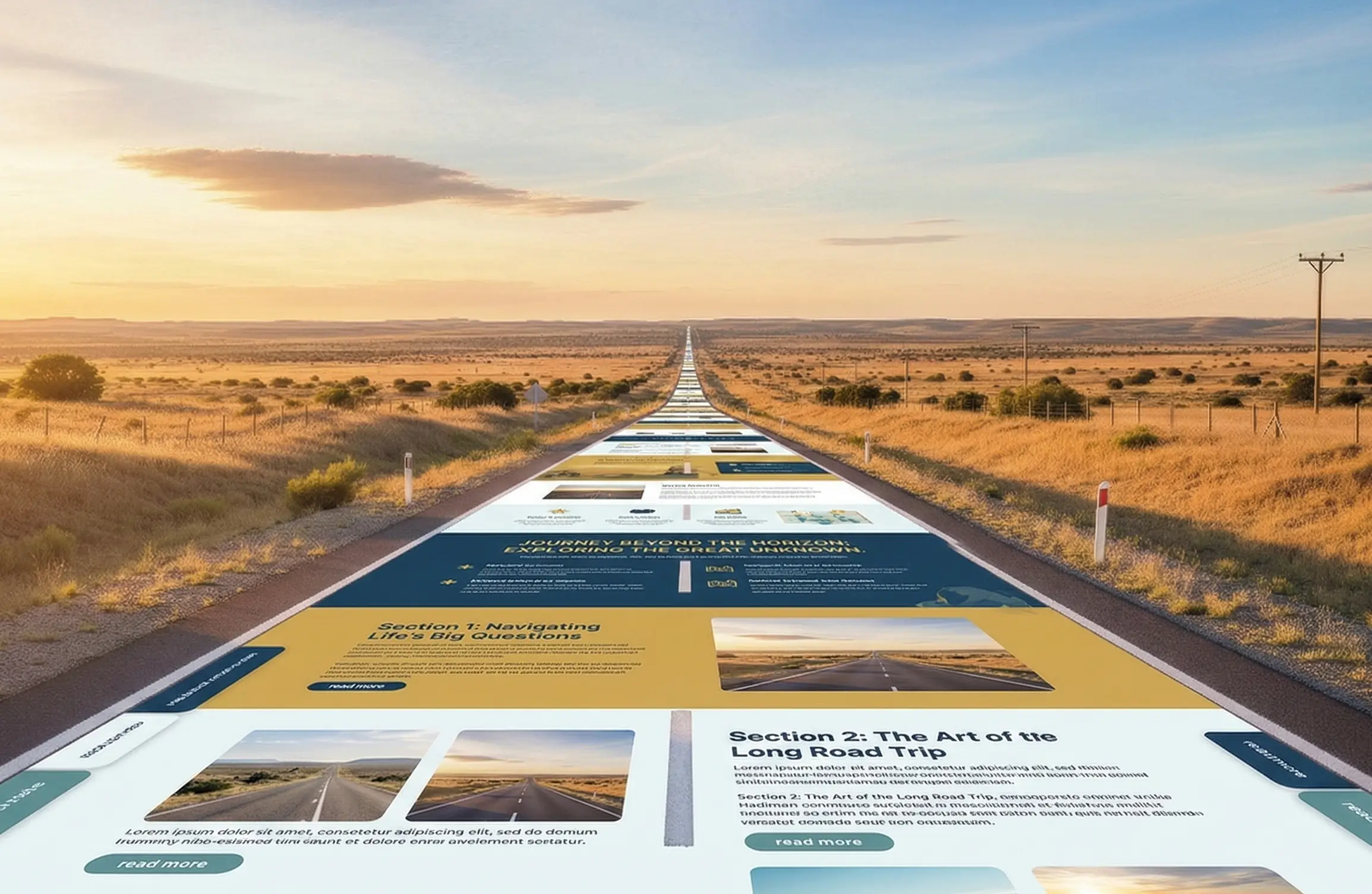
The Simple Logic Behind Long-Form Pages
The idea is actually very simple. It comes down to how different types of visitors behave.
When someone lands on a page, they fall into one of a few broad categories.
1. People Who Aren’t Interested
Some visitors will land on the page and realise immediately that it is not for them.
They bounce.
Long content does not hurt this outcome. They were never going to convert anyway.
2. People Who Are Interested and Ready to Act
Another group already knows what they want.
They recognise that your service or product fits their needs and they convert quickly.
They will usually act above the fold, often within the first screen or two.
Again, page length is irrelevant to them. The conversion opportunity was already there.
3. People Who Are Interested but Need Reassurance
This is where things become interesting.
Many visitors arrive with interest but also hesitation.
They might be asking themselves questions such as:
- Is this the right provider?
- Do these people understand my situation?
- Have they done this before?
- Can I trust them?
- What exactly am I getting?
These visitors start scrolling.
And if the page is structured properly, the page continues to sell as they scroll.
Each section answers another question, removes another doubt, and builds another layer of trust.
4. The Deep Readers
Finally, there are the visitors who will read almost everything.
These are often the most valuable prospects. They are engaged, curious, and actively evaluating your offering.
For them, long-form content is not a problem. It is exactly what they want.
They are looking for detail.
If the information is there, they stay.
If it is not, they leave and look elsewhere.

Why Long Pages Win from a Conversion Perspective
When you design a long page properly, you are essentially creating a conversion path that unfolds as the user scrolls.
Each section performs a specific role.
A typical high-performing structure might include:
- A strong introduction and value proposition
- Clear explanation of the service or product
- Visual examples or case studies
- Testimonials or social proof
- Detailed explanation of how things work
- Frequently asked questions
- Pricing guidance or next steps
- Multiple opportunities to enquire or convert
Instead of expecting a visitor to decide immediately, you earn the conversion gradually.
Every section gives the visitor another reason to trust you.
Why Long Pages Are Also Powerful for Google
There is another advantage that often gets overlooked.
Long-form pages give you the opportunity to create rich topical coverage.
Search engines are trying to understand what a page is about and how well it answers a user’s query. When a page includes detailed explanations, supporting sections, and related information, it provides far more signals.
A well-built long page allows you to naturally include:
- Detailed explanations of your service
- Related subtopics
- Case studies and real-world examples
- Supporting blog articles
- Frequently asked questions
- Industry terminology
- Customer outcomes
Instead of thin content that barely scratches the surface, the page becomes a complete resource around a topic.
That helps search engines understand both the depth of your knowledge and the relevance of your page.

Long Pages Do Not Mean Bloated Pages
There is an important distinction here.
Long pages are not the same as bloated pages.
Simply stuffing more words onto a page does not improve anything. In fact, it can make things worse.
The content still needs to be:
- Clear
- Concise
- Engaging
- Structured properly
Every section should serve a purpose within the copy tree.
Each part of the page should either:
- explain
- reassure
- demonstrate credibility
- remove objections
- or encourage the next step
If a section does none of those things, it probably does not belong on the page.
This Principle Applies to More Than Just Landing Pages
Many businesses assume long content is only useful for blog articles or specialised landing pages.
In reality, almost every page on a website benefits from depth.
This includes:
- Homepages
- Service pages
- About pages
- Industry pages
- Solution pages
Any page that plays a role in building trust or helping a visitor make a decision can benefit from a more complete explanation.
Short pages often leave too many questions unanswered.
And unanswered questions slow down conversions.

Scrolling Is Not the Problem People Think It Is
For years, designers worried that users would not scroll.
Modern behaviour has proven otherwise.
People scroll constantly. It is one of the most natural interactions on the internet.
What they will not do is scroll through boring or irrelevant content.
But if the information is helpful, structured well, and visually supported, users will keep moving down the page.
The Real Goal: A Page That Keeps Selling as It Scrolls
The goal of a long-form page is not simply to be longer.
The goal is to create a page that continues to sell as the user scrolls.
A visitor who arrives uncertain should feel progressively more confident as they move through the content.
Questions get answered.
Trust increases.
And eventually the conversion becomes the natural next step.
The Simple Summary
After years of building and refining websites, the principle can be summarised very simply.
If someone is not interested, they leave.
If they are ready to act, they convert immediately.
If they are interested but unsure, they scroll.
And if your page is structured well, the content they encounter as they scroll will convert them.
// THE TAKEAWAY
That is why long-form pages work better.
On this page
We’re here to help you DeCODE the Digital World
DeCODE builds breathtaking websites that drive sales for your business without a price that would take your breath away.
We understand that Companies don’t need websites. Companies need a regular stream of high-quality leads. Customers eager, educated, and ready to purchase their products or share their vision. This is the core of a DeCODE build.
In 2026 websites are no longer set and forget, winning an online race is now a marathon, not a sprint. Visually stunning sites with limited back end functionality and no ability to perform in search are redundant.
At DeCODE we build sites that perform.
Adam is a digital marketing specialist, business strategist, and Partner at DeCODE Digital, with 20+ years across marketing, sales, business strategy, and commercial transformation. He works with businesses that need more than a marketing plan: a clear strategy, stronger market position, and a digital presence that drives real commercial growth.