
Hosting & Maintenance
Cheap Hosting vs
What You Need to Know
Cheap Hosting vs Premium Hosting
Hosting and maintenance are not the same thing, and the value of getting them right is invisible until the day something breaks. An honest look at cheap vs premium hosting, why we don't push hosting, and how to choose for your business.
Created: June 27, 2026 | Reading Time: 7 mins


“How much should I really be paying to keep my website online?”
It is a common question we get asked at DeCODE, and it’s a good one. The answer very much depends on what you need. Do you want to come up in search over competitors, do you just need a digital proof of life, does it matter if more people convert on your website?
While one host quotes you a few dollars a month, another quotes you ten times that for what looks like the same thing, and you are left wondering whether you are being looked after or taken for a ride.
This article is our attempt to clear that up, without the spin. We’ll also explain the difference between hosting and maintenance, why some hosting options can be genuinely cheap, what you actually get when you pay more, and the one feature of all this that nobody notices until the day they desperately need it.
Everything worth having has a running cost
Before we get into cheap versus expensive, it is worth naming something we all quietly accept everywhere else in life: the good things have a running cost. Not a one-off price, but an ongoing one.
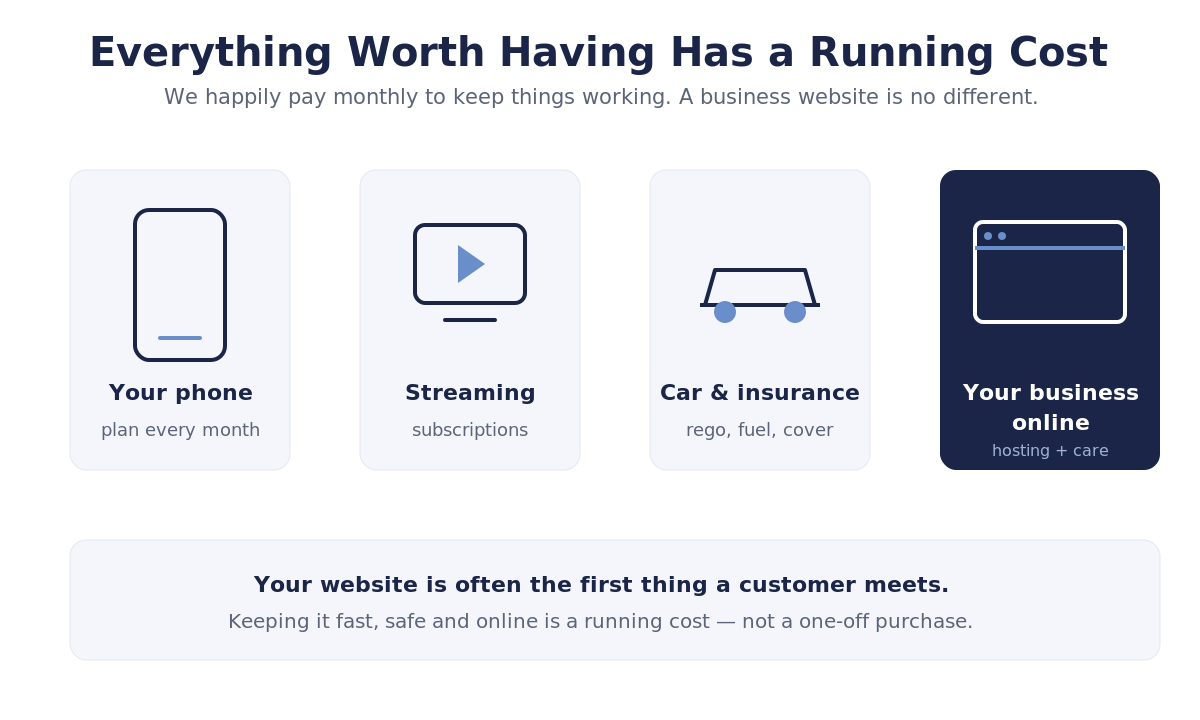
Your phone is useless without a plan you pay for every month. Your favourite shows live behind subscriptions. A car costs you registration, fuel, servicing and insurance long after you have driven it home. None of this surprises us, because we understand that keeping something useful working is different from buying it once.
A business website is the same. For a lot of businesses it is the first thing a customer meets: the digital front door, open around the clock. Keeping that door fast, secure and reliably open is a running cost, not a purchase you make once and walk away from. That is not a sales pitch; it is just the nature of anything that has to keep working while you sleep.
Hosting and Maintenance are not the same thing
This is the single biggest source of confusion, so let us deal with it first. People tend to lump “the website costs” into one bucket, but there are really two separate jobs being done, and they are as different as paying rent and actually cleaning the house.
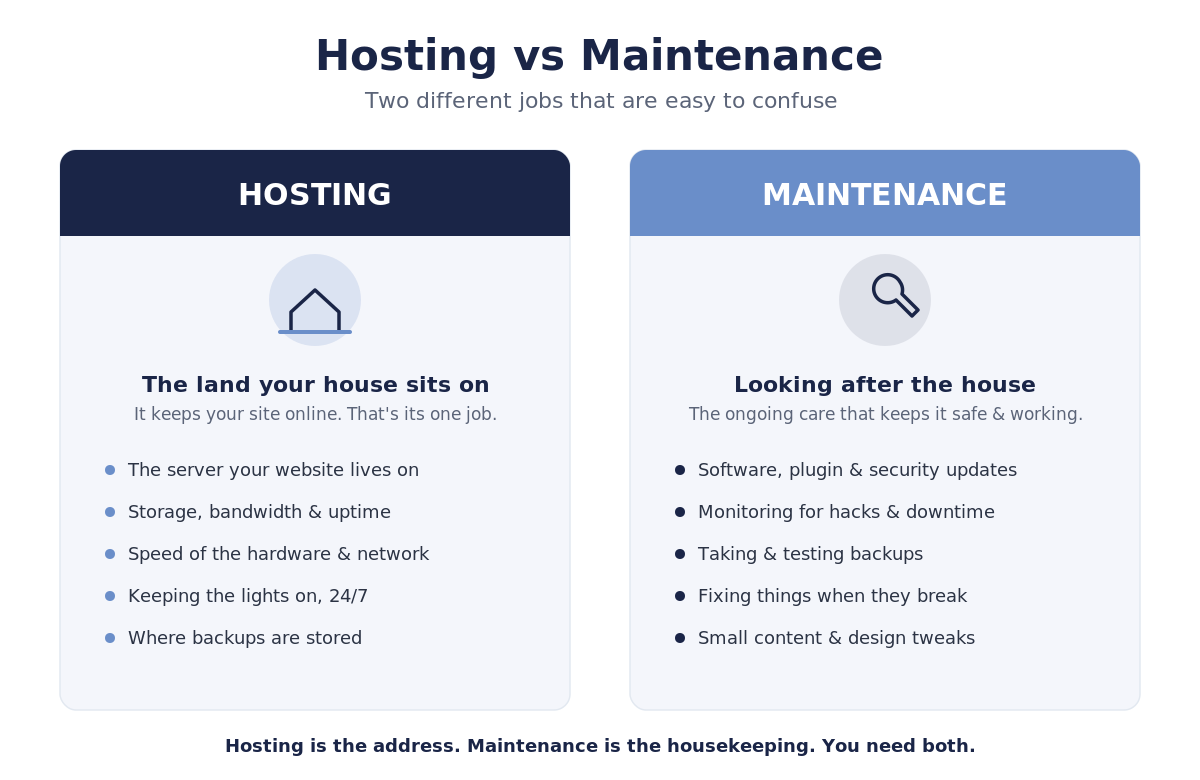
Hosting is the land your website sits on. It is the server your site lives on, the storage and bandwidth it uses, and the connection that delivers your pages to visitors. Its one job is to keep your site online. Good hosting does that quickly and reliably; cheap hosting does it slower and with fewer guarantees. But hosting, on its own, does not look after anything. It just keeps the lights on.
Maintenance is the housekeeping. It is the ongoing care that keeps the website safe, current and working: software and security updates, monitoring for hacks and downtime, taking and testing backups, and fixing things when they break. A website is not a painting you hang on a wall once and forget. It is built from dozens of moving parts (the platform, the theme, the plugins) that are all updated constantly by their makers. Maintenance is the work of keeping those parts in step so nothing falls over.
You can have brilliant hosting and zero maintenance, and still end up with a hacked, broken site. You can have a diligently maintained site on poor hosting, and watch it crawl. The two work together, and it helps enormously to know which one you are actually paying for when you look at a bill.
So why are some hosts so cheap?
Here is the part we want to be fair about, because it would be easy (and lazy) to imply that cheap hosting is a scam. It is not. There are perfectly legitimate reasons a host can charge very little.
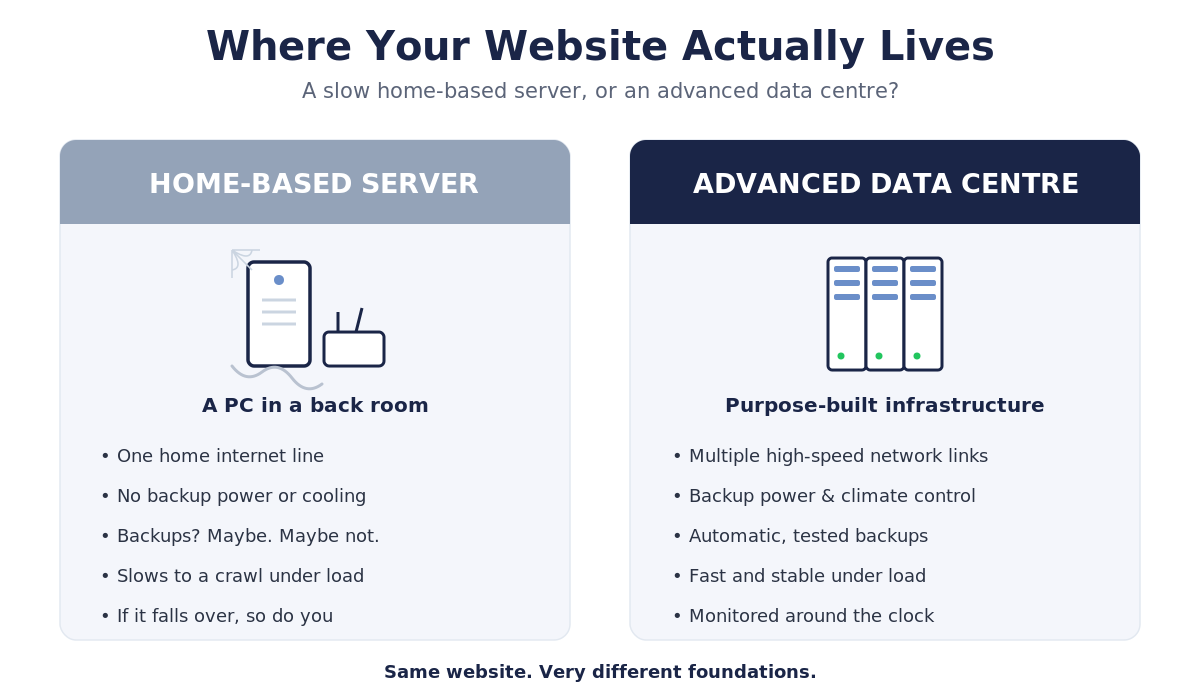
The main one is sharing. Budget hosting typically packs a large number of websites onto a single server, so the cost of that machine is split many ways. It is a bit like a share house: everyone pays less because everyone splits the rent. The trade-off is that you also share the resources, so when a neighbouring site has a busy day, your site can feel it. Cheap hosts also tend to automate almost everything and keep human support light, which keeps their costs (and therefore your price) down. Add the big players’ scale, and a few dollars a month is a real, honest number, not a trick.
So if cheap hosting works for your situation, that is a completely valid choice. The thing to understand is simply what you are trading away for that lower price, because the differences are real, even if they are invisible most of the time.
Cheap vs Premium: The Actual Difference
From the outside, two websites on two very different hosting plans can look identical. Same shopfront, same pages, same logo. The differences only show up under load, over time, and most of all, when something goes wrong.
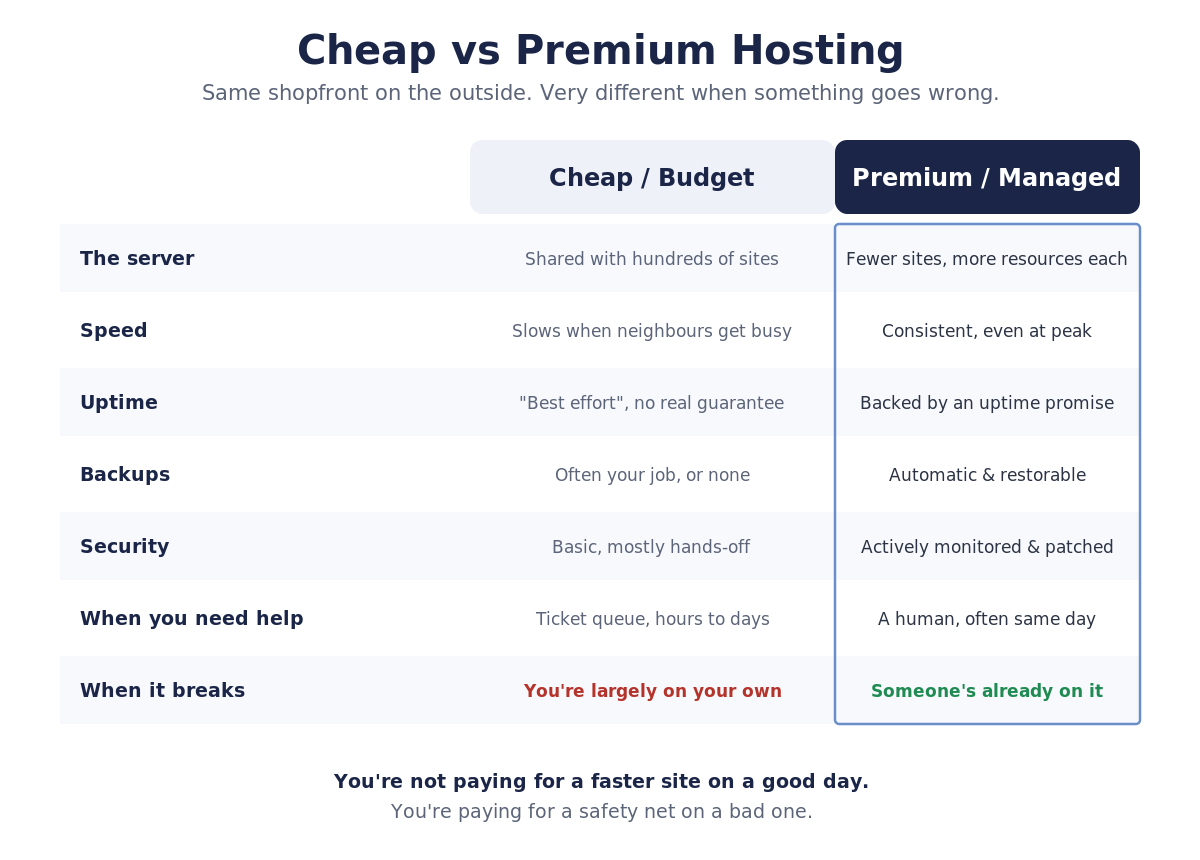
Premium or managed hosting generally means fewer sites per server (so more resources for yours), more consistent speed even at peak times, a genuine uptime commitment rather than a “best effort”, automatic backups you can actually restore from, active security monitoring and patching, and, crucially, a human you can reach quickly when you need one. Cheaper plans tend to be lighter on every one of those fronts.
None of which matters on an ordinary Tuesday when everything is fine. And that is exactly the trap.
The catch: you do not notice any of this until you need it
Most things you buy give you the benefit the moment you own them. You buy a nicer chair, you sit in it, it is comfier, instantly. Good hosting and maintenance do not work like that. Their value is not in something you gain when you buy them; it is in something bad that does not happen, or that gets fixed quietly before you even notice.
You do not feel the benefit of solid hosting and diligent maintenance on a normal day. You feel it the day your site gets hit by malware, or goes down during your busiest sale, or a botched update takes the whole thing offline. That is the moment the difference between cheap and premium stops being abstract. On a well-maintained, well-hosted site, there is a recent backup, someone has already been alerted, and you are back online before most customers ever knew. On a bare-bones setup, you discover, at the worst possible time, that the backup you assumed existed does not, and the “support” is a ticket in a queue somewhere.
It is the same logic as insurance, a smoke alarm, or a spare tyre. The cost of not having it is invisible right up until the moment it is enormous, and by then it is too late to go back and buy it.
What does a “hack” actually look like?
“Getting hacked” sounds abstract until it happens to you. It is rarely a dramatic figure in a hoodie. It is usually quiet, automated, and aimed squarely at your customers and your reputation. Here is what it actually tends to look like.
Spam and defacement
Your pages quietly fill with pharmacy or casino spam, or a stranger’s “we hacked this” message replaces your homepage. Every visitor sees it before you do.
A big red Google warning
Search shows a “Deceptive site ahead” page, or Google quietly drops you from results altogether. Traffic, enquiries and bookings can vanish overnight.
Stolen customer data
Enquiry forms, logins or payment details get skimmed and sold. Beyond the damage to trust, that can trigger real privacy and legal obligations.
Locked out or held to ransom
Your admin access is taken or your files are encrypted. Without a clean, recent backup, getting back online can take days, or cost a ransom.
Almost every one of these is prevented by the same unglamorous work, the updates, monitoring and backups, that good maintenance quietly does in the background. That is the whole point: you never see the hack that did not happen.
Why we don’t “sell” hosting
Here is an honest admission: hosting is actually a big part of what we do. We host and maintain a lot of websites, and we are good at it. But we have never been in the business of “selling” hosting in the pushy sense. We are not here to convince you, pressure you, or make hosting sound scarier than it is so that you sign up with us.
In fact, if a client would rather host elsewhere, we will happily package up their site and hand it over, no hard feelings. The right answer depends entirely on your situation: your budget, your traffic, how much the site matters to your revenue, and your appetite for risk. A sole trader’s brochure site and a busy online store have very different needs, and we would rather you made that call with clear information than feel nudged into anything.
What we will quietly mention is that a fair few of those clients come back. Not because we chased them, but because once they have lived with the difference, they would rather we kept the lights on and looked after the place too. That is the only sales pitch we have: do good work, be straight with people, and let them choose.
The Patterns We See
Here is something that comes up far more often than you would think. We get asked to jump in and fix an urgent problem on a server we do not run and were never set up to look after. A site has gone down, an update has broken something, or it has been hacked, and someone needs it sorted today.
We will always try to help where we can, and we usually can. But we would not be telling the truth if we said we loved doing it. Working on someone else’s server, with whatever limited access and backups that host happens to provide, is slower, harder and more stressful than it should be, and it almost always costs more and takes longer than if the hosting and maintenance had been set up to work together from the start.
This is not about bad-mouthing other hosts, plenty of them are perfectly good. It is simply that “who keeps the lights on” and “who fixes it when they go out” are far easier to manage when they are not strangers to each other.
So, what do I do?
Start by separating the two questions in your head: where does my site live (hosting), and who keeps it healthy (maintenance). Then weigh it honestly against how much the website matters to your business. If it is a quiet brochure site, budget hosting and light maintenance might be exactly right. If it is where your customers find you, book you, or buy from you, the safety net is usually worth every cent, not for the good days, but for the one bad day you cannot predict.
Need a hand thinking it through? Reach out, it’s a conversation we are always happy to have.
On this page
We’re here to help you DeCODE the Digital World
DeCODE builds breathtaking websites that drive sales for your business without a price that would take your breath away.
We understand that Companies don’t need websites. Companies need a regular stream of high-quality leads. Customers eager, educated, and ready to purchase their products or share their vision. This is the core of a DeCODE build.
In 2026 websites are no longer set and forget, winning an online race is now a marathon, not a sprint. Visually stunning sites with limited back end functionality and no ability to perform in search are redundant.
At DeCODE we build sites that perform.










Ilana is a Web Designer & Development Consultant with 15+ years building websites that actually perform: ecommerce stores, membership platforms, training portals, and SEO rebuilds that turn slow, dated sites into properties that rank and convert.