
SEO insight
Content and SEO in a
What content actually ranks now that AI writes 90% of what gets published, and how to write the 10% that matters.
Content and SEO in a Post-AI World
A practical look at how AI is reshaping search, what that means for the content businesses publish, and how to keep standing out in the noise.
Created: June 7, 2024 | Reading Time: 6 minutes


What’s Changed and How to Succeed in Search.
If you’ve been feeling rather lost in navigating how to stand out as a business in a digital world you’re not alone. Things are moving fast as AI develops. There is lots of hype by vendors promoting AI-driven products and services, and lots of funding and research going into this powerful technology.
How can we sift through the noise around AI and understand what it takes to produce quality content that stands out on search engines? Let’s start by understanding what AI is and how it affects the digital space.

AI is all the buzz, but is it really useful for the average business?
Think of AI as a magical toolbox that learns, adapts and gets better over time. When you need to solve a problem or perform a task, you pull out this magical toolbox.
AI systems use data and algorithms to simulate how humans think, learn, and make decisions. This allows them to perform complex tasks like understanding natural language and recognising images.
Here are some ways that AI is being used as a tool in digital marketing:
- Content Creation: AI tools like GPT-4 generate content for blogs, social media, and ad copy to save time and resources.
- Chatbots: AI-powered chatbots provide instant customer service through answering queries and guiding users through their buying journey 24/7.
- Predictive Analytics: AI uses historical data to predict future trends, helping marketers plan campaigns and make informed decisions.
- Personalisation of Content: AI analyses user data to create personalised content recommendations and experiences, boosting engagement and conversions.
- Programmatic Advertising: AI automates the buying of ads, targeting the right audience at the right time for maximum impact.
- Sentiment Analysis: AI analyses social media and customer feedback to understand public sentiment, helping brands adjust their strategies accordingly.

The Impact of AI and ChatGPT on the Digital World
As you can imagine, AI-generated content is flooding the internet. While the rise of AI, particularly models like ChatGPT, has revolutionised the digital landscape, it has also blurred the lines between what is human-generated and AI-produced.
While some of this content is valuable, much of it lacks the depth and nuance of human expertise. This has created an overarching need for more sophisticated methods of evaluating and ranking content to ensure users receive the most relevant and high-quality information.

How is Google Responding to AI?*
AI has been a big deal to Google since its earliest days. It recognises AI’s power to make routine tasks easier and come up with solutions for some of society’s biggest problems. In 2018, Google published a list of Ai Principles which outline the company’s commitment to ethical and responsible AI development.
*Note: While Google is not the only search engine, it is indisputably the most widely-used one. That’s why Google is referenced when we talk about search engines. Also, SEO fundamentals are pretty consistent across most search engines.
Here are some fascinating AI milestones since Google started out back in 1998:
- Spell Check in Search (2001)
Started using machine learning to fix spelling mistakes in searches, helping users find what they need even with typos. - Google Translate (2006)
Launched Google Translate, making it easier to break down language barriers. Today Google Translate supports more than 130 languages spoken by millions of people around the world. - TensorFlow (2015)
Released TensorFlow, an open-source tool that allows developers everywhere to build powerful AI applications such as image recognition and natural language processing. - AlphaGo (2016)
AlphaGo, from Google’s DeepMind, became the first AI program to beat a world champion Go player, showing that AI could handle super complex games. - Transformer Model (2017)
Introduced the Transformer model, revolutionising how AI understands and processes language – particularly longer sentences involved in translation, text summarisation and question answering. - BERT (2019)
Enhanced Google Search with BERT, which understands the context of words in queries better than ever before. This means that questions asked in natural language are better understood, instead of needing to string keywords together. - AlphaFold (2020)
DeepMinds’s AlphaFold cracked the “protein-folding problem”, helping scientists understand diseases and develop new treatments like malaria vaccines faster. The technology has even been used to develop plastic-eating enzymes! - Bard and PaLM 2 (2023)
Launched Bard, an AI to boost productivity and accelerate ideas which has been incorporated in Google services such as Gmail, Docs, Flights and YouTube. This helps users with tasks like trip planning and summarising emails or documents. - PaLM 2 (2023)
A model that improved multilingual, reasoning and coding capabilities. PaLM 2 already powers more than 25 Google products and features – including Bard and generative AI features in Gmail and Workspace. It is also being used to advance research internally on everything from healthcare to cybersecurity. - Gemini (end of 2023)
Launched Gemini, Google’s most advanced and flexible AI model. It can combine different types of information including text, code, audio, image and video, as well as efficiently run on everything from data centres to mobile devices.

Let’s Talk Algorithms and Why They Matter
Algorithms are a set of instructions that tell a computer how to perform a task step-by-step, much like a recipe to cook a meal. As a building block of AI, they help the computer learn from data, recognize patterns, make decisions, and solve problems.
Google uses algorithms to rank pages and websites. While it is impossible to know exactly how these algorithms work, staying informed about important algorithm updates helps in maintaining and even improving your search rankings and visibility to potential customers.
As one of the world leaders in AI, Google has clearly defined principles around addressing the challenges posed by AI-generated content. The company constantly rolls out algorithm updates in order to maintain high-quality search results, combat spam and manage the surge of AI-generated content. Initially, updates were infrequent, but now Google makes thousands of changes annually. These updates significantly impact Search Engine Results Pages (SERPs).
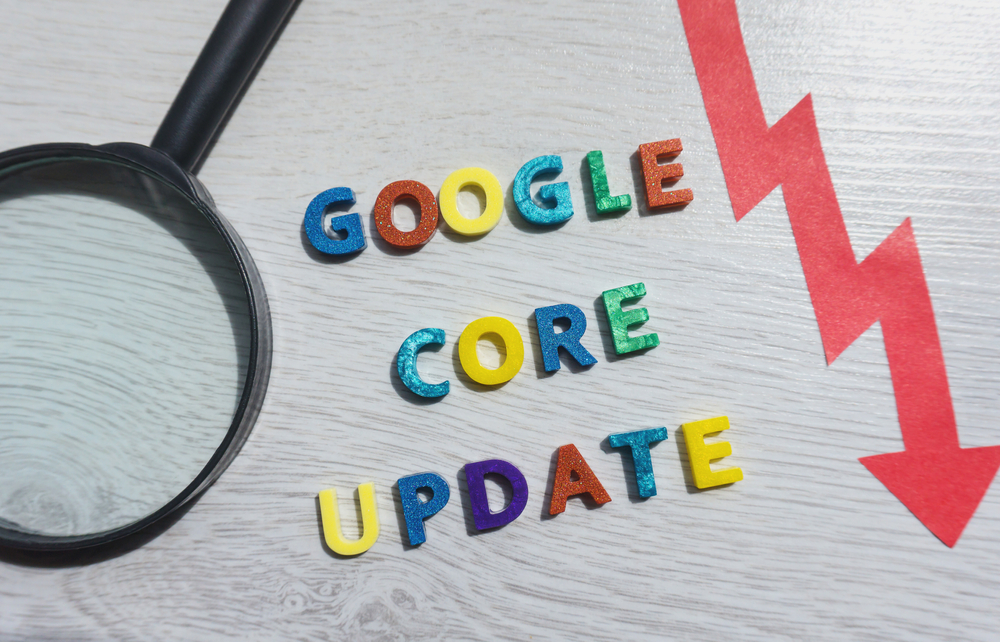
Let’s learn about some key Google algorithm updates and their impact on Search Engine Optimisation.
- Florida Update (2003): The first major update aimed at reducing keyword stuffing and improving the quality of search results. This update marked the beginning of Google’s focus on content quality over keyword manipulation.
- Panda Update (2011): Introduced to penalise low-quality content and sites with thin or duplicate content. This update emphasised the importance of high-quality, original content.
- Penguin Update (2012): Targeted webspam and manipulative link practices. The Penguin update prioritised natural, high-quality backlinks and penalised sites using black-hat SEO techniques.
- Hummingbird Update (2013): A major overhaul of the core algorithm that improved semantic search capabilities. Hummingbird enabled Google to understand the context and intent behind user queries better.
- Mobilegeddon (2015): Prioritised mobile-friendly websites in search results, reflecting the growing importance of mobile search. This update underscored the necessity of responsive web design.
- RankBrain (2015): Introduced as part of the Hummingbird algorithm, RankBrain is an AI-based system that helps Google understand search queries and improve the relevance of results. It marked a significant shift towards machine learning in search.
- Medic Update (2018): Focused on YMYL (Your Money or Your Life) sites, particularly in the health and medical fields. This update emphasised the need for expertise, authoritativeness, and trustworthiness in content.
- BERT Update (2019): A deep learning algorithm related to natural language processing. BERT improved Google’s understanding of the nuances and context of words in search queries.
- December 2020 Core Update: Continued the trend of emphasising quality content and E-A-T (Expertise, Authoritativeness, and Trustworthiness). This update highlighted the importance of user experience and content relevance.
- March 2024 Core Update: Resulted in the de-indexing of hundreds of websites with significant amounts of AI-generated content. This update reinforced the need for human oversight and quality control in content creation.

What is SEO and How to Make it Work for You?
Let’s imagine SEO or Search Engine Optimization in the context of a library. Your website is a book in a huge library (the internet), and search engines like Google are the librarians. To make sure your book gets noticed and read, you need to give it a clear, descriptive title (keywords), fill it with valuable information (high-quality content), and make it a breeze to find on the shelves (user experience). Just like a well-catalogued book attracts more readers, an optimised website draws in more organic traffic and meets users’ search needs.
When it comes to SEO, getting noticed and staying in the spotlight are two different things. SEO is a long-term game that requires consistent attention.
Here are 10 tips for optimising your website’s SEO health:
- Understand your audience
Knowing what your potential customers are searching for is crucial in building a website or content that is well-received. Digital marketing tools like Google Search Console and SEMRush are great resources to support this process.
If your business involves Your Money or Your Life (YMYL) topics – subjects that significantly impact the audience’s wellbeing like medical advice or financial planning – precision and reliability are crucial. Working with Google’s E-E-A-T framework helps keep you on track.
- Conduct competitor analysis
These digital analyses help you understand your competitors and learn from their mistakes so that you can work on offering something better and draw more traffic to your site.
- Avoid keyword stuffing your pages
Overloading content with keywords can lead to penalties. Instead, use keywords naturally and strategically. Tools like Google Keyword Planner and SEMRush help to identify high-volume, relevant keywords.
- Use high quality visuals
Enhance your articles with relevant images, infographics, and videos to illustrate points and improve engagement. Visually appealing content is usually better engaged with and shared on social media.
- Add high-authority links
By strategically placing links, you can significantly enhance your site’s SEO performance. Internal links guide users to other valuable pages on your site, enhancing user experience and helping search engines understand your site structure. External links link to credible sources to provide context and value, boosting your content’s reliability and relevance. Backlinks are best earned from reputable websites. These not only drive traffic but also signal to search engines that your content is trustworthy and authoritative, improving your rankings.
- Create optimised meta descriptions and title tags
Title tags (those clickable headlines in search results) should be concise, descriptive, and include primary keywords to help search engines understand your content and improve visibility. Meta descriptions (the brief summaries under the title tags) should be clear, compelling, and accurately summarise your page while incorporating relevant keywords to boost click-through rates.
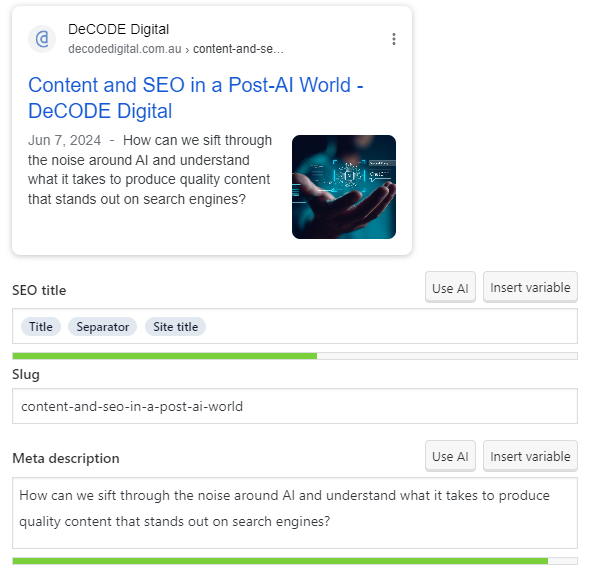
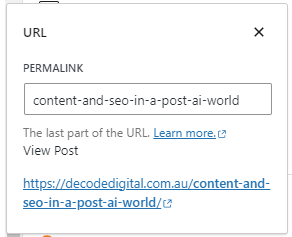
- Optimise your URL slug
The URL slug (the part of the URL that comes after the domain name) should clearly convey the content of the page. Keep this short, descriptive, and focused on relevant keywords. A well-optimised slug not only improves search engine performance but also makes it easier for users to understand and share your link. This small but significant detail can lead to better visibility and higher click-through rates.
- Increase page speed and mobile-friendliness
Ensure your site loads quickly and is accessible on all devices. For example, optimising images and using a responsive design can significantly enhance user experience and search rankings, as search engines favour fast, mobile-friendly sites.
- Create topic clusters
Topic clusters are created by grouping related content around a central pillar page to enhance site structure and relevance. For instance, a central pillar page on “Healthy Eating” can link to clusters of articles on specific diets, nutrition tips, and recipes.
- Regularly Update Content
Search engines favour fresh content, so keep your website current by regularly updating existing pages and adding new, relevant information. This not only improves your rankings but also keeps your audience engaged and returning for more.
Next up, you are what you EEAT!

What is E-E-A-T and how does it help your search rankings?
Google has implemented specific ranking factors to ensure that search results prioritise high-quality, reliable content. A key element of this strategy is the E-E-A-T framework, which stands for Experience, Expertise, Authoritativeness, and Trustworthiness.
In December 2022, it added ‘Experience’ to these quality guidelines, emphasising the importance of content that reflects real-world experience and expertise.
Although E-E-A-T (Experience, Expertise, Authoritativeness, and Trustworthiness) is not an algorithm, it is an important ranking factor for SEO success. Demonstrating E-E-A-T in your content improves your site’s performance and credibility. Here’s how you can ensure your content aligns with these critical elements:
1. Experience
- Showcase Real-World Insights: Use case studies, personal anecdotes, or real-world examples to illustrate your points. This adds depth and authenticity to your content.
- User-Generated Content: Incorporate reviews, testimonials, and user experiences. This not only builds trust but also shows that your content is based on real experiences.
2. Expertise
- Highlight Author Credentials: Include author bios with their qualifications, experience, and other relevant credentials. This reassures readers that the content is created by knowledgeable individuals.
- In-Depth Research: Ensure your content is well-researched and provides comprehensive coverage of the topic. Cite reliable sources and include data and statistics to back up your claims.
- Original Research and Analysis: Where possible, conduct and present your own research. Original data and unique insights add significant value and showcase your expertise.
3. Authoritativeness
- Leverage Expert Contributions: Collaborate with industry experts for guest posts, interviews, or quotes. Their input can add authority to your content.
- High-Quality Backlinks: Aim to get backlinks from reputable websites and industry leaders. This can enhance the perceived authority of your content.
- Recognitions and Awards: Mention any awards, recognitions, or notable achievements related to your site or authors. This builds credibility and authority.
4. Trustworthiness
- Transparency: Be clear about who you are and what you do. Include detailed ‘About Us’ and ‘Contact’ pages with company information, addresses, and other relevant details.
- Accuracy and Honesty: Ensure that your content is accurate and up-to-date. Correct any errors promptly and be honest in your assessments and reviews.
- Privacy and Security: Show that you value user privacy by having clear privacy policies and ensuring your site is secure (e.g. using HTTPS).
- Engage with Your Audience: Respond to comments and feedback. Engaging with your readers builds trust and shows that you value their input.
Examples of E-E-A-T in Action
Demonstrating E-E-A-T (Experience, Expertise, Authoritativeness, and Trustworthiness) is crucial for content to rank well in search engines and provide value to users. Let’s explore how E-E-A-T can be effectively showcased in different content types:
Health and Medical Content
Example: An article on managing diabetes
- Experience: Include patient testimonials or case studies detailing real-world experiences with diabetes management. For instance, a patient sharing their journey of controlling blood sugar levels through diet and exercise adds personal insight and authenticity.
- Expertise: Ensure the article is written or reviewed by medical professionals, such as endocrinologists or dietitians. Clearly state their qualifications, such as “Dr. Jane Smith, MD, Endocrinologist with 20 years of experience in treating diabetes.”
- Authoritativeness: Cite reputable medical sources like Diabetes Australia, Australian Diabetes Association, or peer-reviewed medical journals. Include data and statistics from these sources to support your claims.
- Trustworthiness: Maintain transparency about the sources of your information and disclose any potential conflicts of interest.
Financial Advice
Example: A guide on retirement planning
- Experience: Incorporate case studies or examples of individuals successfully planning their retirement. These could detail various strategies used, such as investing in stocks, real estate, or retirement funds.
- Expertise: The content should be authored or reviewed by certified financial advisors (CFAs) or financial planners. Highlight their qualifications, such as “John Doe, CFA, with over 15 years of experience in financial planning.”
- Authoritativeness: Use data from recognised financial institutions like Vanguard, Fidelity, or government sources such as ASIC or the Department of Finance. Include quotes or insights from renowned economists or financial experts.
- Trustworthiness: Ensure all financial advice is current and accurate. Regularly update the content to reflect changes in laws or financial trends. Provide clear disclaimers about the scope of advice and encourage readers to consult with a financial professional for personalised guidance.
Technical and Industry-Specific Content
Example: A comprehensive guide on cybersecurity for businesses
- Experience: Feature case studies of businesses that have successfully implemented cybersecurity measures. Describe real incidents and how specific actions helped mitigate risks.
- Expertise: The guide should include insights from cybersecurity experts with relevant certifications (e.g. CISSP, CEH). Highlight their experience, such as “Mary Johnson, CISSP, with over 10 years of experience in enterprise cybersecurity.”
- Authoritativeness: Link to industry standards and whitepapers from authoritative bodies like NIST (National Institute of Standards and Technology) or ISO (International Organisation for Standardisation). Refer to studies and reports from leading cybersecurity firms like Symantec or McAfee.
- Trustworthiness: Clearly explain the sources of your information and ensure it is up to date. Explain through the article why you are a credible source of this information.
Legal Advice
Example: An article on understanding GDPR compliance
- Experience: Share case studies of companies that successfully navigated General Data Protection Regulation (GDPR), detailing their challenges and solutions.
- Expertise: Have the article written or reviewed by legal professionals specialising in data protection law. Highlight their qualifications, such as “Jane Roe, LLM, Data Protection Specialist.”
- Authoritativeness: Cite legal texts, government publications, and authoritative sources like the European Commission or national data protection authorities.
- Trustworthiness: Ensure legal advice is current and accurately reflects the latest regulations. Regularly update the content as laws evolve and provide clear disclaimers.
Educational Content
Example: A tutorial on learning Python programming
- Experience: Include testimonials or success stories from individuals who learned Python using the tutorial, showcasing their projects and achievements.
- Expertise: The tutorial should be authored or reviewed by experienced programmers or educators. Highlight their experience, such as “John Doe, Software Engineer with over 10 years of experience in Python development.”
- Authoritativeness: Reference reputable programming resources, such as the official Python documentation, academic papers, and respected programming blogs.
- Trustworthiness: Ensure the tutorial is accurate and regularly updated to reflect changes in the Python language and best practices. Include a section for user feedback and engage with comments to build community trust.
By embedding these principles into your content strategy, you can significantly enhance your site’s credibility and effectiveness, ultimately leading to better SEO performance and user engagement.

How to Succeed in Search in a Post-AI World
There is no doubt that to stay relevant in this rapidly evolving digital era, businesses must focus on producing high-quality content. While the evolution of AI in content creation is significant, it cannot replace human creativity and insight.
Navigating the digital landscape in a post-AI world can seem daunting, but understanding the role of AI and adapting to its impact on SEO and content creation is crucial. AI is a powerful tool that can enhance various aspects of digital marketing, from content creation to predictive analytics. However, it is essential to recognise the limitations of AI-generated content and the continued importance of human expertise.
To succeed you need to be producing high-quality, relevant content and focus on producing valuable, original content to succeed in search rankings. Incorporating SEO best practices, understanding key algorithm updates, and adhering to the principles of E-E-A-T (Experience, Expertise, Authoritativeness, and Trustworthiness) are vital steps in maintaining and improving search visibility.
If you’re struggling in this space, engaging skilled copywriters can provide value that AI cannot match, such as evoking emotional responses, understanding cultural nuances, and appealing to customers’ needs and desires.

Skilled copywriters strategically use AI to enhance their work while adhering to Google’s Search Quality Rater Guidelines. It is the human touch which often results in higher impressions, clicks, and engagement, leading to conversions.
By blending the strengths of AI with the irreplaceable qualities of human creativity and understanding, businesses can confidently navigate the complexities of the digital landscape for sustained visibility, relevance, and competitiveness.
As AI technology advances, staying informed and adaptable will be vital to standing out in a crowded digital space. By leveraging AI’s capabilities while maintaining a strong emphasis on quality and authenticity, businesses can effectively navigate the challenges and opportunities of the post-AI digital world.
Interested in learning about how DeCODE supports our clients in creating quality content and SEO? Get in touch via hi@decodedigital.com.au
References:
- https://blog.google/technology/ai/google-ai-ml-timeline
- https://blog.google/technology/ai/ai-principles
- https://blog.google/intl/en-in/company-news/technology/introducing-gemini-our-largest-and-most-capable-ai-model
- https://www.searchenginejournal.com/googles-algorithm-hates-ai-content-how-to-make-google-love-it/510854
- https://www.searchenginejournal.com/google-e-e-a-t-how-to-demonstrate-first-hand-experience/474446
- https://www.searchenginejournal.com/google-eat/quality-raters-guidelines
- https://www.linkedin.com/pulse/close-study-googles-shifting-approach-sa6jc
- https://www.semrush.com/blog/google-algorithm-update
- https://www.searchenginejournal.com/humans-vs-machines-ad-copy-content-test-data-study/509942
- https://www.semrush.com/blog/seo-writing
- https://www.semrush.com/blog/seo-blog-post
On this page
We’re here to help you DeCODE the Digital World
DeCODE builds breathtaking websites that drive sales for your business without a price that would take your breath away.
We understand that Companies don’t need websites. Companies need a regular stream of high-quality leads. Customers eager, educated, and ready to purchase their products or share their vision. This is the core of a DeCODE build.
In 2026 websites are no longer set and forget, winning an online race is now a marathon, not a sprint. Visually stunning sites with limited back end functionality and no ability to perform in search are redundant.
At DeCODE we build sites that perform.










Adam is a digital marketing specialist, business strategist, and Partner at DeCODE Digital, with 20+ years across marketing, sales, business strategy, and commercial transformation. He works with businesses that need more than a marketing plan: a clear strategy, stronger market position, and a digital presence that drives real commercial growth.