
Website Build · December 2024
Thriving Perth Portal
A heavy informational site for a research-grade spatial data portal built for local governments, organising dozens of data layers into a clear four-pillar story.
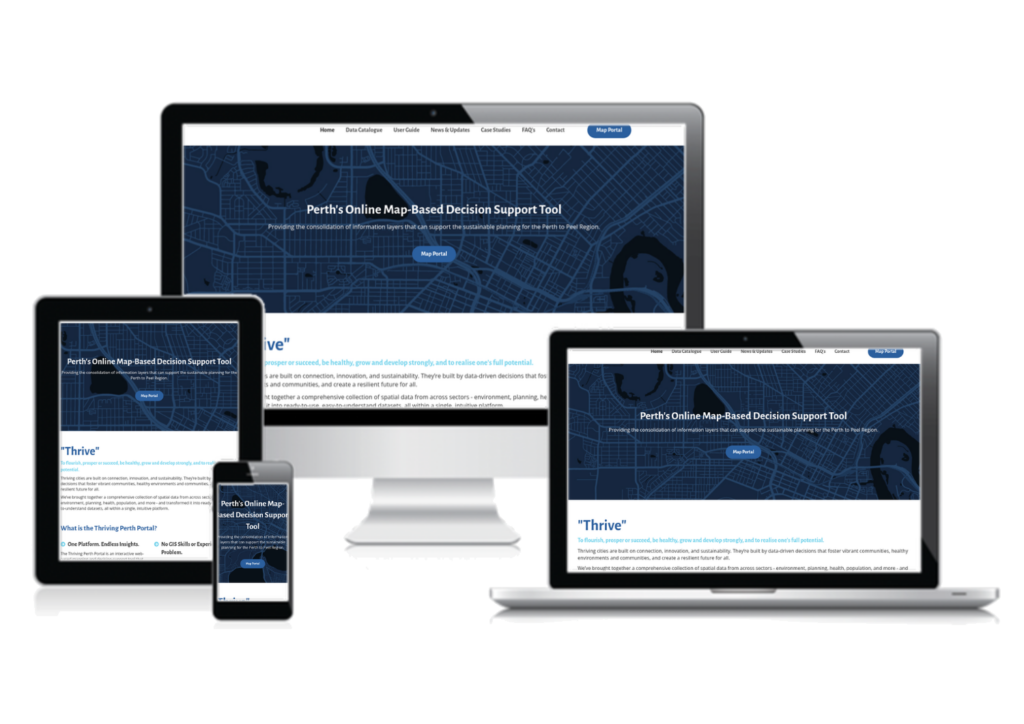
Mobile Optimised
Responsive across every device
Built to Rank in Search
SEO foundations baked in
Custom Design
No templates. Built from scratch.
The Thriving Perth Portal is an interactive web-based mapping and decision-support tool built for Urbaqua in partnership with Water Corporation and Urban Health Consulting. The portal brings together spatial data across environment, planning, hydrology, climate, population and health into a single platform that local governments can use to inform decision-making across the Perth metropolitan area. The marketing site needed to introduce this complex platform to non-GIS users in a way that made the value obvious and the next step easy.
The brief was to explain the portal’s value to non-technical audiences, document the four data category groupings (Place, Planet, People and Prosperity) with their extensive sub-themes, host a data catalogue, user guide, case studies and FAQs, and ultimately drive traffic into the actual map portal, which lives as a separate web app. The challenge was significant: most local government staff have not encountered a tool like this before, so the marketing site had to do the educational work that turns interest into use.
The structure organises the data layers across the four pillars. Place covers spatial planning, infrastructure and land use. Planet covers environment, climate and water. People covers population, demographics and health. Prosperity covers economic indicators and community wellbeing. Each pillar drills down into extensive sub-themes, each with its own custom-styled icon grid that makes the dozens of data layer categories navigable rather than overwhelming.
A data catalogue gives technical users the full reference of available layers, while a user guide walks new users through how to actually operate the portal. Case studies showcase real-world applications of the portal in local government planning, giving prospective users concrete examples of what the tool enables. FAQs answer the practical questions that hold back first use.
Visually the build sits in a clean professional palette appropriate for the research and government-sector audience, with the custom icon system carrying the data layer taxonomy across the site. The aesthetic balances the technical depth of the underlying platform with the accessibility that non-GIS users need to feel the tool is for them.
The cross-link into the actual mapping portal sits prominently throughout, with the marketing site acting as the educational and discovery layer that warms users up before they enter the application proper. Partner credentialing for Water Corporation and Urban Health Consulting alongside Urbaqua signals the seriousness and legitimacy of the platform.
The result is a research and government-sector platform site that does the heavy educational work for a genuinely complex tool. It introduces an unusual proposition clearly, organises a vast amount of underlying data into accessible categories, and converts visitors into portal users by giving them the context they need to start exploring.